
Contemporary Dining Chairs for Cultivated Interiors
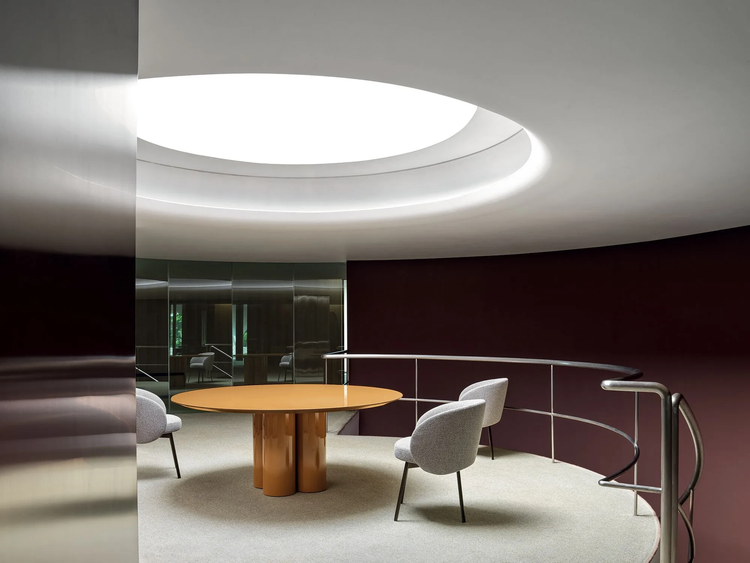
The dining chair is a more demanding design problem than it first appears. It must function as a structural object, holding a person in a position of relative uprightness for extended periods while also contributing to the visual composition of a table setting and reading coherently from every angle in the room.
Contemporary dining chairs, at the level Graye engages with, resolve this problem not by compromise but by specificity: each formal decision is made to serve a precisely understood purpose, and the result is a chair that functions completely and reads as resolved.
Structure, Material, and the Character of a Dining Chair
The structural material of a dining chair determines far more than its physical properties. It establishes the chair's visual weight, its relationship to the floor plane, and the quality of the shadows it casts under dining light. A chair with a heavy timber base reads differently than one whose structure is reduced to a minimal metal rod; both are valid positions, but they produce different rooms.
The Era, designed by David Lopez Quincoces, uses a curved gunmetal grey metal rod structure with brass screws. The curved rod geometry reduces the visual mass of the base to a near-minimum while the gunmetal finish holds a specific tonal authority that heavier materials would obscure. The brass screws are a detail that rewards examination: they introduce a material counterpoint at the joint, making the constructional logic of the piece visible and precise. The seat and back are available in leather or fabric, which allows the chair to shift its tonal register without altering its structural character.
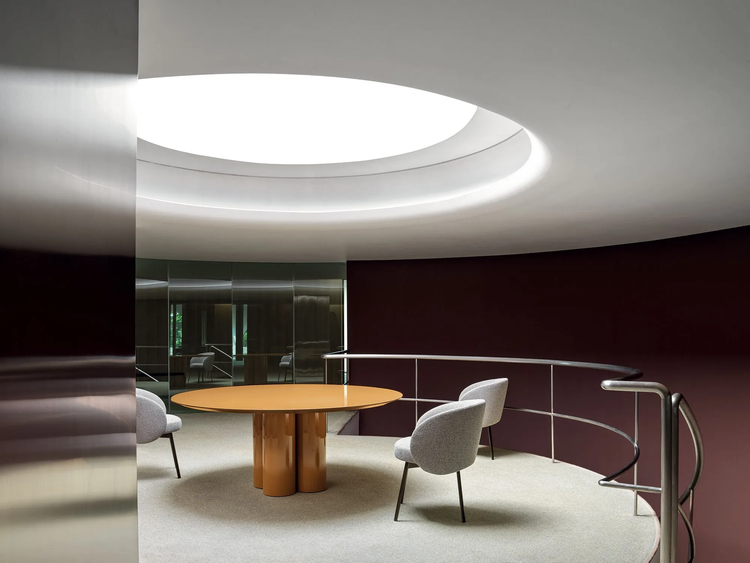
TRE 3
A chair with three legs connected by a sturdy T-shaped support, and a single piece of leather seat. Available in various finishes.
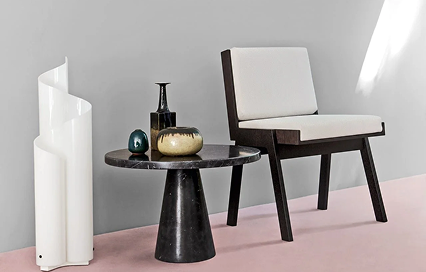
CLUB 44
A sculptural, architectural armchair defined by its inverted V-shaped leg that supports the armrest. Available in various finishes and with/without armrest.
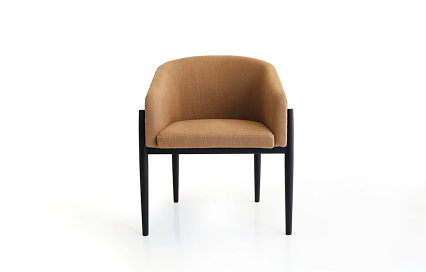
BREZZA
Wooden chair with a soft shell backrest and padded seat, featuring turned black-stained ash legs that reinterpret the Frank chair design with a more refined, elegant form.
The Armrest Decision
Whether to include armrests is among the most spatially consequential decisions in dining chair selection. Armrests add a horizontal dimension to each chair, which affects the spacing between seats and the overall length of the table required for a given number of covers. In generous dining rooms where table length is not constrained, an armrest chair adds a quality of occasion to the table. In more compact settings, a fully armless chair reads with greater lightness and allows more seats to be accommodated without crowding.
Jean-Marie Massaud's Achille, available in leather or fabric with or without armrests, gives this decision back to the client. The chair's form holds equally well in both configurations, which is not a trivial achievement: many chair designs that offer an armrest option produce a visually unresolved result in one of the two versions. The Achille avoids this by developing a formal logic that does not depend on the armrest for its coherence. The armrest, when present, is an addition to a resolved form; when absent, the form remains self-sufficient.
Materiality at the Seat Level
The seat is the surface of a dining chair that accumulates the most wear, the most contact, and the most visible evidence of use over time. Leather, whether full-grain or semi-aniline, develops a patina at the seat and arm contact points that gives the piece a biographical quality: the chair records the use made of it. Natural straw, one of the most ancient seating materials in the Italian tradition, is structurally resilient and develops a tonal warmth with age that synthetic alternatives cannot replicate.
Francesco Faccin's Pelleossa uses a solid ash structure with a traditional straw or leather seat. The solid ash is dimensionally stable and takes on a quiet luminosity with the oil finishes typically applied to it. The straw seat introduces a tactile and visual texture that sits in productive contrast with the precision of the ash joinery.
How Contemporary Dining Chairs Compose the Table
The contemporary dining chairs you select participate in the room not only when they are occupied but also when they are not. The empty table, with its chairs pushed in, reads as a composition in itself: a horizontal plane at table height, a field of chair backs and legs below it, and a relationship between the two that either holds or does not.
Chairs whose back profile is considered in elevation, instead of only in plan, give the dining room a quality of spatial completeness even when no one is seated. The shadow a chair casts on the floor beneath the table is part of this composition. A chair with a minimal structural frame casts a fine, linear shadow; one with a solid base casts a heavier, more opaque one. Neither is wrong. Both are part of the visual field of the room, and they should be chosen with awareness of the floor surface they will meet.
FAQs About Contemporary Dining Chairs
-
Six is typically the maximum for comfortable seating at a two-meter table, with four to five preferred where elbow room and service access are priorities. Armless chairs allow slightly closer spacing than those with armrests.
-
Neutral tones such as beige, charcoal, black, cream, and warm earth shades remain popular because they integrate easily with a wide variety of interior palettes and materials.
-
Full-grain leather is the best choice in terms of durability for high-use dining environments. Solution-dyed performance fabrics are the strongest textile alternative, resisting both abrasion and liquid penetration.
-
The standard seat-to-table-top clearance is 27 to 32 centimeters. Specifying chairs and tables together, or confirming clearance before ordering independently, avoids the ergonomic discomfort that a mismatched pair produces.
-
Absolutely. Modern dining chairs often work well with a range of table materials and forms, creating interiors that feel layered, intentional, and visually dynamic rather than overly matched.
