
Choosing a High End Dresser for Bedroom Storage and Style
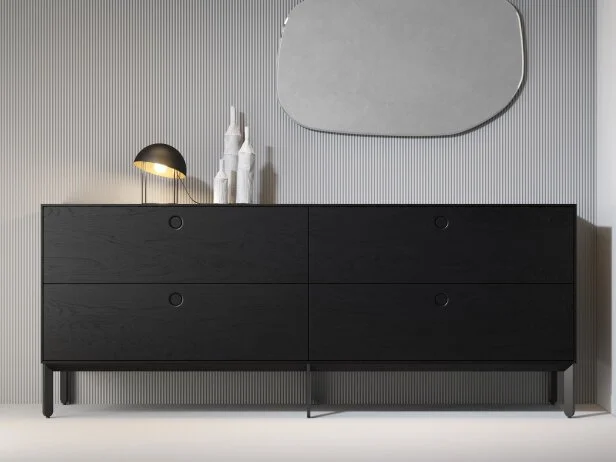
The dresser for bedroom use occupies an unusual design position. It is a storage piece that must also function as a room's primary horizontal surface, the plane at which objects are placed, displayed, and encountered at eye level. It receives a lamp, a mirror, and the accumulated objects of daily life.
Its top surface is the most used horizontal plane in the bedroom after the bed itself, and its material quality is therefore encountered at close range, with high frequency, in conditions of intimate domestic use. These conditions argue for the same level of material specificity that any serious room element demands.
The Dresser and the Bedroom Wall
A dresser placed against a bedroom wall does something architecturally specific. It divides the wall's vertical field at its top surface height, typically between 80 and 95 centimeters, and establishes a datum that the eye reads as a secondary horizon within the room. The depth of the dresser, typically 45 to 55 centimeters, creates a spatial zone along the wall that is neither fully accessible nor entirely furniture-occupied: it is the domestic equivalent of the deep sill, a surface for life.
The dresser's relationship to the wall behind it is also significant. A dresser that is proportionally too narrow for its wall leaves the flanking surfaces unresolved. One that is too wide compresses the wall and reduces the room's sense of spatial openness. The calibration of the dresser's width to the wall it occupies is one of the unspoken spatial decisions that determines whether a bedroom reads as composed. Get it right, and the wall settles; get it wrong, and the room will always read as slightly provisional, regardless of the quality of the piece itself.
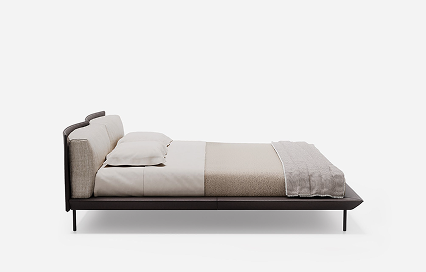
GREENE
Upholstered bed with padded steel-frame headboard, removable goose down cushions, and a two-part bed base with powder-coated steel feet.
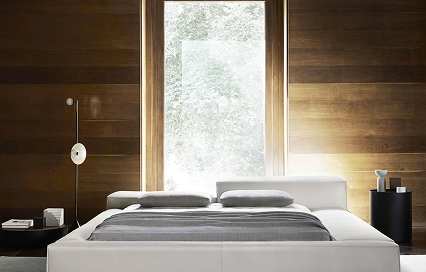
EXTRASOFT
Modular bed comprised of different size elements with fully removable fabric or leather covers and exposed seams.
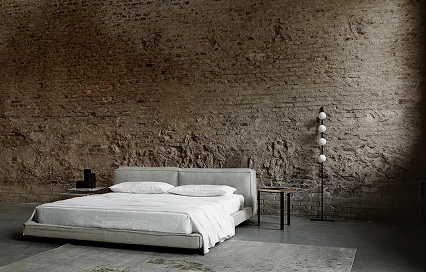
NEOWALL
Bed comprised of soft elements with fully removable fabric or leather covers.
Metal as Primary Material
The dresser for bedroom use has historically been understood as a timber piece. The material authority of metal, particularly the patinated and worked metals available through Graye's cabinetry offering, extends this vocabulary into territory with a different kind of aesthetic presence.
Zanellato/Bortotto's Marea is a sideboard and dresser made in copper, stainless steel, or brass, with an interior finished in natural birch. The exterior material options produce distinct spatial effects. Copper carries warmth and a highly individual patination character that deepens with the particular conditions of its environment.
Stainless steel maintains a consistent, precise surface that reads with architectural neutrality. Brass occupies a middle position: initially warm, it develops a tonal depth over time that cannot be replicated by any applied finish.
Timber Dressers and the Craft Tradition
Timber remains the most nuanced material for a dresser for bedroom use because no two timber pieces are identical, and because the wood's character deepens with the domestic conditions of the room over the years of use. The choice of timber species, the orientation of the grain on the face and top surface, and the treatment applied all produce different aesthetic and tactile results.
Mathias Hahn's Kin is a cabinet available in solid oak, stained oak, or American walnut. Solid oak, with its open grain and warm tone, reads with a quality of material weight that veneered alternatives cannot match. Stained oak allows the grain character to remain visible while the color shifts toward a deeper tonal register. American walnut, with its grain tighter and its color naturally rich in the mid-brown range, has a quiet authority that works particularly well in bedrooms with a low-light quality.
Drawer Operation and the Details of Daily Use
The drawers of a bedroom dresser are opened and closed multiple times a day in varied conditions of light and attention. The quality of their operation is therefore noticed not in moments of deliberate examination but in the cumulative texture of daily experience.
A drawer that extends smoothly to its full length, holds without binding mid-extension, and closes with a consistent resistance at the end of travel represents a fundamentally different daily experience than one whose operation is imprecise.
The hardware used in drawer slides at this level, and the tolerances to which the drawer boxes are fitted within their housings, are among the most direct indicators of manufacturing quality. A drawer that opens without play in the lateral direction, that does not tilt under the weight of its contents when extended, and that closes against a soft resistance at the last centimeter of travel has been engineered to a standard that is physically perceptible in daily use. Graye's cabinet collection holds pieces where these specifications are treated as primary quality markers, not as premium options.
Dresser for Bedroom FAQs
-
80 to 95 centimeters is the standard range for a bedroom dresser. This positions the top surface at a comfortable standing height for use as a display and deposit surface while keeping the piece from competing visually with the bed's headboard.
-
Six to eight drawers in a full-height dresser of standard width is a reasonable working figure for a pair of occupants. The distribution between deep drawers for folded knitwear and shallow drawers for accessories should be considered in relation to the wardrobe's actual composition.
-
In rooms where hanging storage is minimal, a dresser can complement open hanging rails or a compact wardrobe to provide the folded storage component of a complete bedroom storage system.
-
Patinated metal tops benefit from a specialist wax applied periodically; this slows the patination process and maintains the surface at a chosen point in its development. Stainless steel requires only routine cleaning.
-
Soft-close drawers, organized compartments, durable drawer construction, and efficient proportions all improve long-term functionality.
