
Timeless Mid Century Modern Lamps to Brighten Your Interior
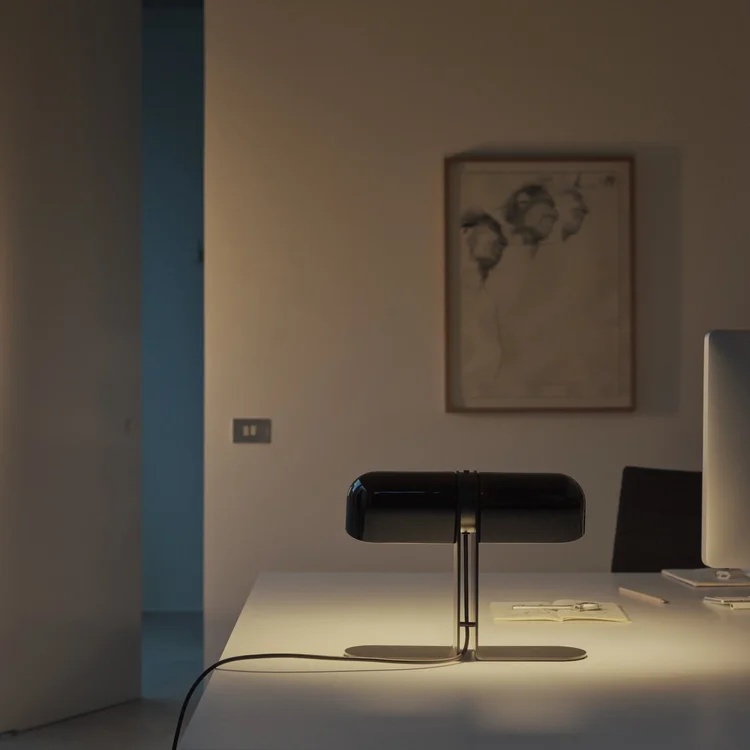
The mid-twentieth century produced a body of lighting design whose formal vocabulary has remained in continuous productive use for seven decades. The reasons are not nostalgic. The best work from this period solved a genuine design problem with formal elegance: how to hold a light source in space in a way that is structurally honest, visually resolved, and capable of producing a quality of light that serves the room rather than simply inhabiting it.
Mid-century modern lamps, when they are worth the designation, carry this intelligence forward. The question is not whether they reference the past but whether they contribute something irreducible to the present.
The Lamp as Object and as Light Source
The fundamental challenge of lamp design is that the object must succeed in two registers simultaneously. By day, it is a sculptural object occupying the room's composition. By night, it is a light source whose quality of illumination shapes the room's spatial character. A lamp that succeeds formally but produces poor light fails at its primary function. A lamp that produces good light but has no formal presence is merely a utility.
The mid-century lamps tradition, at its most rigorous, understood this duality and refused to compromise either register. The formal economy that characterizes the best work from this period, the reduction of the lamp to its essential structural logic, and the elimination of decoration in favor of proportion and raw material presence produce pieces whose formal authority in daylight is directly related to the quality of light they cast at night.
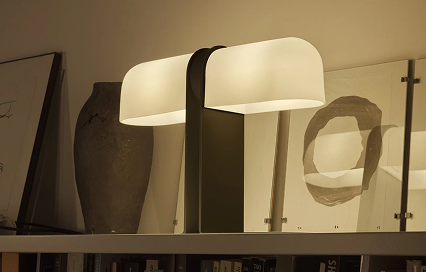
DUO
Black metal table lamp available with an opaque black or translucent white glass diffuser.
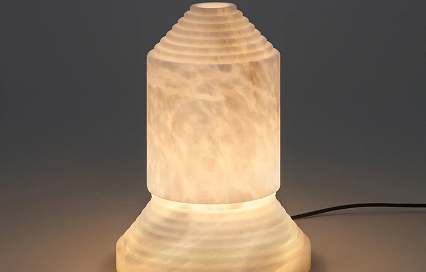
BABEL
Sculpted alabaster table lamp.
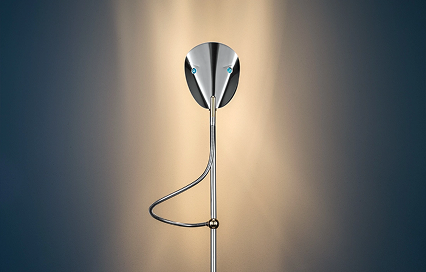
OCCHIBELLI
The collection groups together all lamps, past and future for the simple pleasure of bringing life to a gesture more than to a lamp.
Iron, Light, and the Honesty of Raw Materials
Some of the most spatially compelling mid-century modern lamps derive their character not from geometric precision but from material honesty. The use of rough or worked iron, unpolished and uncoated, introduces a tactile weight that no lacquered surface can replicate. Iron read at close range reveals the marks of its fabrication; at a distance, it holds a tonal depth that shifts under different light conditions.
Enzo Catellani's Luce D'Oro floor lamp uses a rough iron base and structure with a flex cable and an aluminum disc. The iron is the primary material of the piece, with its texture and weight visible as a deliberate formal decision. The aluminum disc captures and redirects light in a way that is directly linked to the lamp's name: a warm, golden illumination whose character shifts with the position of the disc.
The Pendant as Architectural Participant
Mid-century modern lamps extend naturally to the ceiling plane, where a pendant does not merely illuminate but articulates the spatial zone below it. A pendant with a resolved formal logic establishes a vertical connection between the ceiling and floor plane, defining the territory it occupies with a precision that diffuse ambient lighting cannot achieve.
Draw Studio's Esa is a hexagon-inspired pendant that emits a focused downward beam, designed for use as a single spotlight or in clustered configurations to create ambient lighting compositions. The hexagonal geometry reads with a precision that circular pendants do not have, while remaining less assertive than square alternatives. The metalwork finish gives the piece a material authority that deepens in clustered configurations, where multiple Esa pendants distribute focused pools of light across a horizontal plane with an explicitly architectural quality.
How Mid-Century Modern Lamps Perform in Contemporary Rooms
The most successful use of mid-century lamps in contemporary interiors tends to be specific instead of being comprehensive. One or two pieces that carry formal authority, positioned in relation to the room's primary seating and reading zones, introduce resolved design intelligence without transforming the interior into a period exercise.
A floor lamp positioned to one side of a reading chair delivers directional task light while holding its formal presence in the room's composition. A table lamp on a low surface introduces light at a level closer to the seated eye, creating a pool of warmth that pulls the room's spatial center downward.
Mid Century Modern Lamps FAQs
-
Lighting shapes the atmosphere, highlights materials, and influences how color, texture, and architectural details are experienced throughout a room.
-
2700 to 3000 Kelvin produces the warmest, most spatially hospitable light quality for living and seating areas. This range is consistent with the warm, intimate quality that mid-century lamp designs were developed to produce.
-
When the pieces share a consistent formal vocabulary and material language, using both reinforces the room's design argument rather than creating visual redundancy. The scale difference between the two positions of the light at different heights produces a layered illumination.
-
A clustered configuration distributes focused light across a wider horizontal zone, producing multiple pools of illumination that together define a spatial territory. A single pendant concentrates both light and visual attention on one point.
-
In well-designed rooms, floor and table lamps should be the primary sources of evening light, with overhead fixtures used sparingly or not at all. This produces a more spatially intimate and layered light quality.
