
Sleek Modern Couches for Living Room Comfort and Style
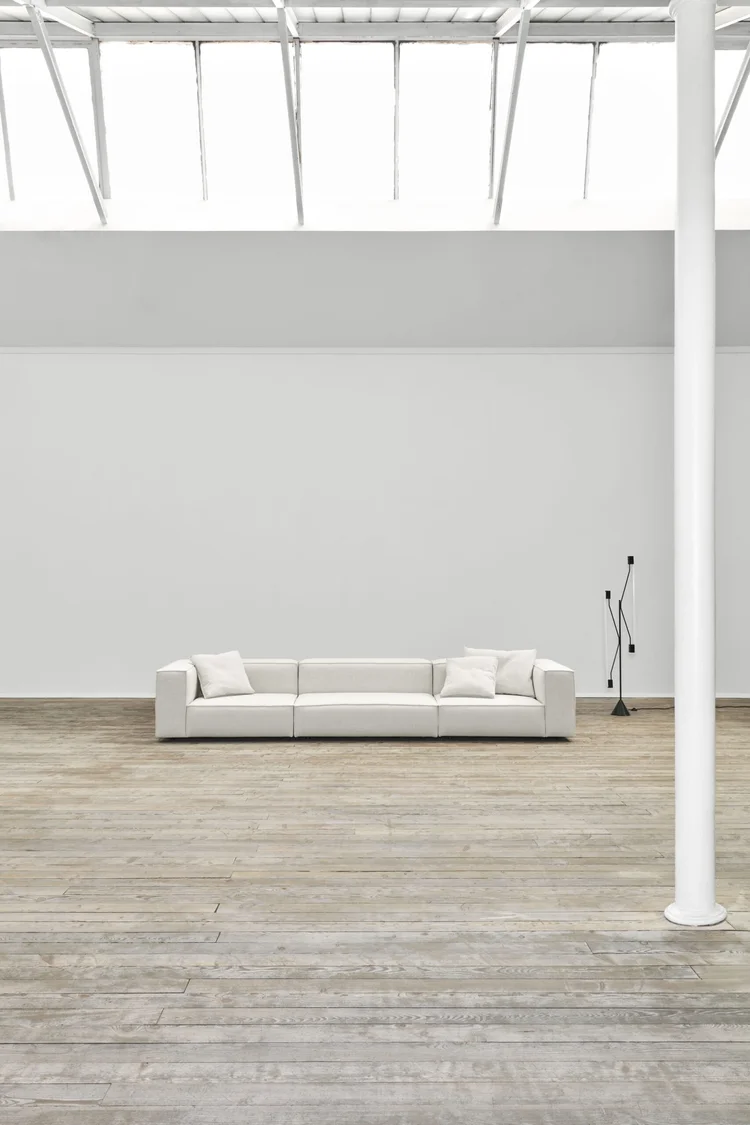
The sofa is the room's most consequential spatial decision. It determines seating territory, establishes the primary horizontal datum from which other furniture takes its cue, and absorbs more daily contact than any other surface in the home.
Modern couches for living room environments, at the level of genuine design intelligence, are not simply large, comfortable seats. They are spatial instruments, pieces whose dimensional logic, upholstery character, and formal vocabulary produce fundamentally different rooms depending on how they are chosen and placed.
Why the Sofa Determines the Room's Spatial Logic
Before the first cushion is selected, a sofa makes spatial decisions. Its length relative to the wall it fronts influences how much breathing room the room retains at each side. Its depth, measured from the front of the seat cushion to the back of the sofa, defines how far the piece projects into the floor plan and how much clearance the circulation path behind it receives.
A sofa that is even 10 centimeters too deep for its room will compress the space in a way that no styling decision can correct. This is why selecting the right modern couches for living room environments requires careful attention to proportion instead of appearance alone.
The relationship between sofa height and ceiling height is equally important. A high-backed sofa in a room with standard ceiling heights adds visual weight and divides the room's vertical field in ways that feel heavy. A low-profile piece allows the ceiling plane to read fully and gives the room a sense of openness that higher pieces cannot achieve. These are not aesthetic preferences; they are architectural realities that determine how a space actually feels to move through and inhabit.
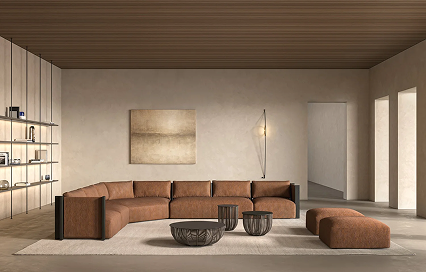
ARKADIUS
Modular seating system with architectural wooden backrests and armrests, pairing structured vertical slats with soft upholstered cushions.
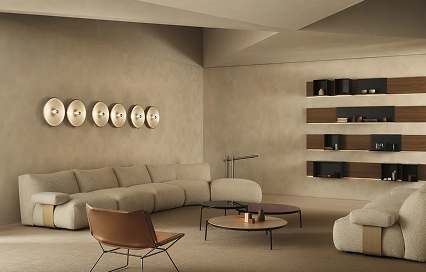
GOOM
A modular system comprising single units, corner units, chaise longue and poufs, with the option of adding one or more armrests
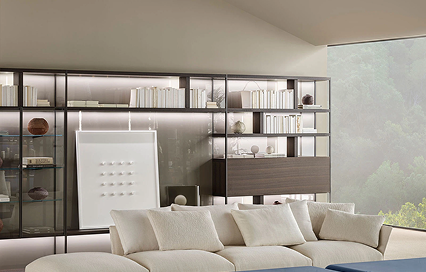
TOBU
Linear three- and four-seater configurations, as well as closed or open corner versions with armless central or end modules. complemented by a square armchair with one or two backrests.
The Module as Design Language
Piero Lissoni's Biscuit is a linear sofa raised on slender metal feet covered in wood. Its formal proposition is clarity: a resolved horizontal form that occupies the room without interruption, its metal and wood feet introducing a visual lightness at the base that lifts the piece above the floor plane. The Biscuit reads as a resolved, self-contained object, one that makes the floor visible around it rather than sitting heavily against it.
Jean Marie Massaud's Goom approaches the question of configuration from a different position. A modular system comprising single units, corner units, a chaise longue, and poufs, with the option of adding one or more armrests, the Goom is a spatial vocabulary rather than a fixed form.
The armrest option is a genuinely valuable detail: it allows the territorial definition of the sofa to be adjusted to the room and use pattern, with armrests adding a sense of enclosure and definition that the open module version deliberately withholds.
How Sectional Configuration Addresses Complex Rooms
The sectional sofa addresses a spatial problem that the linear sofa cannot: what to do with a corner, or with a room that resists the conventional sofa-and-wall relationship. A well-designed sectional does not merely fill a corner; it activates it, transforming what would otherwise be an unresolved spatial zone into the room's seating center. This flexibility is one reason why modern couches for living room layouts increasingly favor modular sectional systems over rigid traditional arrangements.
Gordon Guillaumier's Dao Soft is a sectional sofa offering extreme modularity and freedom in a geometric harmony of soft volumes. Its high backrests and seat elements are padded with different densities, addressing the sofa's ergonomic function with specificity: the high backrest provides genuine head and neck support for extended seating, while the variable padding densities ensure that different positions within the configuration offer different qualities of support. The piece can also be paired with Dao Soft tables, which reinforces the idea of the sectional as the center of a complete seating composition rather than an isolated piece.
Upholstery and the Sensory Experience of Seating
The material of a sofa's upholstery is experienced daily and continuously, which makes it among the most consequential surface decisions in a room. A fabric that photographs beautifully but fails under sustained contact, that pills, marks, or loses its drape over time, is a failure that compounds with every year of use.
High-grade performance fabrics in tight weaves maintain their surface integrity and color depth under daily use. Full-grain leather forms a patina over time that deepens the piece's character. Bouclé and looped textiles introduce a tactile richness that reads beautifully at a distance while rewarding the kind of close, extended contact that a sofa invites.
The choice among these is not primarily visual; it is a question of the daily lived experience your modern couches for living room seating will provide across years of continuous domestic life.
Modern Couches for Living Room FAQs
-
Leave at least 45 centimeters of clearance on each side of the sofa and 90 centimeters of clear circulation path behind it. Measure the wall and map the sofa footprint with tape before committing.
-
A compact sectional, carefully dimensioned to the room, can work well in a smaller space by activating the corner and maximizing seating without adding multiple separate pieces. The key is choosing a system whose module dimensions suit the room's floor area.
-
55 to 65 centimeters is the standard range for comfortable seated use. Depths beyond 65 centimeters tend to position the sitter too far from the edge, which places unnecessary strain on the lower back over extended periods.
-
Modular systems are configured from discrete units with defined dimensional logic, allowing the composition to be adapted to different rooms and uses over time. Standard sofas are fixed forms that cannot be reconfigured.
-
Low-profile modern couches for the living room maintain clearer sightlines across the room, which helps interiors feel more open and visually balanced. Their horizontal proportions also reinforce a calm, contemporary atmosphere.
