
Contemporary Office Furniture for Creative Workspaces
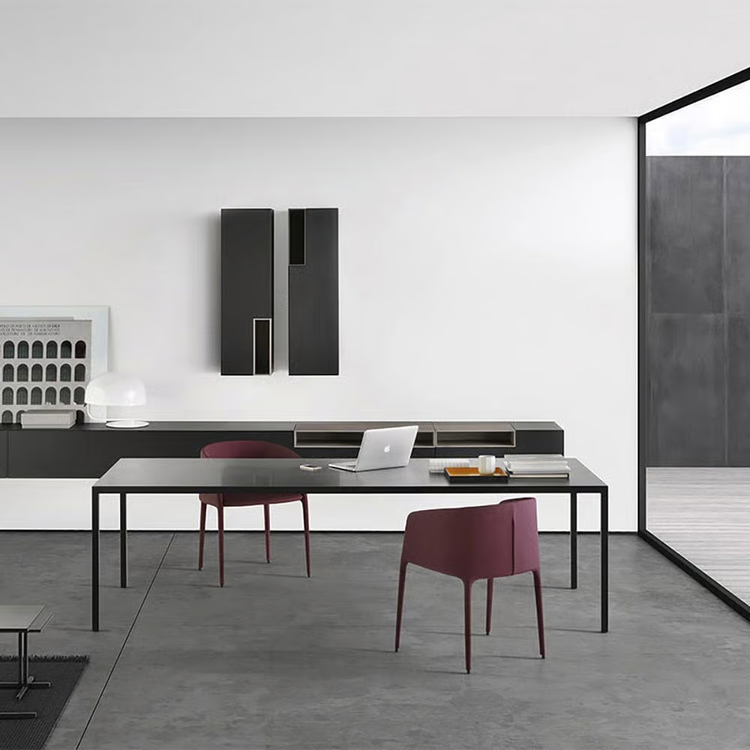
The commercial workspace has undergone a fundamental transformation in its spatial ambitions. The institutional office of the previous century, with its uniform grid of partitioned workstations and fluorescent overhead light, has given way to something more architecturally considered: environments where the quality of the surfaces and the intelligence of the storage contribute directly to the quality of concentration and collaboration they support.
Contemporary office furniture, at this level, is not an amenity. It is infrastructure for the kind of work that demands genuine spatial quality.
The Desk as Architectural Anchor
In a well-designed commercial workspace, the desk is not the background for work. It is the room's primary spatial event, and its material, proportion, and relationship to the surrounding architecture determine the quality of the environment from the moment you enter it. A desk surface that is resolved at the level of its material and its edge detail gives the space a tonal authority that generic alternatives cannot provide.
David Lopez Quincoces's Graft is a table with a wooden veneer top and burnished painted or gunmetal grey legs. The leg finish is a design decision with genuine consequence: burnished paint absorbs light and maintains a consistent tonal presence throughout the day, while gunmetal grey introduces a cooler, more industrial register that suits environments whose architectural palette runs to stone and steel. The wooden veneer top provides warmth and grain at the working surface, producing a material counterpoint to the precision of the metal base.
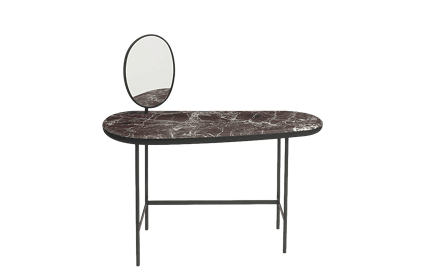
PEBBLE
Inspired by the materiality and the organic form of stones. Available in lacquer, marble, or glass and various finishes.
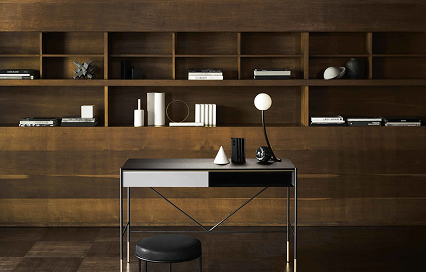
ERA SCRITTOIO
Desk with gunmetal grey legs, matte brass accents, Italian walnut, stone oak, or striped grey top and drawer with coordinating wood or glossy lacquer external parts.
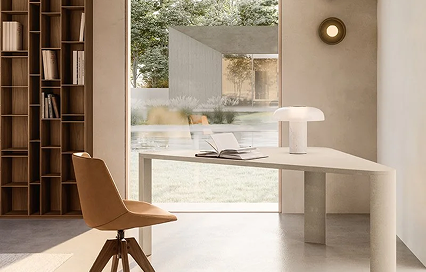
BONNET
Interpret the theme of soft, rational forms with architectural elan, introducing a touch of femininity. With the Coccioperla finish. Available in various colors.
Meeting and Collaborative Surfaces
The meeting table in contemporary office furniture performs a different function than the individual workstation. It must hold groups at conversation distance, read as a resolved formal object from the circulation areas that overlook it, and carry sufficient material authority to give the room its spatial center.
Claudio Bellini's Axy is a metal table with porting options. The porting infrastructure is a practical concession to the technological reality of contemporary meeting environments, but its integration into the table's design means it does not undermine the piece's formal coherence. A table that accommodates cables and connections visibly is a table that reads as provisional; one that incorporates this infrastructure into its structure allows the surface to remain resolved.
Storage and the Architecture of the Workspace
The storage of a commercial workspace is as important as its primary working surface. Open shelving that holds the materials of work without visual disorder contributes directly to the concentration that the workspace is designed to support. Storage that is poorly dimensioned, that requires deliberate effort to access, or that cannot adapt to the changing demands of a working life is storage that undermines rather than enables.
Bruno Fattorini's Minima is a hanging or floor-standing storage system with recycled aluminum uprights, shelving, and lacquered or wooden elements. The recycled aluminum uprights are a material decision as much as a structural one: their dimensional precision maintains its quality over time without the patina development of steel or brass, which makes the system appropriate for environments where visual consistency over extended periods is required.
The combination of open shelving and enclosed elements allows the storage to be configured to the specific working life it holds. A wall of Minima configured to the ceiling height of the workspace gives the storage element an architectural authority that transforms its functional role: it is no longer furniture holding things but a designed wall that happens to be useful.
Light and the Quality of Concentrated Work
Contemporary office furniture is only part of the environmental equation. The quality of light in a commercial workspace determines the quality of concentration it can support as directly as the furniture does. A workspace lit exclusively by overhead sources will produce shadow on the working surface and visual fatigue over extended periods. Task lighting at desk level, positioned to illuminate the working surface without creating screen glare, is the baseline requirement for sustained professional use.
Natural light, where available, should be admitted but controlled: direct solar gain on working surfaces creates glare conditions that override everything else. North or east-facing light, or diffused light from high windows, produces the most consistent working conditions and should inform the orientation of the primary working surfaces in any contemporary office furniture layout.
FAQs About Contemporary Office Furniture
-
High-pressure laminate in matte finish, quality wood veneer with a sealed oil or lacquer treatment, and powder-coated or painted steel all perform well under sustained daily use. Each ages differently, and the choice should be made in relation to the workspace's overall material register.
-
Furniture in an open-plan environment contributes to the acoustic character, spatial definition, and visual coherence of the space. Pieces with considered proportions and consistent material vocabulary create zones within the open plan without requiring fixed partitions.
-
Tonal and material consistency between primary surfaces produces a more resolved environment than piece-by-piece selection. Full matching is not required, but a shared material language, such as consistent metal finishes across desk and storage, significantly improves spatial coherence.
-
At least 90 centimeters of clear circulation path on all sides are accessible to occupants. Emergency egress requirements in commercial spaces typically mandate a minimum of 1.2 meters on primary circulation routes.
-
Yes. Softer seating, lounge-inspired forms, and more refined materials create workplaces that feel welcoming without sacrificing professionalism or efficiency.
