
End Tables That Complete the Modern Living Room
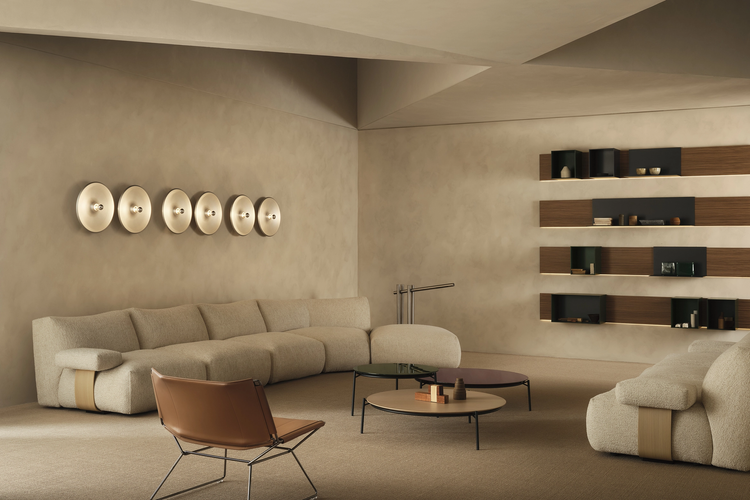
The end table is among the most underestimated elements in interior design. It lacks the visual mass of a sofa, the formality of a dining table, and the programmatic clarity of a desk. What it provides instead is a surface at a specific height, a horizontal plane in deliberate relationship to the seating beside it, resolved in a material that either speaks to the room's existing palette or introduces a calibrated counterpoint.
Modern end tables for living room use, chosen with this spatial intelligence, do something that seems small and is not: they complete the room's composition at the scale of the individual.
The Correct Height and Its Consequences
The height of an end table relative to the seating beside it is a dimensional relationship with daily consequences. A table that sits considerably below the armrest of the adjacent sofa requires the user to lean down and reach forward for anything placed on it; one that sits above the armrest creates a visual interruption at the sightline from the sofa.
The ideal position is within 5 centimeters of the sofa arm height, a range that allows the table to be used without conscious adjustment while reading as a coherent horizontal element within the seating composition.
This calibration is not incidental. It is the kind of dimensional precision that separates a considered interior from one that has been assembled without attention to how the pieces actually function together in daily use. Modern end tables for living room configurations should always be evaluated against the specific seating they will accompany, not in isolation.
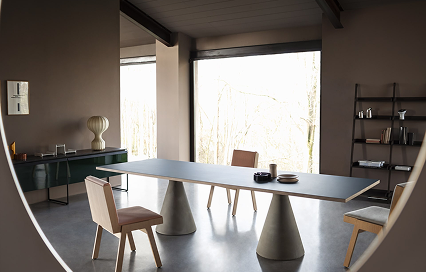
TAVOLO
Features a three-part construction: concrete base, a wooden top and steel connector. Available in various sizes, shapes, and finishes.
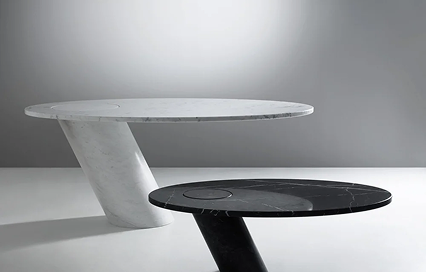
ECCENTRICO
All-marble table with an elliptical top fitted asymmetrically into an inclined cylindrical leg, using weight, friction, and eccentricity to lock the joint without fasteners. Custom sizes and finishes available.
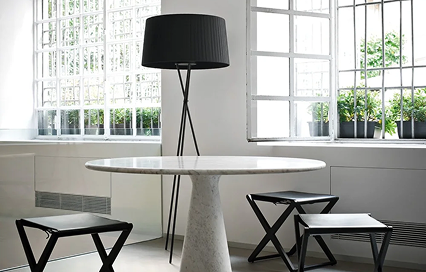
M
All-marble table with a lathe-turned central base in a hyperboloid shape—wider at the bottom, tapering toward the top—to support a circular top that rests embedded in its own thickness. Available in various finishes and sizes.
Material Counterpoint and the End Table's Visual Role
The end table is often the smallest significant surface in a living room, which makes it among the most effective vehicles for material counterpoint. A room whose palette runs predominantly to pale, soft materials, linen upholstery, natural timber floors, and white plaster walls can receive a piece in patinated metal or dense stone as a grounding element, a surface that introduces weight and darkness without the visual commitment of a larger piece.
The R&D De Castelli Outline coffee tables are defined by a thin, colorful graphic line and refined finishes and are designed for standalone use or dynamic compositional arrangements. The graphic line is the piece's defining gesture: it traces the form's perimeter in color, making the table's silhouette legible as a drawing rather than a solid. In a room of substantial pieces, the Outline introduces a visual lightness that is formal and considered rather than merely decorative.
Stone and Timber at the Intimate Scale
The materials that perform best in accent and modern end tables for living room applications are those that develop a quality of presence at close range, surfaces you encounter while reaching for a glass, while placing down a book, or while passing through the room with attention directed elsewhere. These are not performances for the room's sightlines; they are textures and surfaces for the intimate scale of daily handling.
Dordoni Studio's Twin Low is a low table in bruno-stained ash wood with chamfered edges and a recessed travertine or mirrored top, combining solid volumes with a light, origami-inspired design. The chamfered edge is a formal decision that rewards examination: it catches light along its angled plane in a way that a square or rounded edge cannot, giving the piece a visual precision that reads differently from different angles and distances. The recessed top creates a tray-like surface that contains placed objects without holding them rigidly.
The Composition of Multiple Tables
A single end table serves a defined functional purpose. Two or three tables of different heights and materials, composed in deliberate relationship to each other and to the seating they accompany, do something more: they introduce spatial complexity at the scale of the room's secondary elements, creating a micro-landscape within the seating area that holds visual interest without competing with the primary pieces.
The discipline this requires is the same one that governs any compositional decision: the pieces must share enough common language to read as a group while maintaining enough formal distinction to justify the multiplicity.
A Graye accent table selection that combines a stone top at one height with a metal piece at another produces exactly this kind of considered variety. The modern end tables for living room compositions you build from these elements are the spatial layer that gives the room its sense of having been fully resolved.
FAQs About Modern End Tables for Living Room
-
Within 5 centimeters of the sofa arm height is the standard guidance. This allows objects to be placed and retrieved without leaning, and the table to read as a visual continuation of the seating composition.
-
Yes, and the most interesting rooms often use asymmetric pairings. The tables should share a material or tonal language, but need not be identical. One in stone and one in metal, for instance, creates a balanced asymmetry that reads as curated.
-
Powder-coated steel, anodized aluminum, and sealed stone are among the most durable options. These surfaces resist impact and moisture without requiring the maintenance that lacquered or untreated wood finishes demand.
-
Most living rooms reach their natural limit at three to four accent tables of varying heights. Beyond this, the accumulation begins to fragment the floor plan and interrupt circulation. Each table should serve a specific functional or compositional purpose.
-
Round and softly contoured end tables complement curved seating by maintaining smoother visual movement throughout the room.
