
Mid-Century Round Dining Tables for Intimate Gatherings
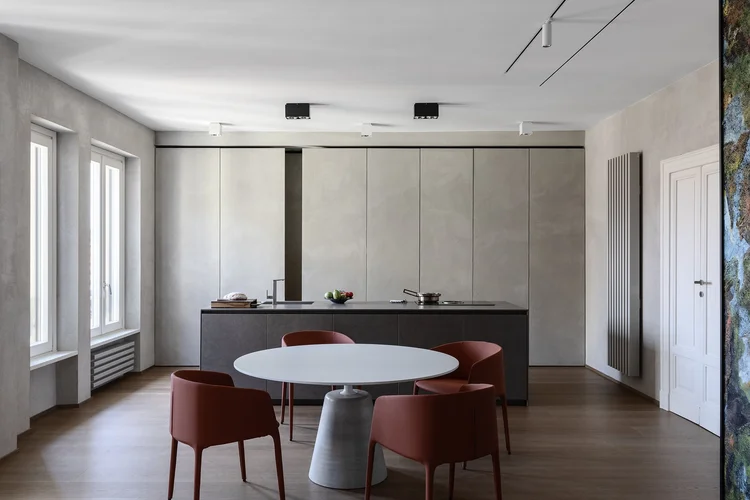
The round table has a spatial authority that its rectangular counterpart cannot replicate. Without a head, it creates conditions of genuine equality among its occupants: every seat is equidistant from every other, every position faces the center, and the conversation that a round table produces is, by spatial logic, more intimate and less hierarchical than the conversation a long rectangle organizes.
The mid-century round dining table, at its most considered, takes this formal and social intelligence seriously, resolving the structural problem of the round top in ways that become formal propositions, statements about how a table can stand in a room as an object in its own right.
The Round Form and Its Relationship to Space
A round table occupies a dining room differently from a rectangular one. Where the rectangle aligns with the room's architectural axes and produces parallel relationships with the walls around it, the circle reads against the room's rectilinear geometry.
In a rectangular room, a round table creates a point of formal contrast: its curved perimeter draws the eye and holds it in a way that a four-sided form cannot. This quality can be used to define the room's spatial center with a clarity that rectangular tables rarely achieve.
The clearance requirements of a round table differ from those of a rectangle in an important way: the table's occupants pull chairs outward in all directions, which means that minimum clearance must be maintained on all sides equally. A dining room that can accommodate a 1.8-meter rectangle with comfortable clearance may only accommodate a 1.4-meter round table with the same margins. This constraint is also a spatial discipline: a properly sized round table in relation to its room produces a composed, resolved result.
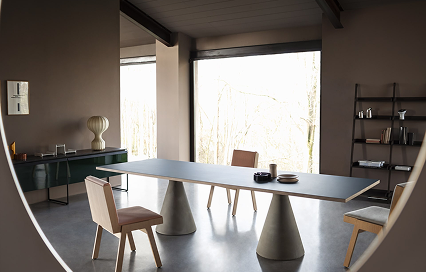
TAVOLO
Features a three-part construction: concrete base, a wooden top and steel connector. Available in various sizes, shapes, and finishes.
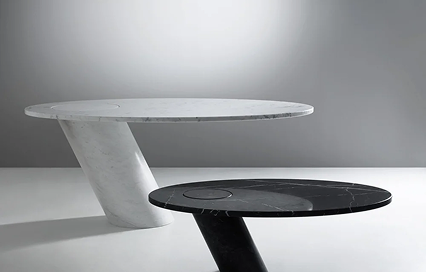
ECCENTRICO
All-marble table with an elliptical top fitted asymmetrically into an inclined cylindrical leg, using weight, friction, and eccentricity to lock the joint without fasteners. Custom sizes and finishes available.
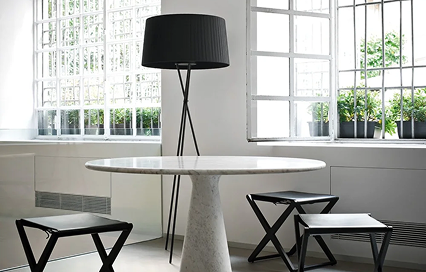
M
All-marble table with a lathe-turned central base in a hyperboloid shape—wider at the bottom, tapering toward the top—to support a circular top that rests embedded in its own thickness. Available in various finishes and sizes.
Material and the Base as Structural Proposition
The mid-century round dining table tradition produced some of its most compelling work in the structural logic of the base. Where rectangular tables can rely on four legs at the corners, a round table has no such orthogonal support structure available. The base must be designed from scratch, and the most significant mid-century round dining table designs treat this structural necessity as a formal opportunity.
Angelo Mangiarotti's Eros is a modular table system available in various shapes and sizes, with uniquely embedded joints. Eyelets at the rims and corners eliminate fragile zones, creating a refined, structurally intelligent design. The embedded joint is the piece's formal signature: the top and base connect without visible hardware, the load path made integral to the form of the stone itself. In a round configuration, this structural honesty makes the table a spatial sculpture that holds authority in the dining room even when unoccupied.
Wood and the Warmth of the Gathered Table
Not all mid-century round dining tables make their argument through structural innovation. Some proceed from material warmth, from the quality of solid timber at the scale of a generous round surface. Solid wood round tables carry the grain of the material continuously across their surface, meeting at the center without the joints that rectangular tables require for wide surfaces.
Formstelle's Turntable is a dining table made of solid wood, available in various woods and sizes. The name gestures toward the round form's natural affinity with rotation and centrality. In solid oak or walnut, the table carries the warmth and grain depth that makes wood the material of choice for rooms where the atmosphere of the gathering is the primary concern. The round form and solid material together produce a table that invites approach from all sides with equal welcome.
Scale, Seating Number, and the Intimate Configuration
The mid-century round dining table is, almost by definition, a table for intimate gatherings. A round table of 1.2 meters seats four people at a comfortable conversation distance. At 1.4 meters, six can be accommodated. Beyond 1.5 meters, the conversation across the table becomes effortful; the round form begins to work against its own social purpose.
Piero Lissoni's Materic offers a round or oval table with a marble or wooden top and a metal or wooden base, with an optional lazy Susan. The lazy Susan is a detail that belongs specifically to the round table's social logic: it acknowledges the table's centripetal character and provides a means of sharing dishes that the rectangle cannot offer with the same spatial grace. In marble, the Materic's top carries a material authority that suits the round form's status as the room's primary object.
Mid Century Round Dining Table FAQs
-
A 1.2-meter round table seats four comfortably. A 1.4-meter table accommodates six. Beyond 1.5 meters, the distance across the table becomes too great for easy conversation at a round dining configuration.
-
A round table with a slender base removes the corners and visual bulk that a rectangular table introduces, which generally makes a compact dining room feel more open. The absence of sharp corners also improves circulation in tight spaces.
-
A single central pedestal or a minimal geometric base integrates most naturally with contemporary architecture. Multiple-leg configurations with tapered or splayed legs read more specifically as mid-century period references.
-
Matching chairs read as more formal; a consistent material across different silhouettes produces a more curated, contemporary result. The round table's democratic geometry actually suits the mixing approach; it enforces equality regardless of chair variety.
-
Their designs rely on precise proportions, clean joinery, and restrained detailing rather than excessive ornamentation, giving them enduring visual clarity.
