
How to Arrange Living Room Furniture for Fluid Flow
Find Ideal Furniture Pieces for Your Living Room
A beautiful living room is not defined by how much furniture it contains, but by how naturally everything occupies its place. Seating should invite conversation, circulation should feel effortless, and architectural features should remain visible rather than becoming obstacles.
Understanding how to arrange living room furniture begins with seeing the room as a composition of volumes, pathways, and pauses, where every piece contributes to the experience of moving through it.
Begin With the Architecture Before Placing the Furniture
The architecture should establish the first point of reference. Windows, fireplaces, built-in shelving, doorways, and important views all influence where furniture can comfortably sit.
Rather than automatically pushing every piece against a wall, consider what the room is asking for. A generous living room may benefit from a central seating arrangement that creates intimacy within a larger volume. A narrower space may need a more linear composition that protects the main path through the room.
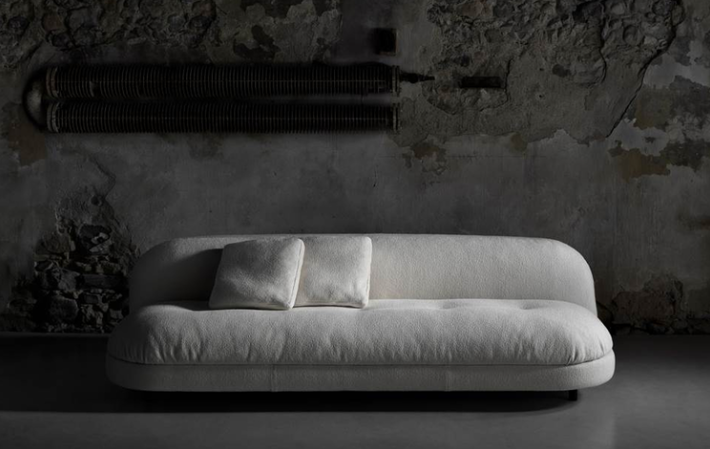
The Gala sofa by David Lopez Quincoces offers a useful example of furniture with a composed presence. Its upholstery and matte black painted steel feet give the sofa a defined silhouette without making it visually cumbersome.
Its placement should respond to the room rather than simply occupy the largest available wall.
Protect the Natural Paths Through the Room
Movement is one of the least visible but most important aspects of a successful interior. There should be a clear route between the principal entrances, adjoining rooms, and areas of use.
A sofa positioned beautifully can still feel wrong if it forces people to walk awkwardly around it. Leave enough space for movement to feel instinctive rather than negotiated.
Establish a Conversation Area That Feels Naturally Intimate
The living room should encourage people to face one another rather than simply face the television or the longest wall. Seating arranged around a shared center creates a stronger sense of conversation and gives the room a more generous social quality.
This does not require perfect symmetry. Two lounge chairs can face a sofa, while a single chair can sit slightly off axis to create a more relaxed composition.
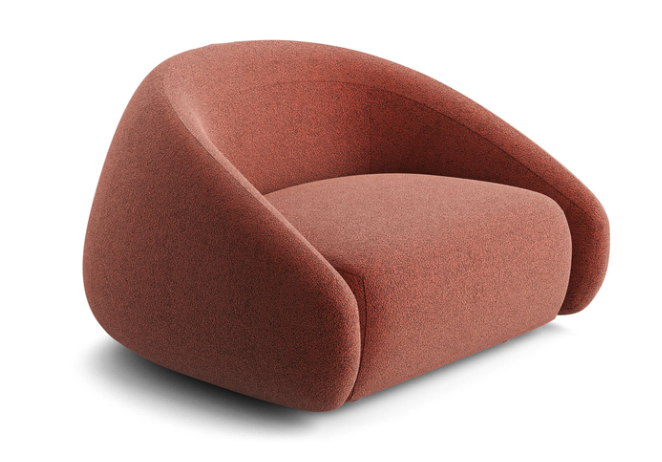
The Apper lounge chair by Antonio Rodriguez has a seamless backrest and armrest design with an organic character inspired by interwar Paris. Its rounded form can introduce a softer, more individual element alongside a larger sofa.
The contrast between collective and individual seating gives the room a richer spatial rhythm.
Use a Central Element to Give the Seating a Sense of Gravity
A conversation area often benefits from something that visually gathers the furniture. A rug can provide that foundation without adding another substantial volume to the room.
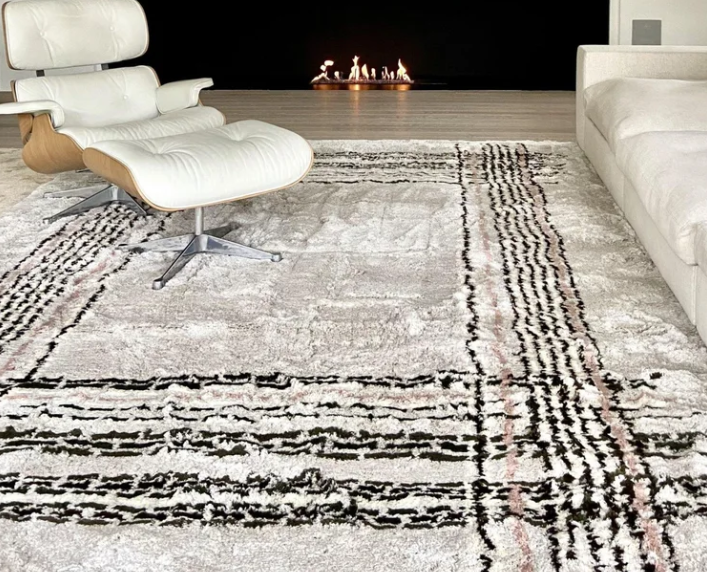
The Checks rug by JOV combines New Zealand wool and Tencel Lyocell and can be customized in color, quality, size, and shape. Its tactile surface gives the seating arrangement a defined ground while allowing the furniture to remain visually distinct.
A rug should be sufficiently generous to connect the principal seating pieces. When it is too small, the furniture can appear scattered. When properly scaled, it creates an almost architectural boundary around the conversation area.
This is one of the quieter principles behind how to arrange living room furniture with elegance. The goal is not to make every object touch. It is to establish relationships that the eye understands immediately.
View Our Collection of Modern Rugs
Balance Large Forms With Lighter Visual Elements
Large sofas naturally carry considerable visual weight. If the room contains only substantial pieces, the composition can become heavy.
Introduce contrast through lighter silhouettes. A lounge chair with an open profile can provide relief beside a deep sofa. A slender table can occupy the space between seats without blocking the view across the room. Open areas around the furniture can be just as important as the furniture itself.
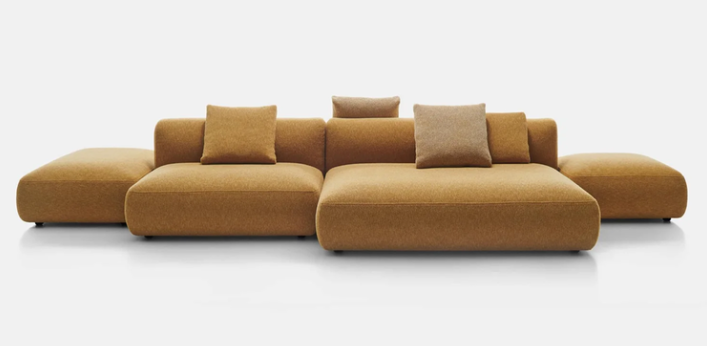
The Cosy Island modular sofa by Francesco Rota offers another approach to scale. Its modular system allows different configurations, making it possible to adapt the seating arrangement to the proportions and requirements of the room.
Modularity can be particularly valuable in large interiors, where a single conventional sofa may not create enough definition.
Allow the Room to Be Experienced From Every Angle
A living room is rarely viewed from one fixed position. You see it while entering from the hallway, passing toward the kitchen, sitting across from the sofa, or looking back from an adjoining space.
Furniture with strong three-dimensional qualities rewards this movement.
Graye's editorial perspective on modern chairs for living room settings considers the lounge chair as a spatial figure rather than simply another seat. Its silhouette contributes to the room even when no one is using it.
This becomes especially important when a chair sits away from a wall. Its back is now part of the composition, making material, proportion, and profile equally important.
Leave Enough Space for the Room to Breathe
Once the major pieces are positioned, resist the urge to fill every remaining space. Empty areas provide visual relief and allow individual forms to retain their presence.
A luxurious living room often feels generous because it has not been over-composed. The eye can move from sofa to chair, from furniture to architecture, without encountering an object at every turn.
This restraint is central to how to arrange living room furniture successfully. Arrangement is not simply about fitting everything into the room. It is about deciding what deserves space.
FAQs
-
Not necessarily. A sofa can face another seating group, a view, or an architectural feature. The strongest orientation depends on how the room is intended to be experienced.
-
Create smaller seating groups within the larger room. Rugs, carefully oriented sofas, and individual lounge chairs can establish intimate areas without visually closing the space.
-
When the room allows it, floating furniture can create more depth and improve circulation. It can also make a large space feel more intentionally composed.
-
The fireplace can become the center of the arrangement, but seating does not always need to face it directly. Angled chairs or a perpendicular sofa can maintain the fireplace as a focal point while encouraging conversation.
-
Treating each piece independently. A beautiful sofa or chair can still feel misplaced if it has no meaningful relationship with the other furniture, architecture, or circulation.