
How to Choose a Dining Table for Your Home
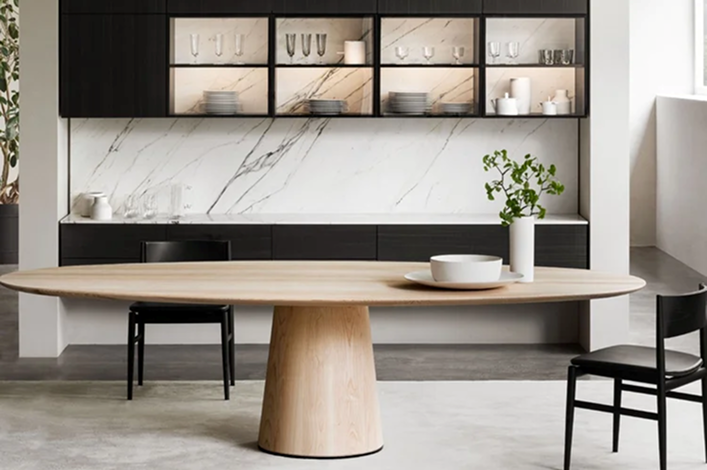
The dining table is the room's primary social object. It determines how many people can gather, how they relate across the surface between them, and what material the most frequently touched horizontal plane in the dining room is made of.
Knowing how to choose a dining table is a spatial, ergonomic, and material decision whose consequences are felt at every meal and whose relationship to the architecture either resolves or unsettles the space.
The Dimensions That Govern Every Other Decision
Before material and form, the dimensions must be established. A table too large compresses clearances on all sides; one too small leaves the dining zone without the visual gravity to anchor the floor plan.
The minimum clearance between the table edge and any wall or adjacent furniture is 90 centimeters, allowing a seated person to stand without obstruction. On circulation sides where guests may need to pass, 120 centimeters is the comfortable minimum. Chair depth when occupied extends the table's effective footprint by 40 to 60 centimeters on each occupied side.
Standard dining table heights range from 72 to 76 centimeters, producing a seat-to-surface clearance of 27 to 32 centimeters with most dining chairs. This clearance should be confirmed between the specific table and chair combination before purchase, as it varies across designer pieces.
Width, Length, and the Social Geometry of the Table
How to choose a dining table is often framed as a question of style, yet proportion is equally important. A width of 85 to 90 centimeters allows two people seated opposite each other to maintain easy eye contact and pass dishes without overreaching. Beyond 100 centimeters, conversational distance increases in a way that the dining room's intimacy cannot easily overcome.
Length defines a seating capacity: each seated person requires approximately 60 to 70 centimeters of table length. A table of 180 centimeters comfortably seats six; 220 centimeters seats eight. Where larger gatherings are anticipated, an extendable table balances the demands of daily use against occasional entertaining.
The Surface Material as the Table's Primary Argument
Once dimensions are resolved, surface material is the most consequential decision in understanding how to choose a dining table. The surface receives light from above, absorbs the evidence of daily use, and communicates the table's material character at the intimate distance of an occupied meal.
Marble carries a natural tonal variation that reads differently in different light conditions. Its weight at the dining table scale is both physical and visual, giving the room a material gravity that no applied finish can replicate. Porous varieties require maintenance attention but reward it with a surface that develops a patina of use rather than deteriorating.
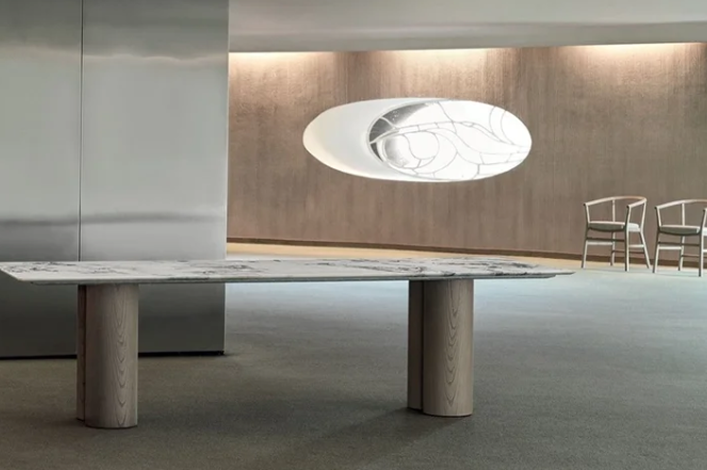
Gabriele e Oscar Buratti's Elly is a table with a rounded base and top available in marble, glossy lacquer, or wooden veneer. The rounded base maintains its architectural logic across all three surfaces, while the material of the top determines the room's register. In glossy lacquer, the surface reflects the room above it; in marble, it introduces weight and geological depth; in wooden veneer, warmth and directional grain.
The Base as Structural Proposition
The base of a dining table is a three-dimensional object occupying the floor plane that is as formally significant as the surface it supports. A base of minimal structural presence allows the floor to read continuously around it, which benefits rooms of modest dimensions. A base of genuine sculptural authority commands space beneath the surface, making its own contribution to the room's composition.
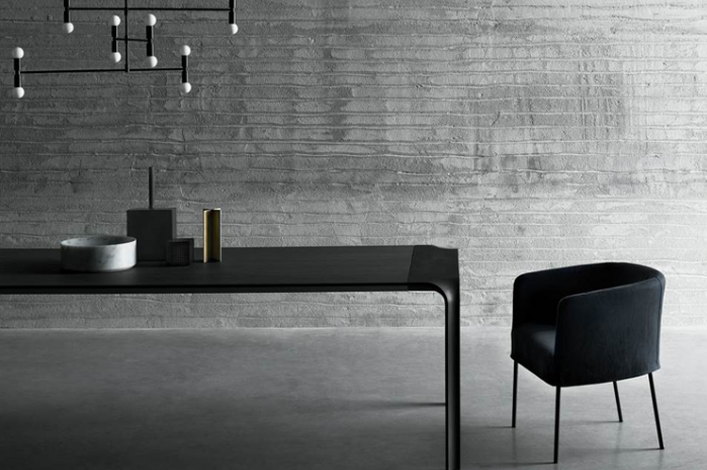
David Lopez Quincoces's Brasilia is a dining table with aluminum legs and a boxed-shaped top in a sandwich of MDF and aluminum sheet pressed and glued, available in various finishes. The aluminum structure carries material consistency between base and top, giving the piece a unified formal identity.
The sandwich top produces a surface with the visual precision of solid metal at a proportion that solid metal alone could not sustain. In a room of clean, rectilinear architecture, the Brasilia holds its position without the visual complexity that more ornamented bases introduce.
Knowing How to Choose a Dining Table for the Long Term
How to choose a dining table appropriately? It is ultimately about understanding it not as a purchase but as the long-term spatial anchor of the dining room. The surface material will age and develop its character. The base will read differently as the room around it evolves. The dimensions will determine whether gatherings of different sizes feel comfortable or forced for as long as the table is in the room.
Graye's dining table collection holds pieces designed with this long view in mind, each one a formal argument about what a dining table can do.
FAQs
-
Higher ceilings allow and invite taller, more visually substantial tables and bases without the room feeling compressed. In rooms with ceiling heights below 2.6 meters, a table with a lower visual profile and a minimal base maintains spatial openness.
-
The table first, always. The table's dimensions and clearance requirements govern the chair selection. Choosing chairs independently and then fitting a table to them reverses the spatial logic and almost always produces ergonomic compromise.
-
A round or oval table removes the corner problem entirely, improving circulation on all sides equally and allowing chairs to be positioned at any point around the perimeter. Rectangular tables are more efficient in narrow rooms where the table's length can run parallel to the longer wall.
-
70 to 80 centimeters above the finished table surface is the standard specification. This delivers focused, warm light across the surface without the fixture dropping into the sightline of guests seated opposite each other.
