
Iconic Modern Lounge Chair Styles to Elevate Your Interior
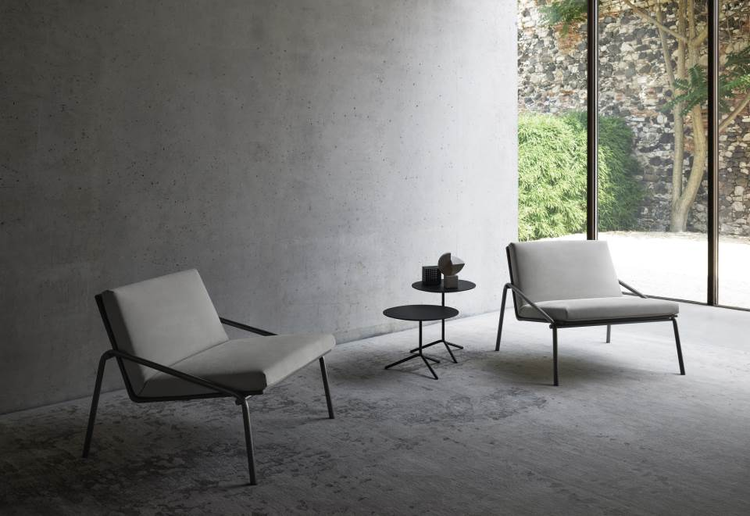
The modern lounge chair is the most personal piece of furniture in the living room. Unlike the sofa, which accommodates groups and adapts itself to social use, the lounge chair belongs to the individual.
It holds a single body in a single posture for extended periods, and in doing so, it must resolve a design problem that is both ergonomic and formal: how to support a person in a state of relaxed attentiveness while reading as a resolved, authoritative object in the room's spatial composition. The chairs in Graye's collection approach this problem from distinct formal positions, each representing a coherent design argument.
The Structure as the Design Statement
Some modern lounge chair designs make their formal argument through the quality of their structure: a timber frame whose joint detailing is legible, a metal base whose section is refined to its structural minimum, or a material combination that acknowledges its own constructional logic.
Ferruccio Laviani's Ada is a lounge chair with a solid natural or stained ash structure and a leather or fabric upholstered seat. The solid ash structure is the piece's primary formal statement: ash takes staining consistently and reveals its grain at every surface, which gives the structure a material character that painted or metal equivalents cannot replicate.
The uprightness of the ash frame places the seated body in a position of attentive relaxation, a posture suited equally to conversation and sustained reading. The choice between natural and stained ash allows the piece to be positioned along the tonal register of the room, moving from warm natural grain to a deeper, cooler stained finish.
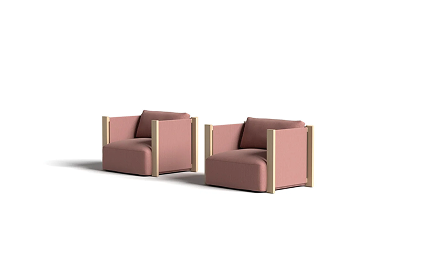
ARKADIUS
Lounge chair with architectural wooden backrests and armrests, pairing structured vertical slats with soft upholstered cushions.
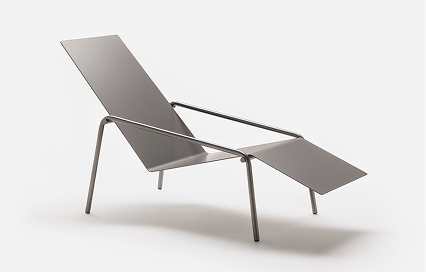
FILLET LOUNGE
Chaise longue with powder-coated stainless steel and aluminum frame, available with removable cushions and finishes suited for both indoor and outdoor use.
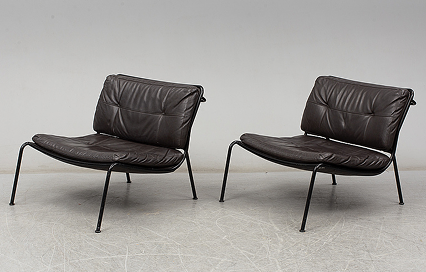
FROG
Lounge chair with removable leather or fabric covers
The Woven Surface and Its Tactile Register
The introduction of a woven element into a lounge chair design produces a qualitatively different material experience from upholstered seating. A woven seat breathes; it yields under contact in a distributed way that foam and fiber upholstery cannot exactly replicate; it introduces a surface texture that reads from a distance as pattern and at close range as craft.
Federica Biasi's Huli is a wooden lounge chair with a woven seat and back, with an optional quilted seat covered in leather or fabric. The wooden structure frames and holds the woven surface, which produces a formal dialogue between the precision of the timber joinery and the organic character of the weave. The optional quilted seat is a genuinely important design decision: it allows the chair to operate in two distinct registers, as a pure woven material object or as a more conventionally upholstered piece, without compromising the formal coherence of either version.
Proportional Intelligence and the Body at Rest
The most consequential dimension of a modern lounge chair is the one most rarely measured in showrooms: the relationship between seat height, seat depth, and back angle. These three dimensions, together, determine the body's posture in the chair, and posture determines whether the chair is used for extended periods or merely occupied briefly.
Piero Lissoni's Frog chair, with removable leather or fabric covers, addresses this proportional question with the dimensional specificity that characterizes the best Italian production. The seat height and depth position the body in a genuinely reclined posture without the mechanical intervention of a reclining mechanism, and the removable covers allow the chair's material identity to be updated over the piece's life without structural replacement.
The Lounge Chair as the Room's Formal Counterpoint
A living room that holds only sofas for seating resolves its functional requirement but not its spatial one. The modern lounge chair introduces a vertical figure into a composition otherwise dominated by the horizontal mass of seating systems.
It draws the eye, punctuates the room, and gives the space a quality of resolved complexity that no amount of sofa configuration can produce on its own. The selection of a lounge chair is, in this sense, among the most spatially significant decisions in furnishing a living room.
FAQs About Modern Lounge Chair
-
A lounge chair positions the body in a more reclined posture with a lower seat height and greater back angle, supporting extended occupancy in a relaxed position. A dining chair maintains the body in a more upright posture appropriate for table use.
-
In very compact living spaces, a pair of well-chosen lounge chairs can substitute for a sofa as the primary seating, with the advantage of producing a more spatially dynamic arrangement than a single sofa against a wall.
-
A chair with a back height of 80 to 90 centimeters from the floor will read comfortably in rooms with ceiling heights below 2.6 meters. Higher backs can feel oppressive in low-ceilinged rooms and interrupt the horizontal spatial register.
-
Tonal consistency between the chair and sofa produces a more unified room. An identical material is not required and often produces a more interesting result when avoided. The key discipline is ensuring that any contrast is clearly intentional rather than the product of uncoordinated selection.
-
Positioning the chair at 90 degrees to the primary window provides sufficient light for reading without the glare of direct solar exposure on the page or screen. A reading lamp on the shadow side completes the lighting arrangement for evening use.
