
Metal Cabinets in Architectural Interiors
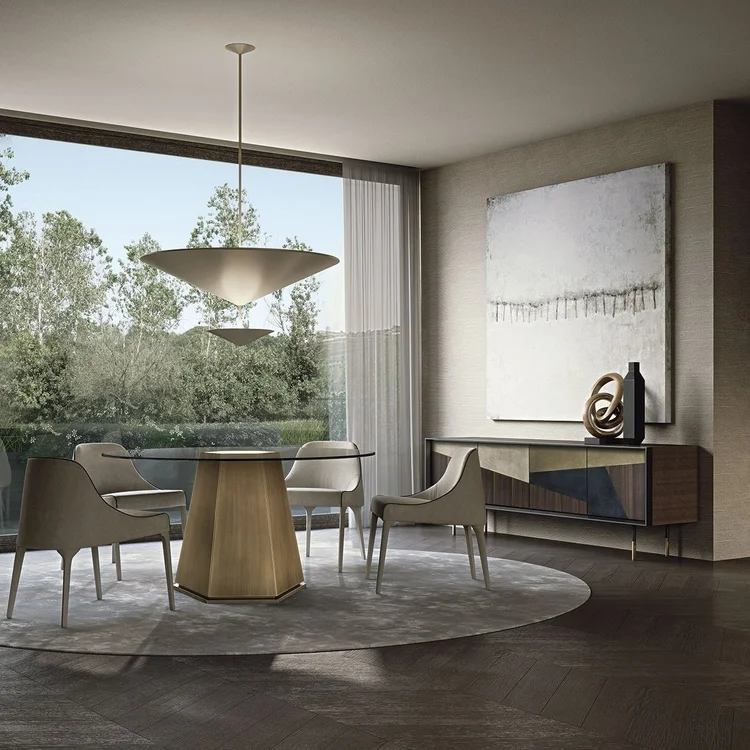
The cabinet is among the oldest furniture typologies, and metal is among the oldest constructional materials. Their combination, however, produces something that is neither traditional nor simply industrial.
Metal cabinets, at the level of serious contemporary interior design, are spatial objects with formal authority derived from material precision: surfaces that reflect, absorb, and interact with light in ways that timber and lacquer cannot replicate and structures that hold their dimensional integrity across decades of use. They belong in a room, not as storage solutions but as architectural presences.
Metal as a Surface Language
The surface of a metal cabinet is not neutral. Unlike lacquered timber, which reads consistently across viewing angles, a worked metal surface changes character with the quality and direction of light.
Hammered metal catches and fragments light, producing a surface that is never fully resolved, always slightly in motion. Brushed metal establishes directional grain lines that read differently across the length of a cabinet than they do at a point of close examination. Patinated and oxidized finishes introduce tonal complexity that deepens over time as the metal continues its surface chemistry.
This material dynamism is the reason metal cabinets occupy a specific and irreplaceable role in interiors whose designers take surface character seriously. A metal cabinet in a room of predominantly soft or pale materials introduces a counterpoint that is both visual and tactile, a surface that demands a different quality of attention from the viewer.
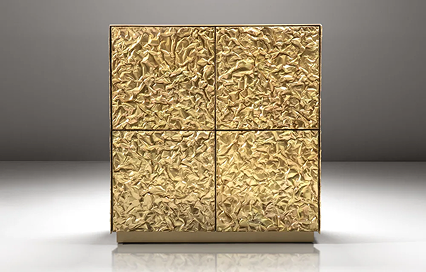
Froissé
Sculptural metal-clad cabinet featuring a textured DePiqué finish that evokes fabric-like folds, revealing a refined black walnut core for a striking, multi-sensory design statement.
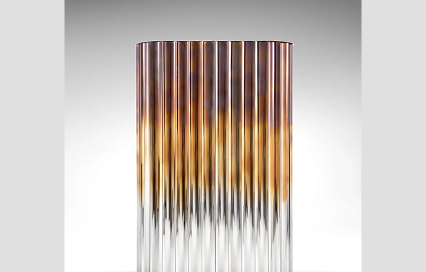
DORICA
Storage cabinet with fluted, Doric column-inspired concave slats and integrated lighting, featuring a drawer for functional storage and a sculptural architectural presence.
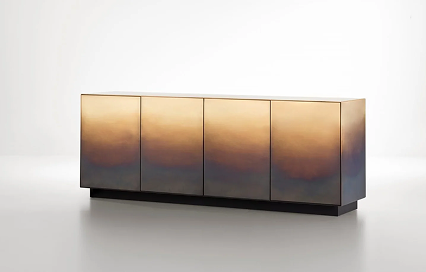
MAREA
Marea sideboard and dresser. Made in copper, stainless steel, or brass. The interior is finished in natural birch.
Brass and the Language of Warmth
Brass is among the most demanding of the metals used in serious cabinet production and among the most rewarding. Its natural tonal range, from the bright yellow of polished new brass through to the deep, almost olive tones of heavily oxidized aged brass, gives the material a biographical character that steel and aluminum cannot produce. A hammered brass surface introduces a further layer of complexity: each surface facet catches light at a slightly different angle, producing a texture that reads as continuous warmth from a distance but reveals its constructional intelligence at close range.
Marco Pisati's Ripple is a cabinet with a sinuous form that evokes the fluidity of water, with a meticulously crafted metal surface that reflects light in polymorphous ways, available in two brass finishes. The sinuous form is not a decorative affectation; it is a structural decision that produces a cabinet surface whose curvature means no two viewing angles produce the same light reading. The available brass finishes allow the piece to be positioned along the tonal spectrum from bright and immediate to deep and considered.
Francesco Forcellini's Sculpt is available in hammered brass, copper, or iridium. The hammered brass option addresses the material's tactile potential directly: the surface bears the marks of its making, which gives the piece a physical presence at close range that any smooth-finished equivalent cannot achieve. Copper, warmer in tone and with a patination character that moves through orange, brown, and eventually green over extended periods, produces a piece whose material identity is explicitly time-dependent.
The Metal Cabinet in a Domestic Interior
The placement of metal-based cabinets in residential settings requires a consideration that the functional category alone does not demand. A metal cabinet positioned against a white plaster wall in a room with natural light from one direction will produce a completely different spatial effect from the same piece in a room lined with timber veneer. The spatial intelligence of the selection lies in this relationship.
Zanellato/Bortotto's Marea, available in copper, stainless steel, or brass with a natural birch interior, addresses this relationship with material specificity. The exterior metal shell and the natural birch interior produce a material dialogue that is experienced daily: the exterior reads from across the room with the authority of its metal finish, while the interior reveals its warm timber surface only at the moment of use. This distinction between public exterior and private interior is one of the defining formal qualities of the cabinet typology, and the Marea resolves it with precision.
Graye's Approach to Metal Cabinets
The cabinet collection at Graye holds metal pieces as spatial objects whose selection requires the same curatorial attention as any other essential element in a room. Metal-based cabinets are not just ordinary storage; they are material statements about the value of surface character, the passage of time, and the relationship between a room's primary palette and the counterpoints that give it depth.
Metal Cabinets FAQs
-
Copper patinates through a sequence of warm oranges and browns before developing a blue-green verdigris in humid conditions. Brass moves through yellows and golds toward a deeper olive-brown patina. Both develop characters that are specific to their placement conditions.
-
Hammered and brushed metal surfaces are more resistant to visible scratching than polished ones because their surface texture distributes and disguises abrasion. High-polish brass and copper surfaces show contact marks more readily and require more careful placement.
-
Metal-based cabinets work very effectively in bedrooms as a material counterpoint to predominantly soft upholstery and textile surfaces. The tonal warmth of brass or copper reads particularly well in bedroom lighting conditions.
-
A natural timber interior, as in the Marea, is the most appropriate finish for clothing contact storage. It does not hold moisture, does not transfer odor, and is dimensionally stable under the humidity variations of domestic bedroom environments.
-
Standard floor-standing metal cabinets require no specialist installation beyond ensuring the floor surface is level. Wall-mounted metal pieces should be fixed to structural wall elements, as their weight typically exceeds that of comparable timber pieces.
