
Modern Sectional Sofas That Redefine Comfort and Scale
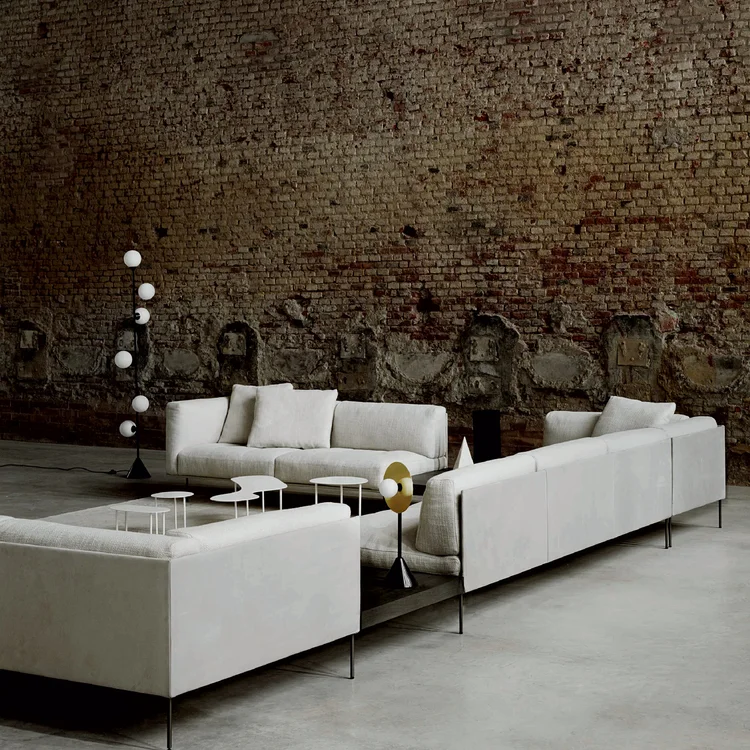
Few decisions in interior design carry as much spatial consequence as the selection of a sectional sofa. It is the piece that establishes seating territories within a room and determines how people gather, how they circulate, and where the visual weight of the composition falls.
A modern sectional sofa, chosen with spatial intelligence, does not merely occupy a room. It organizes it, drawing territory out of undifferentiated floor area and giving the room a legible center from which everything else reads.
The Sectional as a Spatial Proposition
A well-designed modern sectional sofa is not a single piece of furniture with fixed dimensions. It is a vocabulary of modules, each with specific dimensional and formal properties, that can be composed and recomposed to address the particular conditions of a given room. The difference between a floating L-shaped configuration in a room with strong axial geometry and a continuous linear arrangement along a structural wall is not merely aesthetic. It produces a different room, with different circulation patterns and a fundamentally different relationship between the seating territory and the floor plan.
Graye's sofa collection reflects this understanding. The systems represented are spatially considered instruments whose module vocabularies respond to the full range of conditions encountered in serious residential interiors, from double-height open-plan volumes to intimately scaled rooms with strong architectural character.
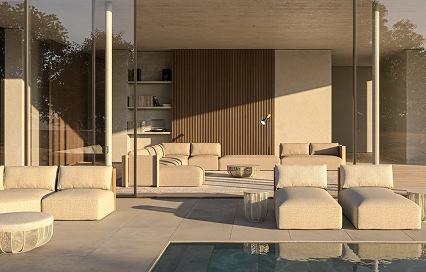
ARKADIUS
Modular seating system with architectural wooden backrests and armrests, pairing structured vertical slats with soft upholstered cushions.
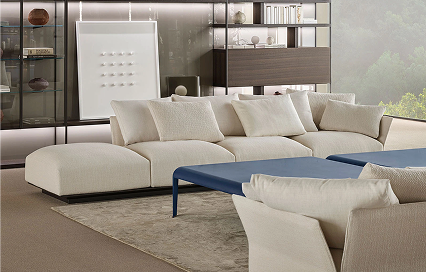
TOBU
Linear three- and four-seater configurations, as well as closed or open corner versions with armless central or end modules. complemented by a square armchair with one or two backrests.
Configuration and the Grammar of Seating
Seat depth governs how far the body is positioned from the floor and from its own structural support. A seat too deep for the sitter's body geometry places an uneven load on the lumbar region. The back angle determines whether the configuration reads as formally upright or absorptive of long hours. Arm height controls the module's silhouette from across the room while determining whether it functions as a surface, a headrest, or a spatial boundary between adjacent seated positions.
Piero Lissoni's Neowall is a modular sofa with fully removable fabric or leather covers whose formal intelligence lies in its handling of horizontal continuity at room scale. A configuration spanning four or five meters of wall reads not as furniture placed against architecture but as an element with its own architectural register, a continuous horizontal plane from which the room's vertical surfaces read more clearly.
Fabric, Surface, and the Material Character of Seating
The upholstery of a modern sectional sofa carries as much compositional weight as the configuration itself. A sectional in a warm wool boucle produces a room organized around tactile warmth and visual texture. The same configuration in smooth semi-aniline leather produces a room that is cooler, more precise, and more responsive to the quality of light that crosses it through the day.
High-grade linen, in densely woven upholstery construction, is unmatched for the depth of tone it holds in dyed colorways and for its drape at cushion edges. These material decisions also affect maintenance, longevity, and how comfortably the sofa integrates with surrounding finishes such as wood, stone, plaster, and metal. Upholstery should never be treated as a secondary detail within the overall composition of the room.
The Architecture of Modularity
Piero Lissoni's Extrasoft offers a configuration range extending from intimate two-seat arrangements to room-spanning compositions without losing the formal coherence of the individual module. The cover system, available in both fabric and leather, makes the piece adaptive across interior contexts that differ in material register and level of formal intention.
Snøhetta's Array approaches modularity from a different structural premise. Its modules are dimensioned to be genuinely portable, making the system reconfigurable in practice as the way a room is used evolves. The variety of upholstery options, applied across a module vocabulary of disciplined formal restraint, produces configurations that read as resolved spatial compositions regardless of the specific layout chosen.
Choosing a Modern Sectional Sofa for Your Space
The contemporary sectional sofa that serves a room well is the one whose proportions respond correctly to the floor area and ceiling height of the specific room, whose module vocabulary addresses its particular geometry, and whose material is chosen with the same attention given to every other surface the room contains.
These are architectural questions, and they reward patient, spatially literate engagement. When considered carefully, the sectional becomes more than seating. It supports circulation, reinforces visual balance, and helps establish a room that feels intentional, comfortable, and structurally resolved over time.
Modern Sectional Sofa FAQs
-
Measure the floor area and map the configuration in tape before committing. The seating footprint should allow at least 90 centimeters of clear circulation on all sides without compressing the room's other territories.
-
A modular system is built from discrete, reconfigurable units with defined dimensional logic. A standard sectional is a fixed form. Modular systems address spatial change; standard sectionals do not.
-
On systems like the Neowall and Extrasoft, fully removable covers allow the upholstery to be exchanged independently of the structural frame, which significantly extends the functional life of the piece.
-
High-grade performance wool offers the strongest balance of surface integrity, recovery after use, and dimensional stability. Full-grain leather is the most durable choice for pieces expected to develop a considered patina over the years.
-
Modern sectionals organize seating in a way that supports conversation, relaxation, and natural circulation. Their scale and configuration help create a visual structure while maintaining a comfortable and cohesive atmosphere.
