
Modern Outdoor Furniture for Elevated Open-Air Living
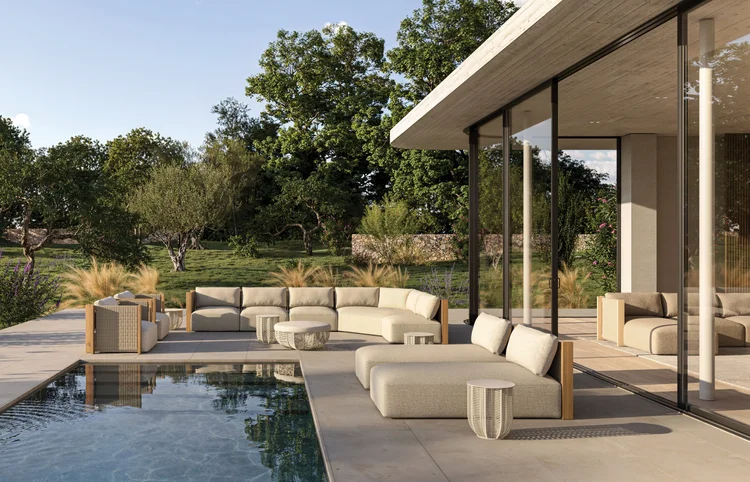
The ritual of the shared meal is perhaps the most significant social ceremony conducted within the home. It is an act that requires a specific architectural stage, where the choice of furniture dictates the pace and atmosphere of the gathering.
While the table provides the horizontal plane for utility, it is the act of curating dining seating that determines the comfort and longevity of the experience. A chair is more than a tool for sitting; it is a tactile interface between the human body and the interior volume.
In a high-end curation, the chair must possess both visual lightness and structural permanence, acting as a rhythmic element that defines the perimeter of the dining area while inviting the inhabitant to settle into the moment.
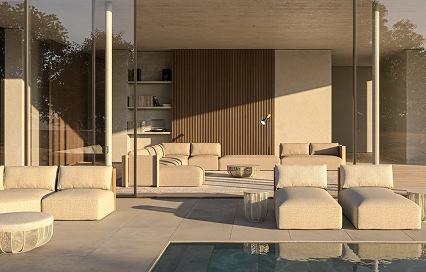
ARKADIUS
Modular seating system with architectural wooden backrests and armrests, pairing structured vertical slats with soft upholstered cushions.
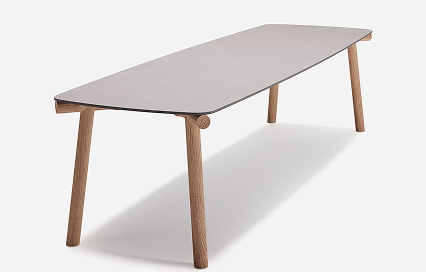
KASUMI TABLE
Dining table with solid teak legs, black stainless steel frame, and porcelain stoneware or black granite top with plastic floor supports.
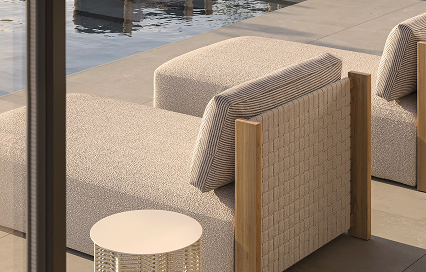
PALME
Inspired by Palmanova’s star-shaped geometry, featuring a sculptural woven cord structure that blends artisanal tradition with contemporary design.
The Architectural Intent Behind Curating Dining Seating
When one approaches the design of a dining space, the chair must be viewed as a repeating structural unit. Unlike a sofa, which acts as a singular monolith, dining chairs create a cadence through their sheer number. The process of designing dining seating involves balancing this repetition so that the room feels cohesive, not cluttered.
In a gallery-like setting, the silhouette of the chair becomes a graphic line against the floor or the wall. If the chair is too heavy, the room feels static; if it is too ephemeral, the table loses its anchor.
By selecting pieces that prioritize a clear architectural logic, the designer ensures that the seating becomes a frame for the conversation that happens above the table surface. This intentionality ensures the space remains balanced during the day and atmospheric at night.
Structure, Teak, and the Logic of Longevity
Burma teak has been the structural material of choice for serious modern outdoor furniture for reasons that extend beyond tradition. Its natural oil content, unusually high among commercial hardwoods, makes it dimensionally stable in conditions of alternating moisture and heat that would cause lesser timbers to cup or split. The grain is tight and interlocked, giving the wood resistance to surface abrasion in both structural and finish-critical applications simultaneously.
The Kasbah, designed by David Lopez Quincoces, uses a solid Burma teak structure to anchor an outdoor modular sofa whose removable fabric covers allow the configuration to respond to both use and season. Deployed across a generous terrace, the system establishes distinct seating territories with the deliberateness that fixed built-in seating achieves indoors. Condensed into a more intimate exterior room, the same modules read as a single resolved composition.
Fabric, Exposure, and the Outdoor Textile
An outdoor performance fabric must resist UV degradation without surrendering the quality of hand and drape that makes upholstered seating worth inhabiting. Solution-dyed acrylics, in which color is introduced into the fiber before spinning rather than applied to its surface afterward, represent the most rigorous approach. The pigment is integral to the fiber structure, so surface abrasion and prolonged solar exposure degrade the fabric uniformly instead of stripping a color layer applied on top.
Piero Lissoni's Extrasoft, in its outdoor version, carries this logic directly: a sofa with fully removable fabric covers, its silhouette resolved with the same low horizontal restraint as its interior counterpart. The piece maintains the formal coherence of a serious interior seating system re-engineered, at the material level, for exterior conditions.
Stone, Scale, and the Structural Object
The table is the piece that most decisively determines the spatial character of an exterior room. A stone table on a terrace does not merely provide a surface. It establishes a datum, a horizontal plane that the eye reads against the ground plane and the horizon simultaneously. Stone in outdoor use must tolerate thermal cycling without developing micro-fractures at structural joints. Engineered composites like Extraforte are specified precisely because they meet these conditions without compromise.
Angelo Mangiarotti's Incas, available in Extraforte stone finishes suitable for outdoor use, is built around a structural logic where two sloping planes bear the full load while vertical elements remain non-contributive. On a terrace, this produces a presence that is architecturally specific: an object that participates in the spatial argument of the place rather than merely occupying it.
The Outdoor Room as a Continuation of Interior Architecture
The most accomplished exterior spaces treat the transition from interior to exterior not as a threshold but as a gradient. This continuity is achieved by holding the same standard of spatial attention, the same rigor in the selection of modern outdoor furniture, and the same care with scale and proportion that the interior demanded. A terrace furnished with this seriousness becomes an inhabited room in the fullest architectural sense.
FAQs About Modern Outdoor Furniture
-
Burma teak, Extraforte stone, and solution-dyed acrylic textiles perform best in warm, high-UV climates. They resist thermal cycling, moisture, and prolonged solar exposure without requiring intensive maintenance.
-
Modular systems allow seating territories to be established and dissolved as the spatial needs of a terrace change. Fixed built-ins offer permanence and a more fully architectural result but sacrifice adaptability.
-
Material continuity between interior and exterior produces the most spatially resolved results. This does not require identical finishes but a shared standard of material quality and tonal discipline.
-
Dense, low-porosity composites like Extraforte tolerate thermal expansion and contraction without surface fracture. Highly porous natural stones, despite their interior authority, are generally poorly suited to outdoor thermal stress.
-
Standard pieces carry a lead time of 16 to 20 weeks. Customized orders typically require an additional 2 to 4 weeks, depending on the specification.
