
Bespoke Fitted Wardrobes: Perfectly Crafted Storage for Elegant Homes
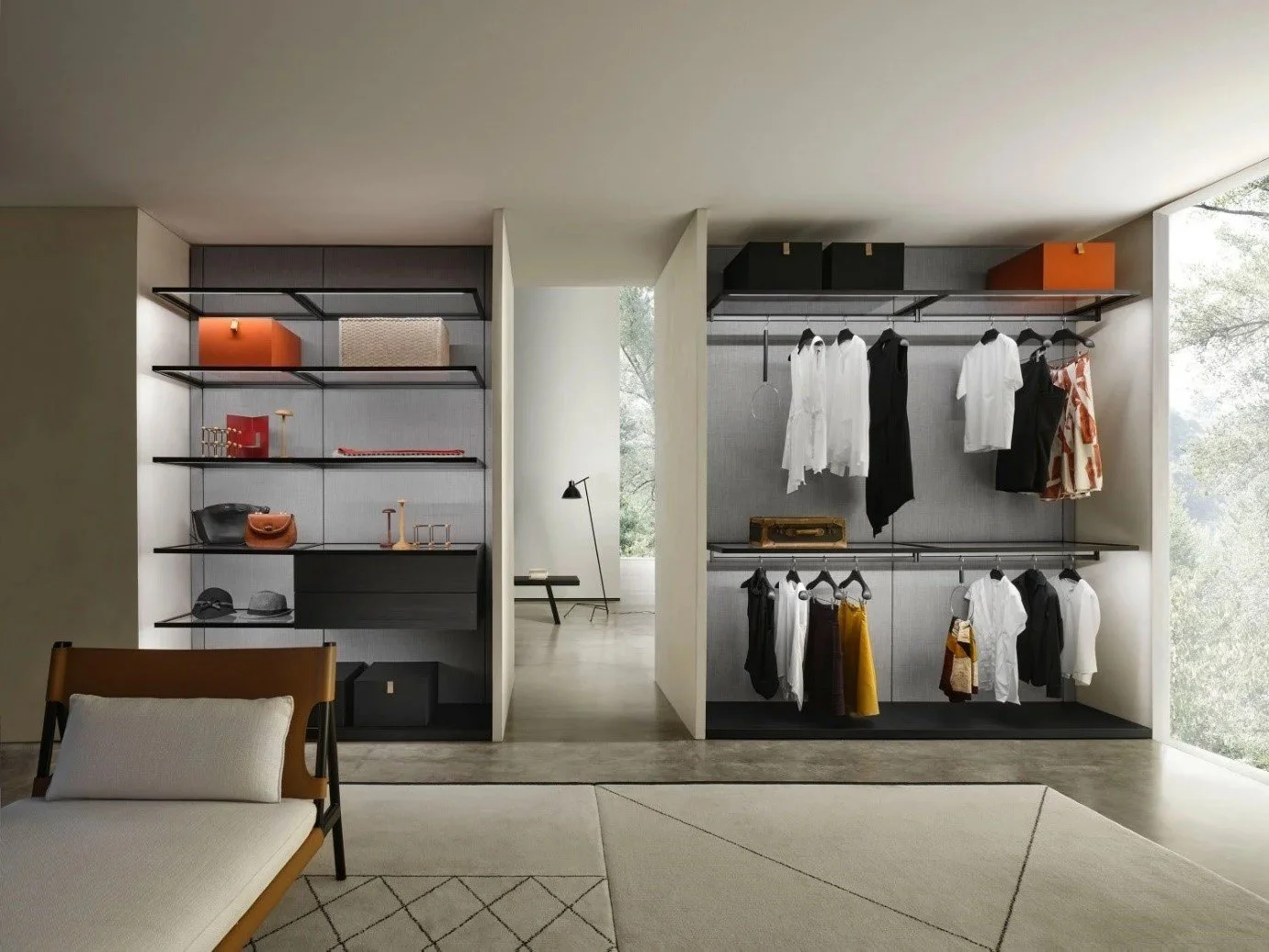
Storage is one of those design challenges that quietly reveals the character of a home. When handled without care, it leaves daily life exposed. Rails become visible through half-closed doors, boxes accumulate above cabinets, and open shelving begins to carry the visual weight of everything we own. The room never quite feels settled.
When handled with intelligence, however, storage recedes. It becomes integrated, architectural, and calm. It supports the room rather than competing with it.
Bespoke fitted wardrobes represent the most considered expression of this approach. They are not simply furniture added for function but spatial interventions designed to belong to the room as completely as its walls, floors, and ceiling.
In refined residential design, this distinction matters. The difference between a wardrobe that occupies a room and one that completes it is subtle but transformative.
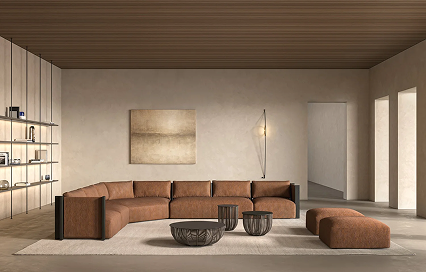
ARKADIUS
Modular seating system with architectural wooden backrests and armrests, pairing structured vertical slats with soft upholstered cushions.
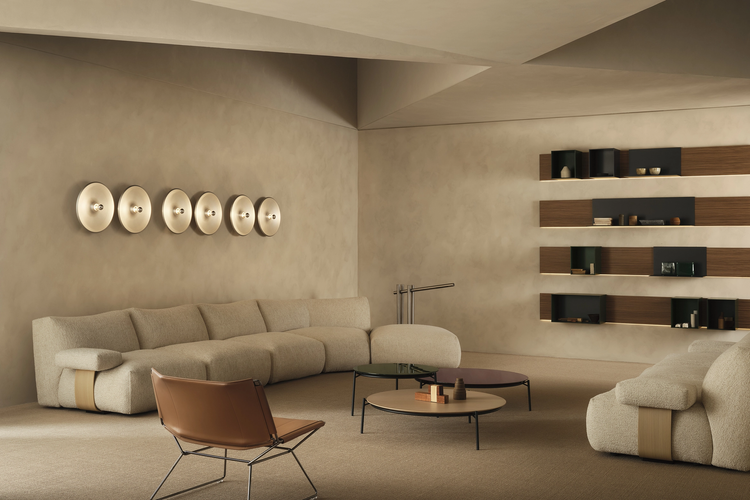
GOOM
A modular system comprising single units, corner units, chaise longue and poufs, with the option of adding one or more armrests.
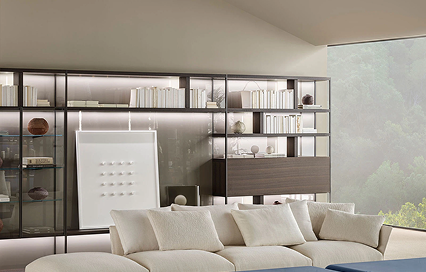
TOBU
Linear three- and four-seater configurations, as well as closed or open corner versions with armless central or end modules. complemented by a square armchair with one or two backrests.
The Case for Bespoke Over Modular
The contemporary furniture market offers an impressive array of modular wardrobe systems. Many are well-engineered and aesthetically competent. For certain applications, they are entirely appropriate.
The difference between modular and bespoke, however, is fundamentally architectural.
Modular wardrobes are designed around standardized dimensions. They assume a typical ceiling height, a relatively square room, and predictable wall conditions. Even when adjusted or customized within a range, they remain based on a system intended to suit most spaces.
Bespoke fitted wardrobes begin from the opposite premise. They assume nothing. Every millimeter is measured. Ceiling heights are taken into account precisely, whether 2.4 meters or 3.1 meters. Skirting boards, cornicing profiles, alcoves, chimney breasts, and structural irregularities are all considered. The design responds to the exact geometry of the room.
When properly executed, there is no visible gap at the ceiling line. No filler panels appear, as afterthoughts, or shadow lines suggest insertion. The wardrobe reads as a continuation of the wall plane.
In some cases, it even improves the perceived proportions of the room by correcting minor asymmetries through careful visual balancing.
This architectural integration elevates bespoke fitted wardrobes beyond furniture. They do not consume space; they refine it.
Designing for Proportion and Balance
One of the least discussed but most important aspects of customized wardrobe design is proportion.
In bedrooms, large vertical surfaces dominate the visual field. A wardrobe that spans an entire wall has a significant impact, whether intentional or not. The arrangement of panels, doors, and divisions must therefore respond to the scale of the room.
For example, in rooms with higher ceilings, narrower vertical door proportions often feel more elegant, reinforcing verticality. In more compact spaces, fewer and wider panels can create calm continuity. Handle placement, shadow gaps, and door reveals must align consistently across the elevation to avoid visual fragmentation.
Even the alignment of wardrobe doors with architectural features such as windows or bed centerlines influences how resolved the space feels. These are not decorative decisions. They are compositional ones.
A well-designed custom wardrobe can make a modest room feel taller, a wide room feel more grounded, or an awkward alcove feel intentional.
Interior Configuration as Personal Architecture
While the exterior of a fitted wardrobe shapes the room, the interior shapes daily life.
True customized design begins with analysis. How many long garments require full-height hanging? Are there tailored jackets that benefit from shorter drop sections? How much folded storage is realistically needed? Is there a requirement for integrated shoe drawers, watch trays, jewelry compartments, or concealed safes?
The most effective designs begin with an honest inventory. It is not uncommon for clients to overestimate hanging space and underestimate shelving or drawer requirements. A detailed assessment ensures the internal architecture reflects actual habits rather than assumptions.
Long hanging sections typically require approximately 1500 to 1700 mm of vertical clearance. Double hanging can reduce this to two sections of 900 to 1000 mm. Drawer stacks should be carefully dimensioned, with shallower upper drawers for smaller items and deeper lower drawers for bulkier garments.
Ventilation is another critical but often overlooked consideration. High-quality wardrobe systems incorporate discreet airflow gaps or breathable backing panels to prevent stagnation, particularly in tightly sealed rooms.
Graye’s closet design and installation service, undertaken in collaboration with Porro’s wardrobe systems, is structured around this level of specificity. Porro’s modular precision allows internal elements to be configured in exact increments, avoiding wasted vertical space and ensuring ergonomic usability.
The result is storage that feels intuitive from the first day of use.
Materials and the Surface of Daily Use
Material selection in bespoke fitted wardrobes is not purely aesthetic. It influences longevity, tactility, and maintenance.
Lacquered finishes remain among the most refined options available. A properly executed matte lacquer absorbs light softly, allowing the wardrobe to recede into the wall plane. Satin finishes introduce a subtle reflectivity, while high-gloss lacquers create a sharper architectural statement.
The quality of lacquer is defined by its depth, consistency, and resistance to micro-scratching. Premium European manufacturers employ multilayer spray applications in controlled environments, followed by meticulous sanding and curing processes.
This results in a surface that maintains uniformity across large panels without orange peel texture or tonal variation.
Wood veneers offer a different sensibility. Walnut introduces warmth and depth. Oak provides clarity and grain definition. Ash feels lighter and more contemporary. Wenge offers dramatic tonal richness.
The key to successful veneer application lies in grain matching. Book matching or slip matching techniques ensure continuity across adjacent panels, allowing the wardrobe elevation to read as a coherent surface rather than fragmented pieces.
In more contemporary interiors, combinations of lacquer and veneer can create layered depth. For example, a matte lacquer exterior paired with walnut interiors introduces warmth upon opening without altering the room’s architectural calm.
Door Systems and the Language of Opening
The experience of opening a wardrobe is deeply physical. It is a daily gesture repeated thousands of times.
Hinged doors provide full access to each compartment and allow for integrated internal lighting that activates upon opening. Soft-close hinges ensure controlled movement and reduce wear. However, hinged doors require clearance space, which must be accounted for in furniture layout and circulation planning.
Sliding systems offer spatial efficiency and visual restraint. High-quality sliding mechanisms from Italian and German manufacturers operate on precision-engineered tracks with soft-close dampers and anti-derailment guides.
Even large-scale doors exceeding 2.7 meters in height can move with minimal effort when properly balanced.
Frameless sliding systems, where aluminum frames are concealed or minimized, create the cleanest aesthetic. Flush floor tracks or recessed ceiling guides maintain architectural continuity.
The tactile quality of hardware also matters. Integrated finger pulls, recessed shadow gaps, or push-to-open mechanisms each create a different user experience.
In more minimal interiors, handleless systems reinforce visual calm. In more traditional settings, refined metal handles can introduce subtle detail.
Lighting as an Integrated Layer
Lighting transforms how a wardrobe functions.
Integrated LED strips positioned vertically along internal panels provide even illumination without casting shadows on garments. Warm color temperatures between 2700K and 3000K are typically preferred in bedrooms to maintain softness.
Sensor-activated lighting enhances convenience, particularly in early morning or late evening use. For glass-fronted wardrobes or open display sections, dimmable lighting adds depth and atmosphere.
Externally, discreet uplighting or ceiling-integrated spots can highlight the wardrobe elevation subtly, reinforcing its architectural presence.
Acoustic and Structural Considerations
In apartments or townhouses, fitted wardrobes can also contribute to acoustic buffering. When installed along party walls, layered carcass construction and solid backing panels may provide minor improvements in sound insulation.
Structurally, taller wardrobes require careful anchoring, particularly in older properties with uneven masonry. Professional installation ensures load distribution is handled correctly and that sliding systems remain perfectly aligned over time.
These technical details are rarely visible, but they define long-term performance.
The Relationship with Architecture
The most successful bespoke fitted wardrobes alter the experience of a room without announcing themselves.
Over time, the bedroom feels calmer, surfaces appear continuous, and proportions feel resolved. There are fewer visible objects competing for attention. The space supports rest rather than distraction.
This is the essence of architectural storage. It is not decorative excess. It is reduction, precision, and alignment.
Porro’s approach to wardrobe systems reflects this philosophy through disciplined geometry, refined materials, and manufacturing accuracy. Graye’s residential design methodology builds upon it, ensuring that each installation responds to the character of the home, whether a contemporary penthouse, period townhouse, or countryside residence.
At its best, storage is not about containment. It is about clarity. A bespoke fitted wardrobe does not just organize possessions. It refines the spatial experience of the room itself, contributing quietly but decisively to the elegance of the home.
FAQs
1. How much depth is required for a properly functioning fitted wardrobe?
For standard hanging garments, an internal depth of 550 to 600 mm is required. Sliding systems usually increase the overall depth to around 620 to 650 mm to accommodate tracks.
2. Are sliding doors less durable than hinged doors?
No. High-quality sliding systems are tested for tens of thousands of cycles. Longevity depends on hardware engineering and installation precision rather than door type.
3. Can custom wardrobes be installed in period properties with uneven walls?
Yes. Customized joinery can be scribed precisely to uneven ceilings, walls, and floors, making it a perfect fit for Georgian, Victorian, or converted properties.
4. What is the difference between lacquered MDF and laminate finishes?
Lacquered MDF is spray finished for a seamless, paint-like surface with visual depth. Laminates are bonded sheets that are more impact-resistant but flatter in appearance.
5. How long does a fully bespoke fitted wardrobe installation take?
Manufacturing typically takes 6 to 10 weeks, depending on finish and complexity. On-site installation generally requires 2 to 5 days, including alignment and final adjustments.
