
Designer Luxury Bedroom Furniture That Modernizes Your Private Retreat
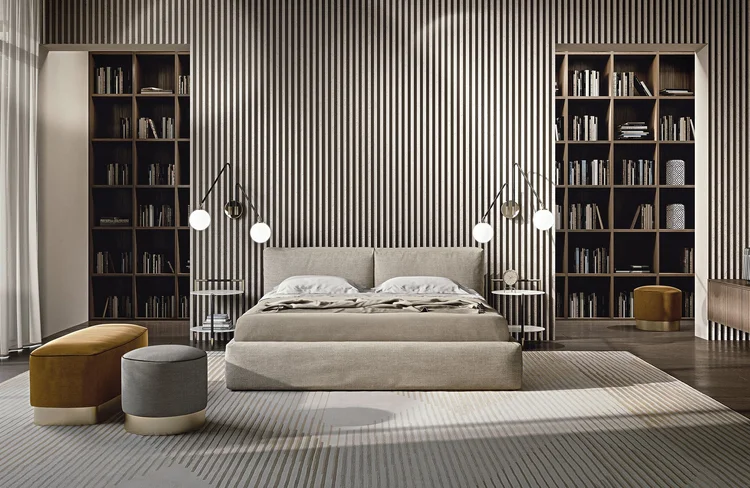
The bedroom is the room that demands the most from design and receives the least theoretical attention. Living rooms are studied, dining rooms are composed, but the private retreat, which is the room given over entirely to rest and to the beginning and ending of days, tends to be treated as an afterthought once the public spaces are resolved. This is a mistake.
The quality of a bedroom, understood not as a photograph but as a daily habitation, is shaped by the same principles that govern any serious interior: material honesty, spatial proportion, and the considered relationship between objects and light. The luxury bedroom furniture you choose is the architecture of that experience.
The Bed as Spatial Anchor
Begin, always, with the bed. Not because it is the most visually dominant element, though it often is, but because it is the piece from which every other decision radiates.
Its scale determines the room's remaining space. Its height and silhouette establish the room's tonal register. A bed with a low platform profile and a headboard that reads as a discrete element will produce a different quality of spatial experience than one with an imposing upholstered form that commands the wall it inhabits.
The Italian furniture tradition approaches the bed with a sophistication that has made its influence on European and international bedroom design essentially pervasive. The best examples in this tradition resist easy categorization: they are not primarily decorative, nor are they merely functional.
Piero Lissoni's bed designs for Living Divani illustrate this position. The forms are resolved without being rigid; the proportions are generous without excess. They occupy a room in a way that feels both considered and inevitable.
For your own space, the questions to ask of a bed frame are the same as those you would ask of any architectural element: How does it relate to the ceiling height? How does it read when approached from the doorway? What does it leave to the sides and foot of the room, and what does that remaining space allow?
Nightstands, Surfaces, and the Discipline of Horizontal Planes
The surfaces adjacent to a bed accumulate life in a way that no other furniture in the room does. Nightstands are not merely functional; they are the domestic landscape of the hours before and after sleep.
They hold books, water glasses, and the last objects handled before the mind releases its grip on the day. They deserve the same material attention as the pieces whose scale commands greater notice.
What distinguishes luxury bedroom furniture at this level is not the presence of ornamentation but the quality of detailing at the intimate scale.
A drawer that closes with a specific resistance. A surface edge that reveals its material thickness in cross-section. The relationship between the horizontal plane of a nightstand and the height of the mattress is a calibration that sounds trivial and is, in practice, endlessly significant for the comfort of daily use.
Lacquered surfaces reward this close attention in a different way than stone or natural wood. A deep matte lacquer, such as the kind produced in Porro’s storage and bedroom furniture, reads differently depending on the viewing distance and the way light interacts with it.
At the room's edge, it registers as a tonal field. At arm's reach, it reveals a depth that flat photography cannot convey. This is the quality that rewards living with, not just looking at.
Wardrobes and the Integration of Storage
A bedroom that requires visible storage, including rails, open shelving, or freestanding wardrobes that announce themselves as problems to be solved, will never fully resolve itself as a space.
The most accomplished bedroom interiors treat storage as part of the architecture: built-in, flush, continuous, and considered. When storage disappears into walls, the room gains a clarity that allows its other elements to read without competition.
Graye's closet design and installation work, undertaken exclusively with Porro's wardrobe systems, proceeds from exactly this principle. Porro's walk-in and integrated wardrobe systems are designed not as furniture in the traditional sense but as spatial proposals.
The configuration of interior fittings, hanging sections, drawer columns, and open shelving for folded pieces can be arranged to suit the specific demands of your wardrobe and your habits.
The exterior reads as architecture: full-height panels in lacquer or natural wood veneer that give a wall back to the room rather than interrupting it.
This integration of function and spatial quality is one of the defining characteristics of serious bedroom design. When storage works at this level, the room settles into itself. The eye finds nothing to correct.
Texture, Softness, and the Hierarchy of Materials
The bedroom is the room where tactile experience matters most. You are, after all, present in it without the social defenses that other rooms invite. Bare feet on floor surfaces, hands on bedside materials, and the quality of upholstered surfaces experienced at length are all the intimate sensory negotiations that bedroom design must address.
Natural materials tend to reward this context. Linen, aged leather, and untreated stone read differently in a bedroom than in a living or dining context. The bedroom is a room that benefits from materials that absorb rather than reflect, that yield rather than insist.
Oak with a natural oil finish has a particular quality of warmth that lacquer cannot replicate; it accepts the light and stops returning it.
This is not to advocate for any particular material over others, but to insist that the choice be made consciously. The luxury bedroom furniture you select should be considered not only visually but also physically as a set of surfaces and textures you will encounter daily, in various conditions of light, at various distances.
Light in the Private Room
Bedroom lighting is among the most consequential and least discussed decisions in domestic design. The bedroom's light requirements span an enormous range: from the focused task light needed for reading to the diffuse ambient quality that eases the transition into rest to the clarity required for dressing. Meeting all of these requirements through a single overhead fixture is a structural failure of most residential lighting plans.
Designer bedroom furniture and lighting interact in ways that demand attention. A sculptural floor lamp positioned to illuminate a reading chair performs double duty: it is both a light source and an object.
Enzo Catellani's floor-standing pieces work at this intersection. Their forms hold their presence in the room during the day, and at night, the quality of light they produce is warm, directional, and unhurried.
Recessed lighting, when used in bedrooms, benefits from dimming controls and warm color temperatures. The particular quality of the room at different hours requires different light. A bedroom that can only be experienced at one level of illumination has not been fully designed.
Composition and the Private Interior
What distinguishes luxury bedroom furniture from its alternatives is not, finally, the individual quality of any single piece. It is the coherence of the whole with the sense that the room has been thought about as a complete spatial experience rather than assembled from good individual decisions.
Your bedroom, as a total composition, should offer something that photography cannot fully capture: the sense of being held, of entering a space that has been resolved on your behalf, that requires nothing of you but presence.
This is the standard toward which bedroom design is considered to reach. It is achievable not through expenditure alone but through attention to proportion, to material, and to the particular quality of the life that will be lived there.
FAQs
1. Why do some luxury bedrooms feel expensive even with minimal furniture?
It usually comes down to proportion, spacing, and material restraint instead of the quantity of items. Even limited luxury bedroom furniture can feel elevated when every piece has a clear spatial purpose.
2. Is it better to invest in a few statement pieces or a full bedroom set?
In contemporary interiors, fewer but more intentional pieces create stronger spatial identity than complete sets. A curated mix of luxurious bedroom furniture often feels more architectural than matching collections.
3. How do designers avoid making luxury bedrooms feel too cold or impersonal?
They introduce warmth through texture, layered materials, and subtle tonal variation rather than decorative excess. This balance allows bedroom furniture to feel refined without becoming sterile.
4. What role does negative space play in arranging luxury bedroom furniture?
Negative space is treated as an active design element, as it defines how each piece is perceived. Proper spacing around bedroom furniture determines whether a room feels composed or crowded.
5. Can high-end bedroom furniture work in smaller bedrooms?
Yes, when designed with scale in mind, luxurious bedroom furniture can actually enhance smaller spaces by reducing visual clutter and improving spatial flow through lower profiles and lighter forms.
