
Elegant Built-In Closet Ideas for Seamless High-End Storage
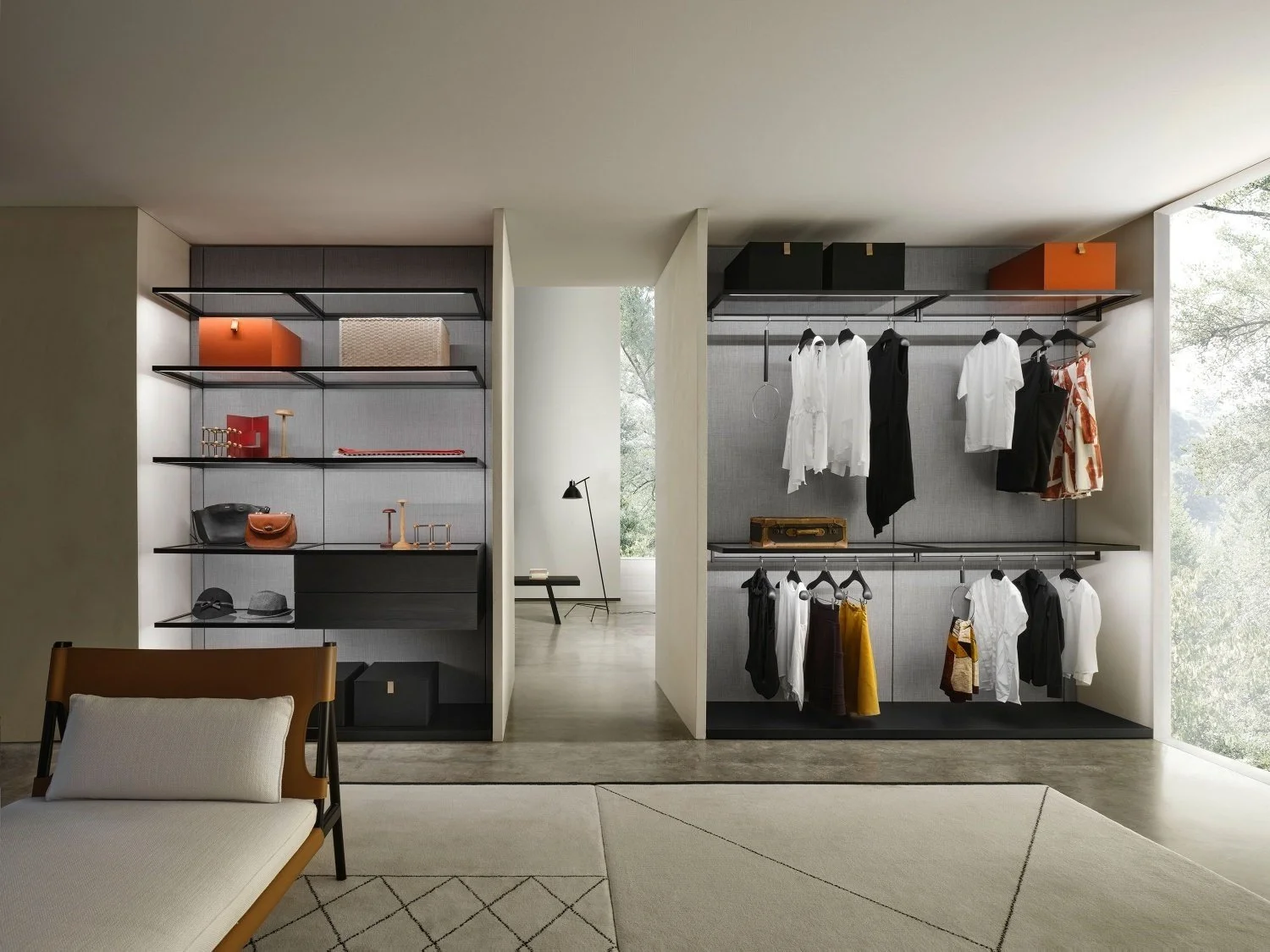
There is a particular intelligence required when designing storage that does not announce itself. The best built-in closet ideas do not broadcast their presence. They integrate so completely into the architecture of a room that they feel inevitable, as though the wall itself had always held this capacity.
Storage at this level is not furniture placed within a space. It is part of the spatial language of the home, resolved with the same consideration given to materiality, proportion, and light.
Built-in closets, when executed with precision and restraint, offer something that modular or freestanding wardrobes cannot. They respond directly to the room's geometry. They align with ceiling height, acknowledge skirting profiles, and work with the specific rhythm of architectural detail.
In homes where every surface carries intention, the closet becomes an extension of that intention rather than a compromise forced upon it.
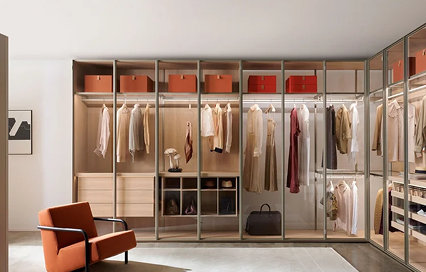
DRESSING ROOM
A modular system that emphasizes continuity and openness. This design creates luxurious spaces that are both functional and visually striking, perfect for showcasing your wardrobe while maximizing accessibility.
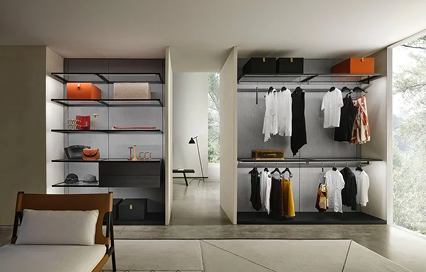
BOISERIE
A wall-mounted panel system blending elegance and minimalism. With no side panels, it offers a clean, uninterrupted surface that integrates seamlessly with other Porro solutions.
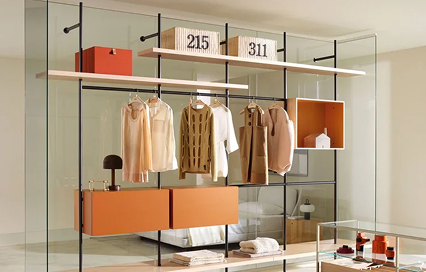
BOUTIQUE MAST
A dynamic, freestanding design that pairs vertical uprights with elegant shelves and accessories. Ideal for displaying clothing and accessories like an upscale boutique.
The Architectural Logic of Built-In Closet Ideas
A built-in closet operates on a different set of principles than a wardrobe system purchased and installed as a finished object. It is designed for your room specifically, taking into account ceiling height, wall depth, alcove dimensions, and the position of windows, doors, and natural light sources. The result is not an object inserted into a space but an element native to it.
In homes designed by architects with serious spatial intelligence or renovated by designers working within historical frameworks, built-in closets become opportunities to correct proportions. A room that feels too tall can be grounded through the introduction of a full-height closet wall with carefully articulated horizontal banding. A narrow bedroom can be widened perceptually by a recessed closet that reads as a continuous plane rather than a bulky intrusion.
The junction between closet and architecture should be invisible. When a built-in closet is resolved properly, there is no reveal at the ceiling and no shadow gap suggesting separation. The closet becomes a wall, and the wall becomes storage. This is not cosmetic trickery. It is the correct application of joinery principles to interior architecture.
Material Continuity and Surface Resolution
Material selection in built-in closet ideas must account for how surfaces are experienced across the entire room. In a bedroom where walls are finished in a matte limewash or honed plaster, a glossy lacquered closet door can feel discordant. Conversely, in a space with crisp architectural detailing and high-contrast finishes, a softly textured door might read as unfinished.
Lacquered panels in neutral tones remain among the most refined choices for contemporary interiors. A deep matte white or soft grey lacquer allows the closet elevation to recede, maintaining the room's spatial clarity. The precision required to execute a flawless matte lacquer finish is considerable.
Multi-layer spray applications in controlled environments, followed by careful sanding and curing, produce a surface free of orange peel texture or tonal inconsistency. This level of finish is achieved reliably by European manufacturers working to tolerances that mass production cannot replicate.
Natural wood veneers introduce warmth and tactility that lacquer cannot. Walnut, white oak, and ash are frequently specified for built-in closets in residential interiors where material richness is valued.
The key to successful veneer application lies in grain continuity. Book-matched or slip-matched veneers ensure that adjacent panels read as a coherent surface rather than a patchwork. When a closet spans an entire wall, this continuity becomes essential to maintaining visual calm.
Graye's closet design service addresses these material decisions through direct collaboration with clients and their architects, ensuring that built-in closet ideas are grounded in the broader material logic of the home.
Internal Configuration That Reflects How You Dress
The exterior of a built-in closet addresses the room. The interior addresses daily life. This is where built-in closet ideas become genuinely personal, because the habits of dressing vary significantly from one person to another.
A closet designed for someone whose wardrobe consists primarily of tailored garments will prioritize long-hanging sections with clear internal heights of 1700 to 1900 millimeters. A wardrobe dominated by folded knits, denim, and casual pieces benefits from deep shelving in graduated depths, preventing compression that distorts fabric. Shoe storage requires vertical clearance of approximately 180 to 220 millimeters per tier, with adjustable options to accommodate seasonal rotation.
Drawer configuration is equally critical. Shallow drawers of 80 to 120 millimeters suit accessories, watches, and jewelry. Mid-depth drawers of 150 to 180 millimeters work for lightweight garments and undergarments. Deeper drawers of 200 to 250 millimeters accommodate knitwear and heavier fabrics. The most successful built-in closet ideas begin with an honest audit of what will actually be stored, not an idealized version.
Integrated lighting transforms functionality. Vertically mounted LED strips along cabinet frames eliminate shadows on hanging garments. Warm color temperatures between 2700K and 3000K maintain the softness appropriate to a bedroom environment. Sensor activation adds convenience without requiring conscious interaction.
Proportional Discipline and Door Systems
The scale of closet doors influences how the room is perceived. In spaces with high ceilings, tall, narrow door panels reinforce verticality and elegance. In more modestly proportioned rooms, wider panels create horizontal continuity that can make the space feel more grounded.
Hinged doors provide full access to each compartment and allow for integrated lighting systems that activate upon opening. Soft-close hinges ensure controlled, silent movement and extend hardware longevity. The clearance required for hinged doors must be accounted for in furniture layout and circulation planning.
Sliding systems offer spatial efficiency and visual restraint. High-quality mechanisms engineered by Italian and German manufacturers operate on precision tracks with anti-derailment guides and soft-close dampers. Even doors exceeding 2.7 meters in height move effortlessly when properly balanced.
Frameless sliding systems, where aluminum frames are minimized or concealed entirely, create the cleanest aesthetic and require the highest manufacturing precision.
Handle selection is another point of material resolution. Integrated finger pulls maintain surface continuity. Recessed shadow gaps offer tactile engagement without visual intrusion. In more minimal interiors, push-to-open mechanisms eliminate hardware entirely, allowing the closet elevation to read as an uninterrupted plane.
Built-In Closet Ideas for Specific Architectural Conditions
Not all bedrooms offer a single uninterrupted wall suitable for closet integration. Alcoves, chimney breasts, sloped ceilings, and period architectural features require adaptive strategies.
In Georgian and Victorian homes, alcoves flanking a chimney breast present natural opportunities for built-in storage. Closets designed to fit these recesses can be scribed precisely to uneven walls and ceilings, a capability that freestanding furniture cannot offer. The depth of period alcoves often accommodates full-depth hanging without projection into the room, maintaining the original proportions of the space.
Attic bedrooms with sloped ceilings benefit from built-in closets designed to follow the roofline. Low sections can house drawers and shelving, while taller sections accommodate hanging garments. This approach improves usable volume without forcing furniture into geometries it was not designed for.
In loft conversions and open-plan environments, built-in closets can also function as spatial dividers. A double-sided closet accessible from both the bedroom and dressing area creates separation without the visual weight of a solid wall. Acoustic performance can be enhanced through layered construction and insulated backing panels.
Shelving and Display as Part of the Closet Architecture
Not all closet storage requires concealment. Open shelving within a built-in system can provide display space for accessories, handbags, or curated objects. The depth and spacing of open shelves should be calibrated to the items they will hold. Shelving too deep creates visual clutter. Shelving too shallow becomes impractical.
Adjustable shelving systems allow for future flexibility, but fixed shelving produces cleaner visual results when dimensions are known in advance. Glass shelves introduce lightness and transparency. Timber shelves introduce warmth. Metal shelves contribute to industrial restraint.
Integrated display lighting, whether recessed spots or linear LED strips, transforms open shelving from functional storage into an architectural feature. Dimmable systems allow intensity to be adjusted based on time of day and use.
Graye's residential design approach emphasizes this broader view, ensuring that built-in closet ideas are not isolated interventions but contributions to a complete spatial narrative.
A Closing Reflection on Built-In Closet Designs
When resolved with architectural discipline, built-in closet ideas do more than organize garments. They shape how you move through your home and how you begin and end each day. They bring proportion to the wall, integrity to materials, and quiet to daily ritual.
In a city defined by light and line, storage must rise to the level of architecture. The most enduring built-in closet concepts are those that disappear into the structure while refining it. They do not compete for attention. They hold it, quietly, through precision.
FAQs
1. How early in an architectural project should built-in closets be designed?
Ideally, during schematic design. Ceiling heights, wall depths, electrical planning, and HVAC placement all affect cabinetry integration. Retrofitting built-ins after construction limits proportion and lighting precision.
2. What is the optimal internal depth for high-end built-in closets?
For hanging garments, 550 to 600 millimeters of clear internal depth is standard. If integrating internal lighting channels or sliding mechanisms, additional structural allowance must be calculated from the outset.
3. Are handleless systems durable over time?
When engineered with integrated aluminum channels or reinforced door frames, yes. Poorly executed push-to-open systems can misalign, but precision European hardware maintains tolerance with long-term stability.
4. How can built-in closets respond to Los Angeles climate conditions?
Material stability is critical. Engineered carcasses, properly sealed veneers, and humidity-aware installation prevent warping in coastal and canyon microclimates where temperature shifts are common.
5. Is integrated lighting better than overhead lighting alone?
Yes. Vertical integrated LED profiles reduce shadowing on garments and provide accurate color rendering. Overhead fixtures alone cast uneven light and distort fabric tones.
