
Calibrating Small Walk-In Closets with Bespoke Luxury Design
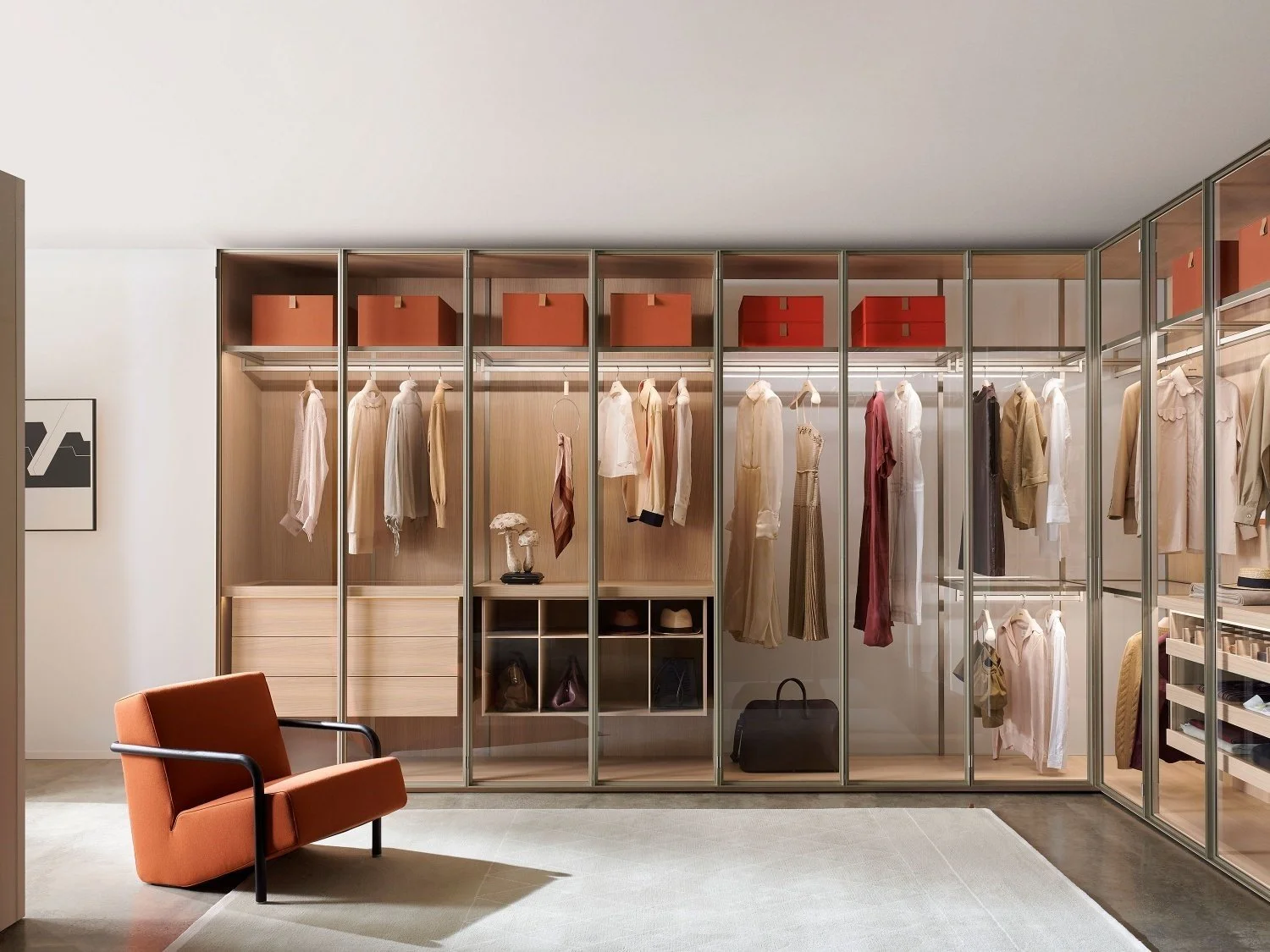
In the category of small walk-in closet design, constraint is not a limitation but a discipline. A reduced footprint asks more of architecture. Every millimeter must justify itself, and every surface must hold both function and composure.
Unlike expansive dressing rooms that rely on scale for impact, the small walk-in succeeds through calibration, proportion that replaces abundance, and detail that replaces spectacle.
The walk-in closet, at its best, is not auxiliary space. It is a private interior within the interior, a room devoted to ritual and order. When compact, it becomes even more intimate. The task, then, is not to fill it, but to refine it.
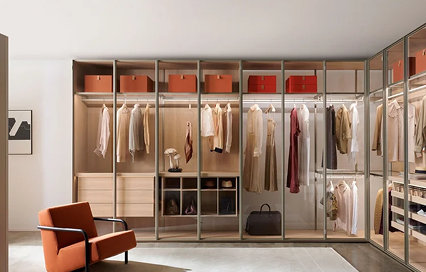
DRESSING ROOM
A modular system that emphasizes continuity and openness. This design creates luxurious spaces that are both functional and visually striking, perfect for showcasing your wardrobe while maximizing accessibility.
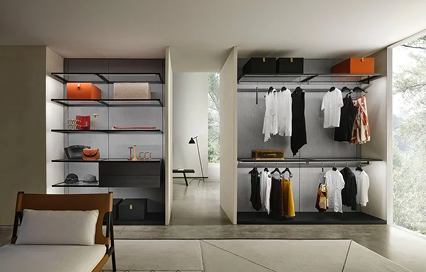
BOISERIE
A wall-mounted panel system blending elegance and minimalism. With no side panels, it offers a clean, uninterrupted surface that integrates seamlessly with other Porro solutions.
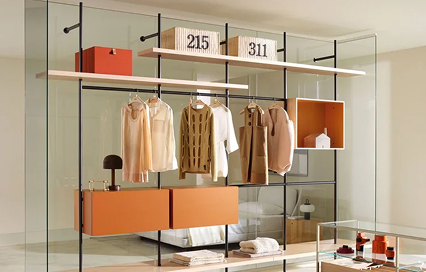
BOUTIQUE MAST
A dynamic, freestanding design that pairs vertical uprights with elegant shelves and accessories. Ideal for displaying clothing and accessories like an upscale boutique.
The Architecture of Compression in Small Walk-In Closet Design
Small rooms magnify error. In a compact walk-in closet layout, a shelf placed a fraction too low or a drawer bank too deep will compress circulation to discomfort. The geometry must be exact.
Begin with movement. A walk-in closet, however modest, implies passage. Clearances should allow the body to turn without hesitation. Thirty-six inches is often cited as standard circulation width, yet in compact closets, a more nuanced approach is required. Strategic recessing of cabinetry, alternating depths between hanging and shelving sections, and floating elements that allow glimpses of the floor can subtly release pressure.
The vertical plane becomes primary. Full-height millwork draws the eye upward, elongating the room. But height must not translate into visual heaviness. Integrated finger pulls, recessed plinths, and shadow gaps introduce rhythm and relief. Italian wardrobe systems, such as those developed by Porro, have long mastered this vertical elegance. Their modular logic allows for precision within constraints, balancing storage density with architectural clarity.
Compression, when resolved properly, creates focus. The room feels deliberate rather than diminished.
Bespoke Millwork as Spatial Strategy
True luxury in storage is not excess but exactitude. Bespoke millwork recalibrates the small walk-in closet design from a utilitarian container to an architectural intervention.
Custom cabinetry allows depths to vary according to garment type. A section dedicated to tailored jackets demands different proportions than one intended for evening gowns. Drawer heights should respond to objects, not arbitrary standards. Shallow trays for watches or jewelry, lined in suede or saddle leather, create a tactile pause within the larger composition.
Material continuity is essential in compact spaces. A single timber species carried across panels, shelving, and drawer fronts establishes calm. Rift-sawn oak, walnut with a matte oil finish, or lacquered surfaces in muted mineral tones prevent visual fragmentation. The temptation to introduce multiple finishes in a small footprint often results in noise.
Bespoke does not imply ornate. In fact, restraint is the greater discipline. A closet conceived as part of the broader interior architecture will echo the home’s material language, whether that is honed limestone flooring, brushed brass hardware, or patinated steel accents. The closet becomes an extension of the architectural narrative, not an afterthought.
For those considering comprehensive closet designing, the emphasis should always be on integration rather than insertion. The millwork should feel as though it was conceived with the walls, not installed against them.
Concealment and Display as a Delicate Balance
One of the most overlooked dimensions of small walk-in closet design is the choreography between what is hidden and what is revealed.
Open shelving provides immediacy but can quickly overwhelm a compact room. Glass-fronted cabinets in smoked or fluted glass offer mediation. They suggest content without broadcasting it. The play between opacity and translucence introduces depth, especially when subtle interior lighting is employed.
Selective display is more powerful than total exposure. A single open niche dedicated to a rotating selection of shoes or handbags can serve as a curated moment within an otherwise disciplined envelope. The principle mirrors gallery practice. Negative space around the object grants it significance.
Concealment also has psychological weight. Drawers that close flush, doors that align seamlessly, and mechanisms that operate without sound contribute to a sense of order that extends beyond the visual. In a small room, this quiet precision is felt immediately.
Light as an Instrument of Expansion
Light, when treated as a medium instead of a utility, can recalibrate the perceived dimensions of a room. In a small closet design, it is the primary amplifier.
Layered lighting is critical. Ambient light at a warm, calibrated temperature prevents the space from feeling clinical. Integrated linear LEDs recessed within shelving introduce shadow lines that define edges. Vertical illumination along panel joints can elongate the walls.
Wall-mounted fixtures, when thoughtfully placed, serve both sculptural and functional roles. Discreet wall lighting can wash surfaces gently, revealing the grain of wood or the subtle texture of lacquer. The objective is not brightness but depth.
Consider also the color rendering index of the light source. Garments must be seen accurately. A high CRI ensures that navy reads as navy, not charcoal. Such technical considerations are rarely discussed in mainstream commentary, yet they determine daily experience.
Motion sensors, calibrated to respond softly, allow the room to illuminate upon entry without abruptness. In a compact environment, the transition from shadow to light should feel measured.
Mirrors and the Architecture of Reflection
Mirrors are proposed as a simple solution to small spaces. In truth, their placement requires discipline.
In a small walk-in closet design, a mirror should not merely reflect; it should extend. A full-height panel positioned at the end of a narrow run can visually double the depth of the room. When integrated flush within millwork, it reads as architecture and not an accessory.
Antique or lightly tinted mirrors introduce warmth and temper glare. In contrast, overly clear mirrors can produce a clinical effect, particularly when combined with bright lighting. The tone of reflection matters.
Where possible, mirrored panels concealed within doors offer flexibility. They preserve the integrity of the material envelope while providing function when required. For projects incorporating bespoke mirrors, the frame detail and edge treatment should align with the broader hardware language of the closet.
Reflection, used judiciously, becomes a spatial strategy rather than a decorative device.
Hardware as Tactile Interface
In a small room, the hand is constantly in contact with surfaces. Hardware becomes a daily point of exchange between body and architecture.
Brushed brass pulls, patinated bronze knobs, or leather-wrapped handles offer texture at arm’s length. The temperature of metal against the skin, the weight of a drawer as it glides, and the quiet closure of a hinge all contribute to the perception of quality.
Soft-close mechanisms are not indulgences but expectations. Drawer interiors lined in felt or leather dampen sound and protect contents. Such details are not visible at first glance, yet they define the experience of use.
The scale of the hardware must correspond to the scale of the room. Oversized pulls in a compact closet disrupt proportion. Understated, elongated handles reinforce verticality and elegance.
Acoustics, Scent, and the Intimate Atmosphere
A small walk-in closet is an enclosed environment. Its atmosphere extends beyond sight.
Textile-lined panels, upholstered drawer inserts, and even area rugs with low pile can soften acoustics, preventing echo within tight walls. The absence of reverberation contributes to a sense of calm.
Ventilation must be discreet yet effective. Fine materials and garments require stable conditions. Integrated systems that maintain airflow without visible grilles preserve the integrity of the design.
Scent, though intangible, shapes memory. Cedar-lined compartments or subtle diffusers placed within concealed niches create a sensory signature unique to the space. In a compact room, such nuances are intensified.
A Room of Private Measure
Ultimately, a small walk-in closet is not judged by its square footage but by its coherence. When proportion, material, light, and detail align, the room transcends its size.
The success of small walk-in closet design lies in its refusal to compensate with excess. Instead, it refines, calibrates, and understands that intimacy, when shaped with precision, carries a quiet authority.
In the end, a small walk-in closet is less about refining storage than about composing space at its most personal scale. When approached as architecture more than cabinetry, even the most compact dressing room can hold a sense of deliberateness that extends far beyond its walls.
FAQs
1. What is the ideal minimum size for a small walk-in closet design to feel comfortable, not cramped?
While walk-in closets can begin at approximately 4 by 6 feet, comfort depends less on raw dimensions and more on circulation planning. Alternating storage depths, maintaining at least 30 to 36 inches of clear passage, and avoiding opposing full-depth cabinets are critical to preserving ease of movement.
2. How can lighting temperature affect garment perception in a small walk-in closet?
Lighting with a high color rendering index above 90 ensures accurate color perception. Warm light around 2700K to 3000K creates a softer atmosphere, while still allowing fabrics to read correctly. Poor lighting temperature can distort tones, particularly in navy, black, and neutral garments.
3. Are glass-front cabinets practical in a small walk-in closet design?
When executed in smoked or fluted glass, they provide visual depth without full exposure. They reduce visual clutter compared to open shelving while maintaining a sense of lightness. Clear glass, however, requires disciplined organization to avoid visual density.
4. What materials are best suited for humid climates in bespoke closets?
Stable engineered substrates with high-quality veneer finishes perform well in fluctuating humidity. Solid timber elements should be properly sealed. Integrated ventilation and consistent climate control are equally important to preserve both cabinetry and garments.
5. How do mirrors influence spatial perception in narrow walk-in closets?
Mirrors positioned at the end of a circulation path can visually extend depth. Flush integration within millwork prevents visual fragmentation. Tinted or antique finishes temper glare and introduce warmth, contributing to a more cohesive spatial experience.
