
Mid-Century Modern Interiors: Iconic Design Meets Modern Luxury
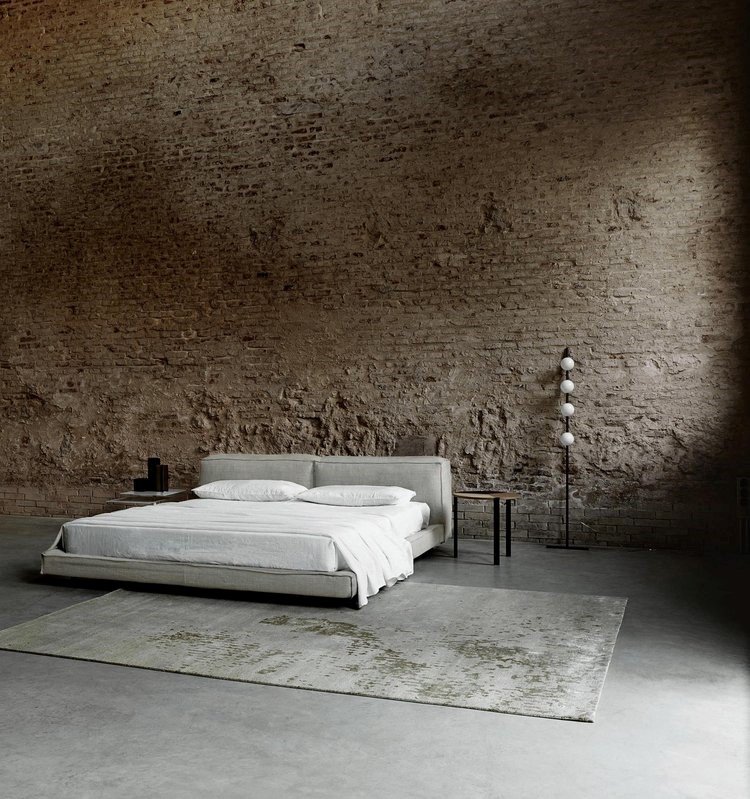
Mid-century modern interior design endures not as nostalgia but as a discipline. Born in the postwar decades between the 1940s and 1960s, it proposed a radical clarity: structure expressed honestly, materials used with integrity, and ornament reduced to line and proportion.
What distinguishes it today is not its recognizable silhouettes but its philosophical restraint. In contemporary homes, the language of mid-century modern interior style continues to evolve, absorbing new technologies and refined craftsmanship without surrendering its original rigor.
To engage with this tradition is not to recreate a period room. It is to understand why the proportions work, why the materials endure, and why certain objects still feel inevitable in space.
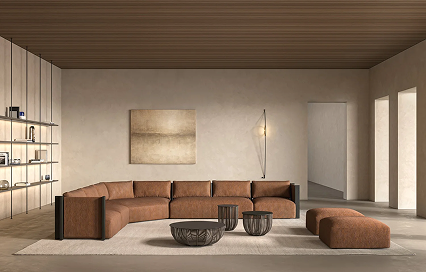
ARKADIUS
Modular seating system with architectural wooden backrests and armrests, pairing structured vertical slats with soft upholstered cushions.
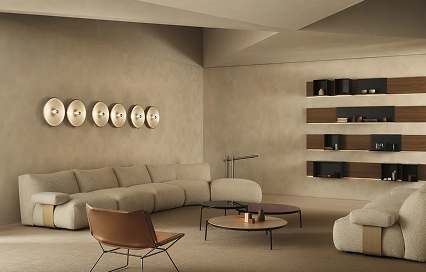
GOOM
A modular system comprising single units, corner units, chaise longue and poufs, with the option of adding one or more armrests.
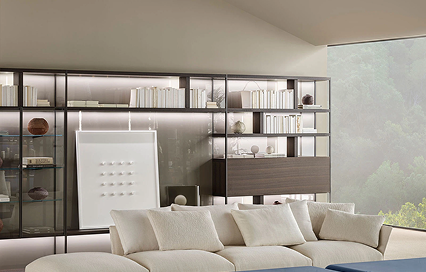
TOBU
Linear three- and four-seater configurations, as well as closed or open corner versions with armless central or end modules. complemented by a square armchair with one or two backrests.
The Architectural Logic Beneath the Aesthetic
At its core, mid-century modern interior design is architectural before it is decorative. The movement emerged in dialogue with modernist principles shaped by the Bauhaus and later interpreted through American and Scandinavian contexts. Open plans replaced compartmentalized rooms, glass expanded the wall, and the boundary between interior and exterior softened.
In Los Angeles, particularly, the Case Study Houses demonstrated how steel frames, post-and-beam construction, and expansive glazing could create continuity between landscape and living space. Interiors were not filled but composed; furniture floated, built-ins replaced excess cabinetry, and circulation was intentional.
When translated into contemporary residences, this architectural clarity remains essential. A low horizontal credenza only resonates if ceiling heights and sightlines are considered. A sculptural lounge chair achieves presence when granted negative space around it. Without attention to architectural proportion, references to the mid-century risk becoming surface gestures.
Material Honesty and the Warmth of Structure
Materiality is where a mid-century modern interior layout diverges from later minimalist interpretations. It does not seek sterility. It seeks truth.
Walnut, teak, and rosewood were favored not for rarity, but for grain. Their warmth offset the cool precision of steel and glass. Brick hearths, terrazzo floors, and exposed beams anchored interiors in tectonic expression. The structure was visible, and the joint mattered.
Today, this ethos can be reinterpreted with equal integrity. Rift-sawn oak cabinetry, honed basalt floors, and brushed brass hardware echo the original commitment to honest materials while meeting contemporary expectations of performance. Italian manufacturers such as Living Divani and Porro have extended this lineage, refining modular systems that maintain clean lines while introducing subtle technical sophistication.
The question is not whether to replicate a 1955 living room, but how to inhabit the principles of that era using the best materials available now.
Furniture as Sculpture and System
The enduring icons of mid-century modern interior design are reduced to a catalog of names: Eames, Saarinen, Noguchi, and Jacobsen. Yet what binds these designers is not style, but inquiry.
Charles and Ray Eames explored molded plywood as both a structural and expressive medium. Eero Saarinen eliminated the “slum of legs” beneath tables through singular pedestal forms. Isamu Noguchi blurred the boundary between art and furniture, treating the coffee table as a biomorphic sculpture.
In contemporary interiors, these pieces remain relevant not because they are recognizable but because they negotiate space with intelligence. A Saarinen table clarifies circulation. An Eames lounge chair introduces ergonomic generosity without visual heaviness.
To integrate such works today requires restraint. One iconic piece placed with intention carries more authority than a room crowded with references. Mid-century modern interiors are successful when objects are allowed to breathe.
Light as a Modernist Medium
Modernism understood light as material. Large panes of glass, clerestory windows, and open plans were not stylistic decisions, but spatial strategies.
Artificial lighting followed suit. Fixtures were reduced to essential geometries. Globe pendants, linear sconces, and sculptural floor lamps created atmospheres without excess ornament.
In contemporary interpretations, thoughtful wall lighting can echo this lineage. A discreet sconce that washes a textured wall reinforces architectural rhythm. A pendant suspended over a dining table should read as form and illumination simultaneously.
Light temperature matters. Warmer tones preserve the warmth of wood. Excessively cool light fractures the harmony between material and structure. When calibrated carefully, illumination enhances rather than competes with the architecture.
Storage and the Integration of Function
One of the least discussed strengths of mid-century modern interior design is its approach to storage. Built-ins were not secondary. They were integral to the architecture.
Low-profile cabinets extended along walls, visually elongating rooms. Floating shelving maintained lightness. Hardware was minimal, often recessed or integrated. The aim was visual continuity.
In present-day homes, this philosophy can extend to more specialized spaces. Thoughtful closet designing that adopts mid-century principles will favor flat-panel doors, consistent wood veneers, and concealed pulls. Storage should align with the architectural grid of the room.
The result is not just tidiness, but coherence. When storage reads as architecture, the room retains its clarity.
Color as Counterpoint to Restraint
While often associated with neutral palettes, mid-century modern interior design embraced color with precision. Mustard, olive, burnt orange, and deep teal appeared not as decoration but as a counterpoint to wood and concrete.
In contemporary settings, color can be reintroduced through upholstery, art, or a single lacquered surface. The restraint of the envelope allows for moments of saturation. A velvet sofa in moss green, placed within a room of walnut and plaster, resonates without overwhelming.
The discipline lies in limitation. Too many competing hues erode the calm geometry that defines the style.
Craft Reconsidered for Contemporary Living
The mid-century era celebrated industrial production, yet it did so with respect for craft. Molded plywood required experimentation, metal fabrication demanded precision, and textiles were woven with intent.
Today, advanced fabrication techniques allow for even finer tolerances. Seamless joinery, concealed hinges, and integrated technology can coexist with mid-century principles if handled discreetly. Hidden charging stations within a credenza or integrated speakers within millwork should not disrupt the visual language.
Your home need not become a museum of period pieces. Instead, it can embody the clarity of mid-century thinking while accommodating contemporary life.
The Dialogue Between Past and Present in Mid-Century Modern Interior Design
The most compelling interiors do not replicate history. They engage it.
Mid-century modern interior layout provides a framework grounded in proportion, material honesty, and structural expression. Within that framework, contemporary luxury can emerge through precision detailing, refined finishes, and curated restraint.
Italian Rationalism, with its emphasis on geometry and order, offers a parallel lineage that complements mid-century principles. When these traditions intersect, interiors achieve both warmth and discipline.
To live within such a space is to inhabit a philosophy. Lines are clean, but not severe. Materials are rich, but not ostentatious. Objects are present, but never excessive.
In its most considered form, mid-century modern interior design is less about era and more about ethos. It invites you to edit, to select, and to place with intention. It reminds us that luxury is not accumulation but calibration.
As contemporary homes continue to evolve, mid-century interior design remains a touchstone. Not because it is fashionable, but because its logic endures. When interpreted with care, it offers interiors that feel both grounded in history and fully aligned with the present moment.
FAQs
1. What defines an authentic mid-century modern interior layout versus retro imitation?
Authenticity lies in proportion, material honesty, and architectural integration. Retro imitation focuses on surface motifs without respecting spatial logic or structural clarity.
2. Can a mid-century modern interior layout work in new construction homes?
Yes, if the architecture supports open plans, clean sightlines, and integrated storage. Applying mid-century furniture to compartmentalized layouts often feels disconnected.
3. What wood species are most appropriate for mid-century modern interiors?
Walnut and teak remain historically accurate, but rift-sawn oak and stained ash can achieve similar warmth when detailed with restraint.
4. How do you introduce technology without disrupting mid-century aesthetics?
Integrate it discreetly within millwork or architectural elements. Concealed wiring, flush-mounted controls, and hidden speakers preserve visual clarity.
5. Is a mid-century modern interior design suitable for small spaces?
Yes. Its emphasis on floating furniture, built-ins, and clean lines can enhance perceived openness when proportion and circulation are carefully considered.
