
Modern Minimalist Bedrooms: Sleek, Luxurious Spaces That Inspire Calm
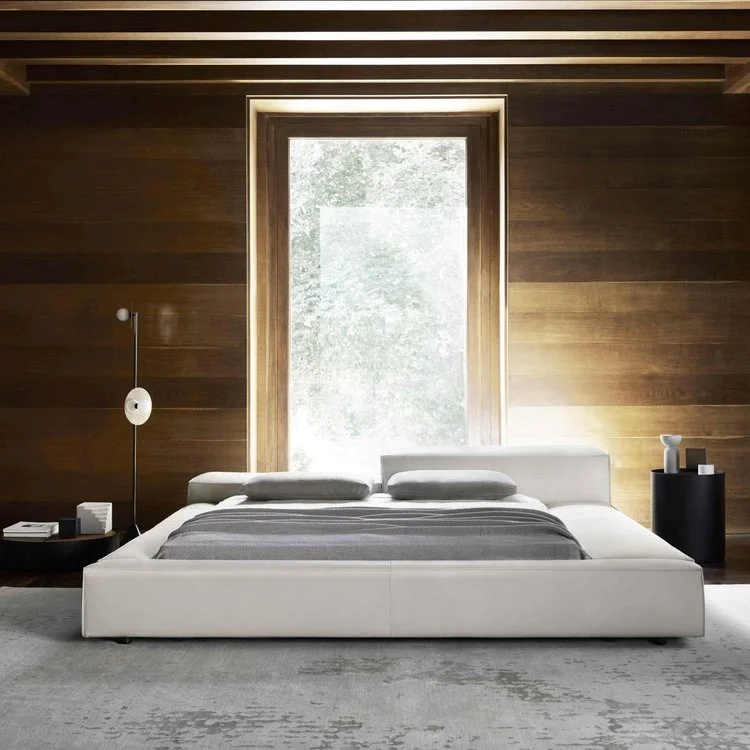
The bedroom is the most private interior. It demands a different register of design than public-facing rooms. Where living spaces perform hospitality and dining rooms stage gathering, the bedroom exists for withdrawal.
Modern minimalist bedroom ideas, at their most effective, acknowledge this distinction. They do not pursue simplicity as an aesthetic posture but as an atmospheric necessity. Reduction becomes a tool for psychological decompression. What is removed matters as much as what remains.
Minimalism, when properly calibrated, is not about deprivation. It is about precision. In the bedroom, where the body seeks restoration, every surface, texture, and light source contributes to either ease or agitation. The task is to compose an environment so coherent that it recedes, allowing rest to occupy the foreground.
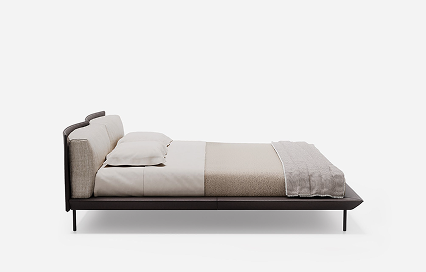
GREENE
Upholstered bed with padded steel-frame headboard, removable goose down cushions, and a two-part bed base with powder-coated steel feet.
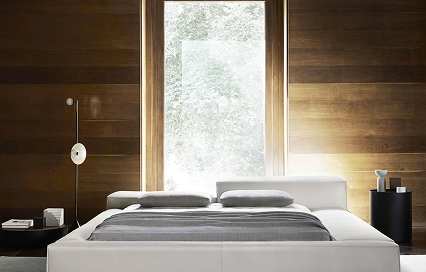
EXTRASOFT
Modular bed comprised of different size elements with fully removable fabric or leather covers and exposed seams.
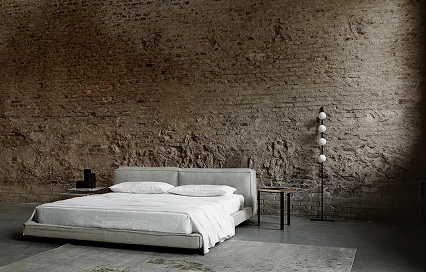
NEOWALL
Bed comprised of soft elements with fully removable fabric or leather covers.
Material Reduction and Sensory Depth
A common misconception about minimalist interiors is that they lack warmth. In truth, poorly executed minimalism is cold. Thoughtful minimalism, grounded in material depth, achieves warmth through texture rather than ornament.
The palette in modern minimalist bedroom ideas typically centers on neutral tones: whites, soft grays, warm taupes, and natural wood finishes. But within this narrow chromatic range lies significant tactile variation. Linen bed coverings, wool area rugs, honed limestone flooring, and oiled walnut furniture all register as neutral yet offer distinct sensory experiences.
The bedroom is a room of proximity. Materials are encountered at arm's length, beneath bare feet, against skin. Their tactile qualities matter profoundly. A headboard upholstered in Belgian linen feels different from one wrapped in Italian wool bouclé, even if both read as off-white from across the room. The hand perceives what the eye does not.
Stone, when introduced, should be matte, not polished. Travertine, honed marble, or basalt tiles contribute mass and coolness without glare. Timber, whether in flooring, wall cladding, or furniture, should display grain openly. Bleached oak, rift-sawn walnut, or whitewashed ash bring organic irregularity into otherwise controlled compositions.
Metal accents in brushed brass, blackened steel, or satin nickel provide visual punctuation without decorative excess. A slender brass picture light above a single artwork or blackened steel drawer pulls on a credenza introduces definition while maintaining restraint.
The principle is sensory richness within formal simplicity.
The Platform Bed as Sculptural Anchor
In modern minimalist bedroom ideas, the bed itself becomes the room's primary mass. Without surrounding furniture to diffuse attention, the bed must carry both functional and formal weight.
Platform beds, with their low profiles and absent bed frames, align closely with minimalist principles. They sit close to the floor, lowering the room's visual center of gravity and creating a sense of groundedness. The horizontal emphasis complements the broader spatial logic of the minimalist bedroom.
Upholstered platform beds in neutral textiles offer softness without fuss. A linen-wrapped frame in pale gray or sand introduces texture while maintaining visual calm. Leather, when used, should be full-grain and allowed to patina. The expectation is longevity and graceful aging, not pristine permanence.
Timber platform beds, particularly those with visible joinery and oil finishes, bring warmth and materiality. Japanese-influenced designs, with low plinths and minimal ornamentation, echo centuries-old spatial philosophies that prioritize restraint and proportion.
The bed's placement also matters. Centering it on the primary wall, often opposite the entry, establishes symmetry and anchors the room. Flanking elements, whether matching nightstands or asymmetrical compositions, should maintain balance without rigidity.
Nightstands as Functional Sculpture
Nightstands in minimalist bedrooms are not afterthoughts. They are functional sculptures that mediate between the bed and the room's perimeter.
The scale must be proportionate. Overly large nightstands overwhelm, and undersized pieces appear tentative. The height should align roughly with the mattress top, allowing access without awkward reach.
Floating nightstands, cantilevered from the wall, preserve floor space and enhance the room's sense of lightness. They create shadow gaps that introduce visual rhythm. Integrated drawer systems concealed within flush panels maintain clean surfaces while providing necessary storage.
Solid timber nightstands with visible grain, single-drawer credenzas in walnut or oak, or minimalist metal frames supporting stone or glass tops all align with minimalist logic. The unifying principle is restraint in form and honesty in material.
Surfaces should remain largely clear. A single lamp, a book, perhaps a carafe of water. The nightstand is not a staging area but a functional pause. Clutter here negates the room's broader compositional discipline.
Wardrobes and Storage as Architectural Envelope
Visible storage disrupts minimalist bedrooms. Clothing, personal items, and daily necessities must be accommodated, yet their presence should not dominate.
Built-in wardrobes, floor-to-ceiling and flush with walls, dissolve into the architecture. When finished in the same material as surrounding walls, whether plaster, timber paneling, or lacquered surfaces, they become invisible. Door hardware should be recessed or minimal. Push-to-open mechanisms eliminate visible pulls entirely.
Walk-in closets, when space allows, remove storage from the bedroom altogether. This separation preserves the bedroom's psychological function as a space of rest rather than preparation. The ritual of dressing occurs elsewhere, leaving the sleeping chamber undisturbed.
For smaller footprints, freestanding wardrobes in minimal forms, such as those by Porro or Living Divani, offer storage without visual weight. Clean-lined credenzas, low-profile dressers, and wall-mounted cabinets provide function while maintaining formal discipline.
Mirrors, integrated within wardrobe doors, serve dual purposes. They provide utility while visually expanding the room. When paired with minimal frames or frameless installations, they read as architectural rather than decorative.
Lighting as Atmospheric Calibration in Modern Minimalist Bedroom Ideas
Light shapes the minimalist bedroom more profoundly than almost any other element. Its quality, direction, and intensity determine whether a space feels serene or sterile.
Natural light, when available, should be honored but controlled. Floor-to-ceiling windows flood rooms with daylight but require layered window treatments for privacy and light modulation. Sheer linen curtains diffuse brightness without blocking it entirely. Blackout panels, concealed within ceiling pockets, allow complete darkness when needed.
Artificial lighting must be layered. Ambient light establishes baseline warmth. In minimalist bedrooms, this comes from concealed sources: cove lighting, recessed ceiling fixtures, or integrated LED strips within millwork. The goal is soft, even illumination without visible glare.
Task lighting addresses specific needs. Adjustable reading lamps mounted to walls or cantilevered from headboards provide directed light without occupying nightstand surfaces. Their forms should be sculptural yet restrained. Matte black, brushed brass, or powder-coated white finishes maintain material coherence.
Accent lighting, though subtle, adds dimension. A single picture light above artwork or a low-level floor wash along a feature wall introduces shadow play without complexity. Ceiling lighting, when present, should be diffused through alabaster, frosted glass, or fabric shades to prevent harshness.
Dimmers are essential. The bedroom must accommodate morning brightness, evening transition, and nocturnal dimness. Lighting scenes calibrated to the time of day allow atmospheric shifts without manual adjustment.
The Bedding as Textile Landscape
In modern minimalist bedroom ideas, where furniture and objects are restrained, bedding assumes greater visual and tactile significance.
Linen, with its irregular texture and matte finish, is the material most aligned with minimalist sensibility. It softens with washing, resists pilling, and regulates temperature. Belgian and Italian linens, stone-washed or enzyme-treated, achieve a remarkable hand feel.
Percale cotton, crisp and cool, offers an alternative. Its smooth surface contrasts with rougher textures elsewhere in the room. Thread count, usually fetishized in marketing, matters less than weave quality and fiber length.
Wool blankets, cashmere throws, and quilted coverlets in neutral tones add layering without pattern. The strategy is textural depth within chromatic restraint.
Pillow arrangements should avoid excess. Two sleeping pillows and perhaps a single European square suffice. Decorative pillow towers disrupt the bed's clean geometry and serve no functional purpose.
Bedding should be monochromatic or subtly tonal. White-on-white, gray-on-gray, or cream-on-sand maintain visual calm while allowing textile variation to register tactilely.
Technology and Its Concealment
Modern bedrooms accommodate technology, yet its visibility conflicts with minimalist principles. The challenge is integration without visual intrusion.
Televisions, when desired, should be concealed within millwork or housed in lift mechanisms that retract them when not in use. Wall-mounted screens, though common, introduce black rectangles that dominate walls. Framed displays that mimic artwork when inactive offer a compromise.
Charging stations, increasingly necessary, should be integrated within nightstands or headboards. Surface clutter from cables and devices undermines compositional discipline. Wireless charging pads embedded into furniture eliminate visible cords.
Climate control, sound systems, and motorized blinds should be operable through concealed panels or integrated home systems. The fewer visible switches and controls, the cleaner the visual field.
Technology serves the inhabitant but should not dictate the room's formal language.
Bringing Modern Minimalist Bedroom Ideas into Practice
The minimalist bedroom is not a style applied but a discipline practiced. It requires ongoing curation, an editing process that continues beyond initial installation.
Objects accumulate, and surfaces collect. The minimalist bedroom demands periodic reassessment. What no longer serves, functionally or formally, should be removed. The room should breathe, not suffocate beneath accumulation.
This is not austerity but clarity. The bedroom, more than any other room, benefits from spatial and visual quietness. When modern minimalist bedroom ideas are executed with material depth, acoustic consideration, and lighting precision, the result is not coldness but profound calm.
The success of such a space is measured not in what it contains but in what it allows: rest, withdrawal, and psychological restoration. In a culture that demands constant engagement, the minimalist bedroom offers something increasingly rare: permission to recede.
FAQs
1. How can a minimalist bedroom feel warm without introducing decorative elements?
Warmth emerges through material selection rather than ornamentation. Linen, wool, natural wood with visible grain, and matte stone all introduce tactile richness within a minimal formal vocabulary.
2. Are minimalist bedrooms practical for storing clothing and personal items?
Built-in wardrobes flush with walls, concealed storage within platform beds, and integrated millwork systems allow substantial storage capacity without visual presence. The key is architectural integration rather than freestanding furniture.
3. What is the ideal lighting temperature for a minimalist bedroom?
Warm white light between 2700K and 3000K creates a restful ambiance without yellowish distortion. Dimmable systems allow adjustment from morning clarity to evening softness.
4. Can modern minimalist bedroom ideas accommodate children or shared sleeping arrangements?
Minimalism is spatial philosophy, not lifestyle exclusion. Shared bedrooms benefit from the same principles: restrained palettes, functional clarity, and integrated storage prevent visual chaos even with multiple occupants.
5. How often should a minimalist bedroom be reassessed to maintain its composition?
Seasonal curation prevents accumulation. Quarterly assessments allow the removal of items that no longer serve. Minimalism is not a static achievement but an ongoing practice of editing.
