
Walk-In Closet Designs That Combine Functionality with Luxury
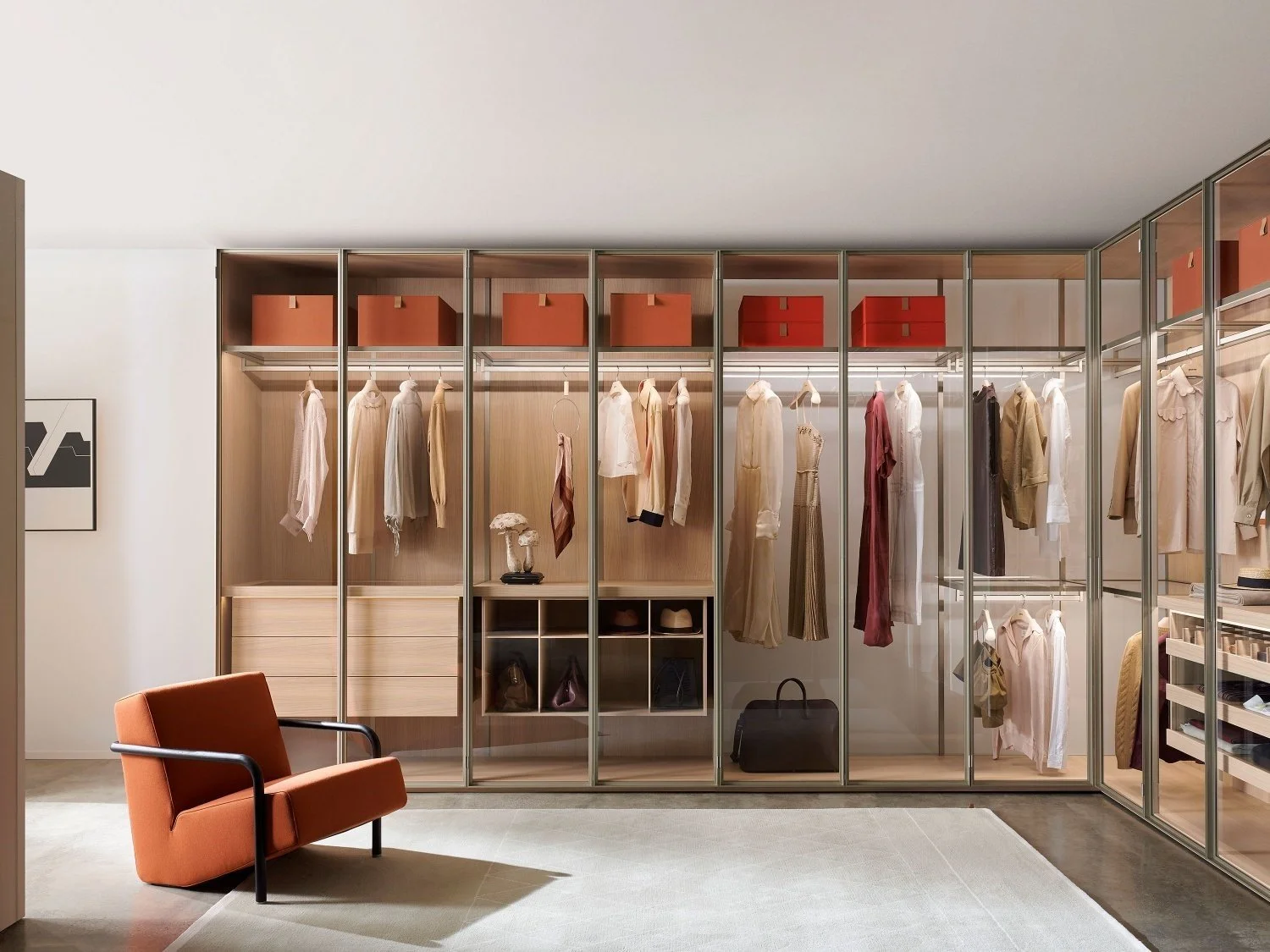
There comes a point in the design of a serious home when the wardrobe requires more than a larger cabinet or another chest of drawers. It calls for a room of its own, dedicated entirely to dressing.
In a well-organized walk-in closet, clothing, accessories, and personal pieces are arranged with clarity and intention. At its best, walk-in closet design goes beyond storage. It transforms the daily act of dressing into a calm, deliberate ritual, supported by thoughtful proportions, refined materials, and lighting that enhances both function and atmosphere.
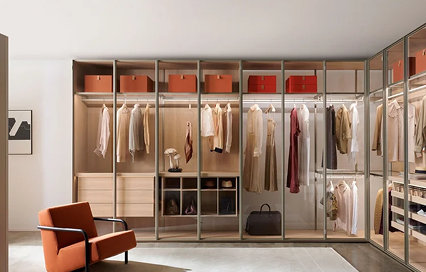
DRESSING ROOM
A modular system that emphasizes continuity and openness. This design creates luxurious spaces that are both functional and visually striking, perfect for showcasing your wardrobe while maximizing accessibility.
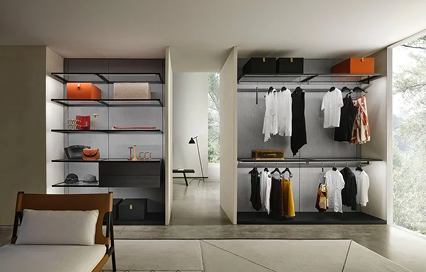
BOISERIE
A wall-mounted panel system blending elegance and minimalism. With no side panels, it offers a clean, uninterrupted surface that integrates seamlessly with other Porro solutions.
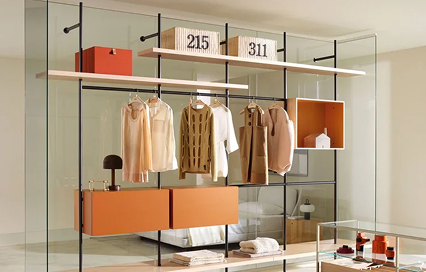
BOUTIQUE MAST
A dynamic, freestanding design that pairs vertical uprights with elegant shelves and accessories. Ideal for displaying clothing and accessories like an upscale boutique.
The Closet as a Room
The shift from wardrobe as furniture to wardrobe as room changes the design parameters entirely. A walk-in closet is not simply an enlarged cupboard. It is an architectural space that benefits from proportion, lighting, material consistency, and thoughtful spatial planning.
When poorly executed, even a generously sized dressing room can feel cramped and utilitarian. When properly designed, it becomes an extension of the bedroom, equal in refinement.
Proportion is the first discipline. Circulation width determines comfort. In a double-sided configuration, a clear internal width of approximately 2.2 to 2.4 meters is typically considered the minimum for ease of movement. This dimension allows cabinetry depths of 550 to 600 millimeters on each side while preserving a comfortable central passage.
If the space falls below these dimensions, careful recalibration of cabinet depth or layout becomes essential. Precision systems such as Porro’s wardrobe solutions, specified through Graye’s closet design and installation service, are designed with these spatial relationships in mind, ensuring balance between storage capacity and comfort.
Layout Typologies and Their Implications
Walk-in closet design generally resolves into several established layout typologies. Each affects not only storage efficiency but also how the room feels to inhabit.
The parallel layout consists of two opposing walls of cabinetry with a central passage. It is the most storage-efficient arrangement and well-suited to purpose-built dressing rooms. By distributing long hanging, short hanging, shelving, and drawers across extended wall lengths, it reduces unnecessary movement during dressing.
The L-shaped layout works particularly well in rooms with windows, angled walls, or awkward geometries. By concentrating storage on two adjacent walls, the remaining space can accommodate a central island or seating element. This configuration usually feels more like a dressing room than a storage corridor.
The U-shaped layout wraps three walls with cabinetry, enhancing storage density. It is highly effective in dedicated closet rooms with a single point of entry. The risk lies in visual heaviness, which can be mitigated through consistent finishes and disciplined internal organization.
In larger dressing rooms, a central island introduces additional functionality. Typically between 800 and 1000 millimeters deep, islands are suitable for accessory drawers, watch trays, jewelry compartments, or folded garments. Glass-topped drawers allow contents to remain visible while protected.
Internal Fittings and the Logic of Organization
A successful walk-in closet reflects the way you actually dress, not how you imagine you might.
Full-length hanging sections for coats, dresses, and suits require approximately 1.7 to 1.9 meters of clear internal height. Short hanging sections for jackets and shirts typically require 900 to 1100 millimeters. Double hanging can dramatically increase capacity if the ceiling height permits.
Drawer configuration is equally important. Knitwear benefits from deeper drawers of 200 to 250 millimeters, while accessories are better suited to shallow drawers of 80 to 120 millimeters.
Felt-lined trays for jewelry and watches prevent abrasion. Integrated shoe racks should allow adequate vertical spacing, typically 180 to 220 millimeters for most footwear.
Ventilation should not be overlooked. Fully enclosed cabinetry benefits from discreet airflow gaps or breathable backing panels to prevent humidity buildup, particularly in tightly insulated modern homes.
Lighting Inside the Walk-In Closet Design
Lighting is one of the most critical technical elements of walk-in closet design. The purpose of a dressing room is to present clothing accurately, which requires light that approximates natural daylight.
A color temperature spanning from 3000K to 4000K provides clarity without appearing overly cool. A Color Rendering Index (RI) of 90 or above ensures that fabric tones appear true rather than distorted.
Integrated LED strips positioned vertically along cabinet frames minimize shadowing. High-density diffused strips prevent the visible spotting effect caused by exposed diodes. Motion sensors add convenience while reducing energy consumption.
Decorative lighting can also contribute to the atmosphere. In larger dressing rooms, a pendant positioned centrally above the circulation space introduces softness and visual completeness. The fixture should be scaled proportionally and selected to complement the wider bedroom suite.
Mirrors, Joinery, and Finish Detail
Mirrors serve both practical and spatial functions. A full-height mirror mounted on a wall or integrated into a door visually extends the depth of the room. In narrower layouts, this can significantly enhance perceived width.
Joinery quality becomes particularly apparent in a walk-in closet design because it is experienced at close range every day. The precision of door alignment, the smooth extension of drawers, and the consistency of lacquer or veneer finishes all reveal manufacturing standards.
Shelf edges should be refined and durable. Soft close mechanisms should operate silently and consistently, and gap tolerances between doors should remain uniform across the entire installation. These are subtle indicators of quality that define long-term satisfaction.
Material choices also affect longevity. Lacquered finishes provide a seamless appearance but require careful application to avoid inconsistencies. Veneers such as walnut or oak introduce warmth and can be grain-matched across panels for visual continuity.
The Walk-In Closet as Part of a Suite
The most accomplished interiors treat the bedroom, dressing room, and bathroom as a cohesive suite. The walk-in closet becomes a transitional space between rest and preparation.
Material continuity strengthens this sequence. Timber flooring from the bedroom may continue into the closet. Cabinetry tones can relate softly to bathroom joinery. Hardware finishes might echo tapware or lighting details.
This approach creates coherence rather than uniformity. Each room retains its identity while contributing to a larger spatial narrative. Through Graye’s broader residential design services, the walk-in closet is considered not as an isolated feature but as part of a complete architectural composition.
When executed with care, a walk-in closet becomes more than a storage solution. It becomes a daily experience of order, material refinement, and spatial calm.
FAQs
1. What is the minimum dimension required for a functional walk-in closet?
A practical minimum for a double-sided layout is about 2.2 meters in overall width. This allows standard cabinet depths and a comfortable central circulation zone.
2. What cabinet depth is recommended for hanging clothes?
A clear internal depth of 550 to 600 millimeters accommodates most garments without crushing sleeves or lapels. Sliding doors may require additional track space.
3. What lighting specification is best for accurate color matching?
LED lighting between 3000K and 4000K with a CRI above 90 ensures fabrics appear true to color. Even distribution prevents shadows on hanging garments.
4. Are glass-fronted cabinets practical in a walk-in closet design?
Yes, particularly for accessories and folded garments. Low-iron glass reduces green tinting, and integrated lighting enhances visibility while keeping dust out.
5. Should a walk-in closet have its own ventilation system?
In airtight homes, mechanical ventilation or passive airflow panels prevent humidity buildup, protecting delicate natural fibers like wool and silk from mold, odor retention, and long-term fabric deterioration.
