
High Quality Contract Outdoor Furniture for Commercial Luxury
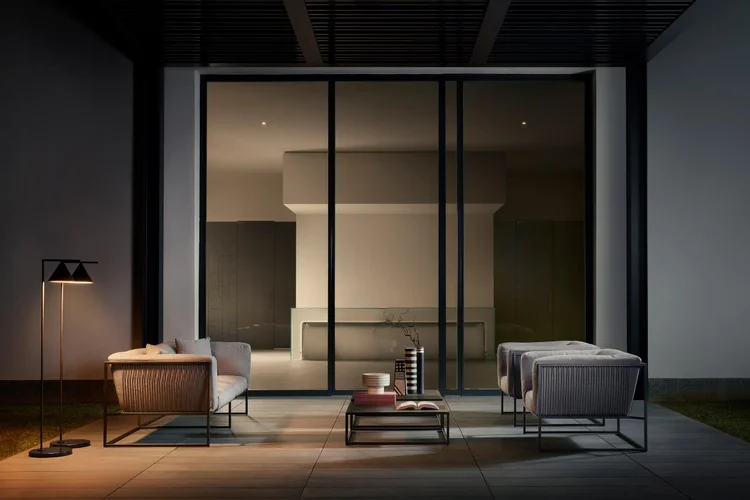
The outdoor spaces of hotels, restaurants, private clubs, and cultural institutions place demands on furniture that residential environments rarely approach.
Contract outdoor furniture must tolerate not only the physical conditions of exterior exposure but also the intensified use patterns of commercial settings: hundreds of seating contacts per day, the sustained mechanical stress of being moved and repositioned by staff and guests, and the visual scrutiny of guests who have chosen to spend time in a setting that promises quality. A single piece that reads poorly, ages badly, or fails structurally does not merely inconvenience a guest; it communicates something about the institution's standards.
For this reason, commercial outdoor furniture must be evaluated through multiple criteria simultaneously: structural integrity, weather resistance, maintenance requirements, ergonomic comfort, and visual coherence with the surrounding architecture. Materials such as powder-coated aluminum, treated teak, high-performance textiles, and marine-grade finishes are selected not only for appearance but for their ability to maintain performance over long periods of intensive use.
What Contract Specification Requires That Residential Selection Does Not
The distinction between a piece appropriate for residential outdoor use and one suitable for contract outdoor specification is primarily structural and material rather than formal. A piece that will receive daily use by twenty people requires a different standard of joint engineering than one that will be used by the same two or three people over a decade. The load cycles are different, the handling is less careful, and the margin for surface wear is narrower because the piece must read as new for longer.
Contract outdoor furniture also requires practical serviceability that residential pieces rarely need, such as seat pads and covers that can be removed easily and washed in commercial laundry equipment, frames that can be stacked or nested efficiently in storage, and finishes that can be retouched in the field without specialized equipment. These are constraints that serious contract-grade designers address at the specification stage rather than as afterthoughts.
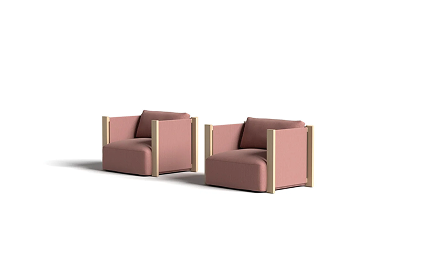
ARKADIUS
Lounge chair with architectural wooden backrests and armrests, pairing structured vertical slats with soft upholstered cushions.
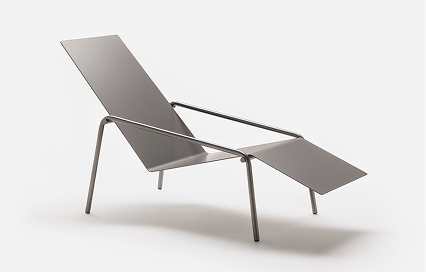
FILLET LOUNGE
Chaise longue with powder-coated stainless steel and aluminum frame, available with removable cushions and finishes suited for both indoor and outdoor use.
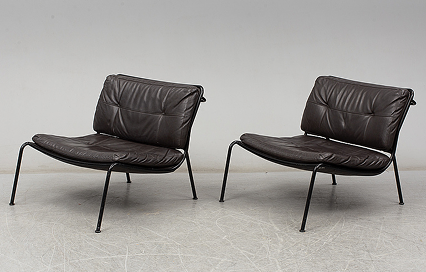
FROG
Lounge chair with removable leather or fabric covers
The Formal Quality That Hospitality Demands
The functional requirements of contract-based outdoor furniture do not eliminate the formal requirement. A hotel terrace or restaurant courtyard is a composed spatial experience as much as a functional environment, and the furniture that occupies it contributes to or detracts from that composition in every detail. A piece that tolerates heavy use but reads as institutional undermines the hospitality environment it is supposed to support.
Margherita Rui's Dolmen collection, inspired by biomorphism and habitation archetypes and available in various finishes and materials, represents the formal ambition that serious contract outdoor furniture must achieve. Its reference to the habitation archetype addresses the deepest spatial requirement of hospitality design: a furniture proposition that offers a sense of shelter and belonging rather than simply providing a surface to sit on.
Scale, Configuration, and the Hospitality Outdoor Environment
Commercial outdoor environments require furniture that can be configured and reconfigured to serve multiple spatial functions within the same physical space. A hotel terrace must accommodate intimate couples' seating, group dining, and large event configurations, often on the same day. This demands a modular vocabulary whose individual pieces are formally coherent in different configurations and whose handling characteristics allow rapid reconfiguration by service staff.
The Axy outdoor dining table by Claudio Bellini, as a metal dining table, offers the dimensional consistency and structural integrity required in contract settings where table layouts must be precisely managed for service efficiency. Metal construction ensures that the table's dimensions remain stable across temperature cycling, allowing predictable layout planning regardless of daily weather conditions.
Graye's Approach to Contract Outdoor Specification
Graye's hospitality and contract service approaches contract outdoor furniture specifications from a position of curatorial authority and practical experience. The pieces in the outdoor collection are selected not only for their design quality but also for their production standards and serviceability in commercial settings.
Graye works with architects, designers, and specifiers who require fast response times, accurate technical information, and professional follow-through on orders and delivery, providing the support infrastructure that meets contract outdoor specifications' demands. This includes coordination across timelines, material selections, custom requirements, and installation logistics, ensuring that outdoor environments perform consistently while maintaining the level of refinement expected in high-end hospitality and residential projects.
Contract Outdoor Furniture FAQs
-
Pieces intended for commercial use in public spaces should meet or exceed EN 581 (outdoor furniture stability and strength) standards, with supporting fire resistance certification for textile components where local codes require it.
-
Contract-grade pieces are engineered to specific structural standards for high-cycle commercial use, with supply chains and documentation that support procurement, insurance, and maintenance requirements. Standard commercial patio furniture typically lacks this level of specification support.
-
Some pieces in Graye's outdoor collection are suitable for hospitality use; the appropriate selection depends on the specific structural and serviceability requirements of the project. Graye's contract team advises on suitability for specific commercial contexts.
-
Well-specified contract outdoor furniture in a premium hospitality setting typically has a service life of eight to twelve years with proper maintenance. Poor specification or inadequate maintenance can reduce this to three to five years.
-
Rooftop environments typically involve higher wind exposure and more direct UV radiation than ground-level terraces. Specifications should prioritize weighted or anchored bases, UV-stable fabric treatments, and powder-coat thickness sufficient for the increased weathering exposure.
