
King Size Bed Dimensions: Planning Your Master Bedroom Layout

The king-size bed is the most spatially demanding of the standard mattress formats, and understanding its dimensions is only the beginning of the spatial conversation it opens. King-size bed dimensions define the minimum room size that will accommodate the bed comfortably; the width of clearance available on each side for nightstands and circulation, the scale of the headboard appropriate for the wall it will occupy, and the relationship between the bed's mass and the room's proportions as a whole.
Getting these relationships right produces a bedroom of genuine spatial quality. However, getting them wrong produces a room that is technically large enough but perpetually feels slightly off.
The Standard Dimensions and What They Mean Spatially
A standard king mattress measures 193 centimeters wide and 203 centimeters long (approximately 76 by 80 inches). Adding a frame and base typically brings the overall footprint to approximately 203 centimeters wide by 215 centimeters long. These are significant dimensions. At just over two meters wide, the king bed occupies a substantial portion of any standard bedroom's width, and the floor area implications compound the minimum clearance requirements around the bed.
The generally accepted minimum clearance for comfortable circulation and dressing on each side of a king bed is 75 centimeters, though 90 centimeters is preferred. On both sides plus the foot, a king bed configuration requires a room of at least 353 centimeters in width to function without compromise and approximately 303 centimeters in length if placed against the primary wall with a foot clearance of 90 centimeters. These are minimums; a room that merely clears these dimensions will feel precise rather than generous.
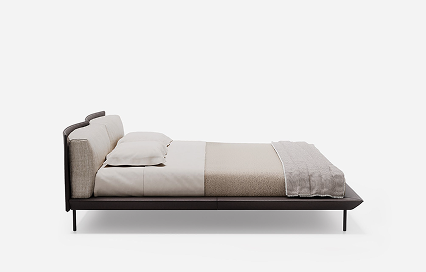
GREENE
Upholstered bed with padded steel-frame headboard, removable goose down cushions, and a two-part bed base with powder-coated steel feet.

EXTRASOFT
Modular bed comprised of different size elements with fully removable fabric or leather covers and exposed seams.
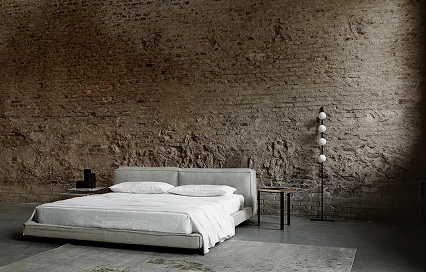
NEOWALL
Bed comprised of soft elements with fully removable fabric or leather covers.
The Headboard and the King Bed's Wall
The king-size bed's 193-centimeter width creates a specific challenge for the headboard it is paired with. A headboard sized exactly to the mattress width reads as proportionally equal because the wall behind a king bed is typically substantial, and the headboard, relative to it, needs to carry visual weight. A headboard that extends 8 to 12 centimeters beyond the mattress on each side and rises to a height that relates meaningfully to the room's ceiling produces a much more resolved result.
Piero Lissoni's Neowall bed, comprised of soft elements with fully removable fabric or leather covers, addresses the king format's wall relationship with a headboard system that is designed to read architecturally at scale. The soft elements can be arranged to provide a headboard presence appropriate for the breadth of the king's sleeping surface, and the removable cover system means the material can be updated as the room evolves.
Nightstands, Side Clearance, and the Bedroom Suite
With 193 centimeters of bed width, the nightstand on each side of a king bed is placed further from the circulation center of the room than in a queen configuration. This distance has consequences for the nightstand's practical function: reaching across a wider clearance to a surface that sits 30 centimeters from the mattress edge is a different experience from the more compact geometry of a queen suite.
The nightstand height relative to the finished mattress surface is the primary calibration point. The standard guidance of positioning the nightstand surface within 5 centimeters of the mattress top holds regardless of bed width, but the horizontal distance from the sleeping position to the nightstand surface increases with bed width, which makes the nightstand's own footprint more relevant. A nightstand that is too narrow reads as undersized at the scale of the king bed; one of sufficient width grounds the composition on each side.
The King-Size Bed Dimensions and the Room's Overall Composition
Piero Lissoni's Extrasoft bed, with modular construction and fully removable fabric or leather covers, allows the king-sized sleeping surface to be resolved as a composed upholstered element instead of a single fixed form. The modular character of the system means the configuration of cushions and elements can be adjusted to suit the specific proportions of the room, which is particularly valuable in a master bedroom where the king bed's scale demands that the upholstered surface be handled with precision.
Understanding king-size bed dimensions in full, from mattress footprint through frame to headboard and nightstand relationships, is the foundation from which a master bedroom of genuine spatial quality can be built. Graye's bed collection holds pieces designed to address this scale with the material and formal intelligence the king format demands.
King Size Bed Dimensions FAQs
-
Standard king-size bed dimensions are 193 by 203 centimeters. A California king is narrower and longer at approximately 183 by 213 centimeters. The California king is better suited to taller sleepers who prioritize length, while the standard king provides greater shared width.
-
A minimum room size of 380 by 450 centimeters allows a king bed with 90-centimeter clearances on all three accessible sides, space for nightstands on each side, and clearance for a wardrobe on an adjacent wall without the room feeling compressed.
-
A king mattress benefits from either a platform base or a slatted base with slats no more than 7 centimeters apart. A slat span greater than this can result in uneven mattress support and accelerated wear at unsupported points.
-
A headboard height of 120 to 150 centimeters above the floor, measured to the top of the headboard, produces a proportionate relationship with a 3-meter ceiling. This positions the headboard at roughly half the ceiling height, which is the standard reference point for vertical proportioning in bedroom design.
-
The additional upholstered surface area of a king headboard and bed base contributes meaningfully to the acoustic absorption of the room, reducing flutter echo and softening the overall reverberation character of the space. This effect is proportionally greater in rooms with hard floor surfaces.
