
Custom Closet Design in Los Angeles: Tailored Storage for Elevated Living
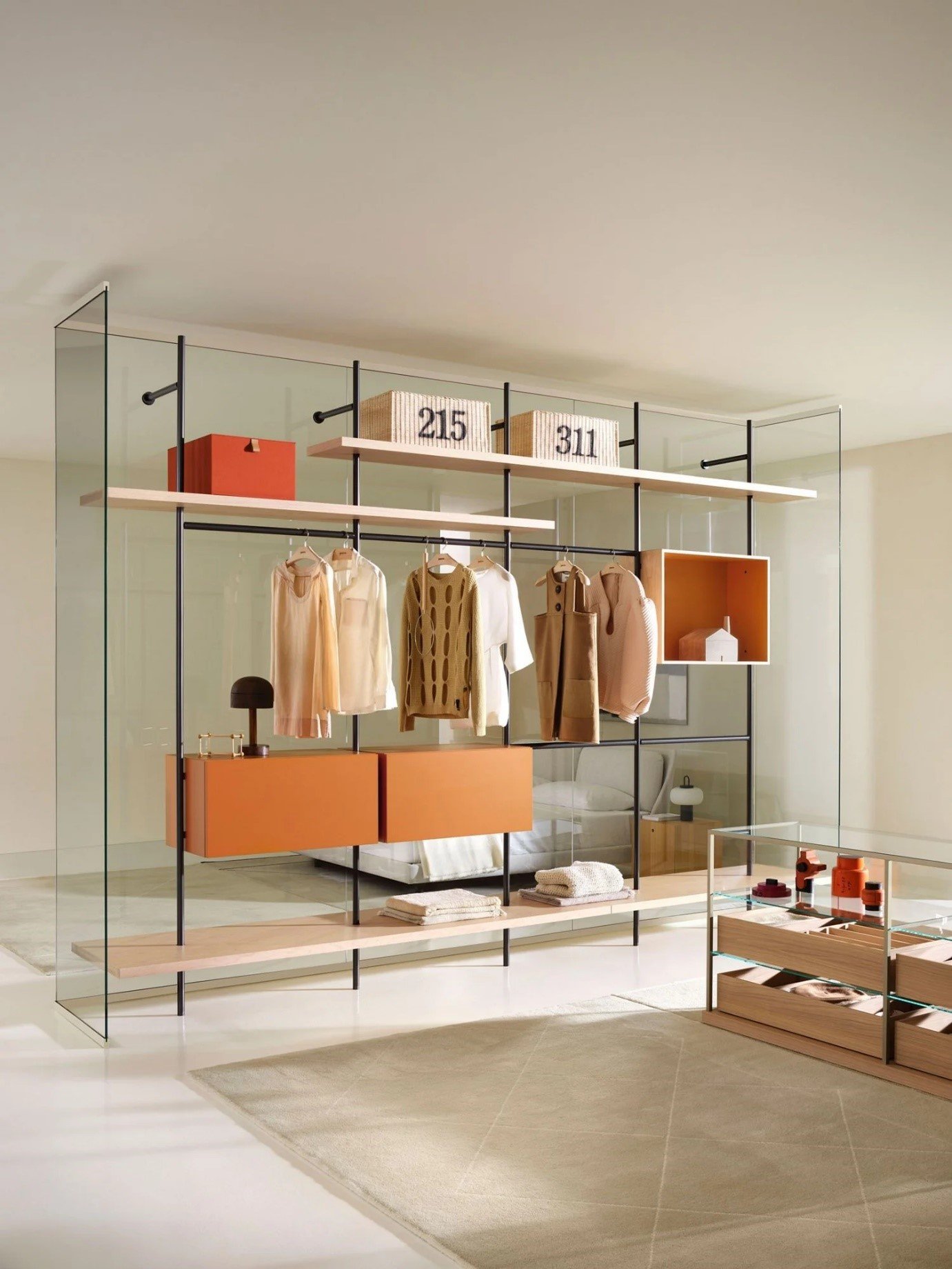
In the contemporary residence, storage is no longer concealed behind decorative panels or relegated to secondary status. It has become structural. The wardrobe, when approached with rigor, operates as architecture within architecture. For those considering custom closet design in Los Angeles, the question is not simply how to organize garments but how to construct a spatial framework for daily ritual.
At Graye, this philosophy finds precision through partnership with Porro, the historic Italian manufacturer whose systems, under the art direction of Piero Lissoni, redefine storage as a discipline of proportion and material continuity. These are not cabinets applied to walls. They are architectural systems that articulate volume, divide space, and shape movement.
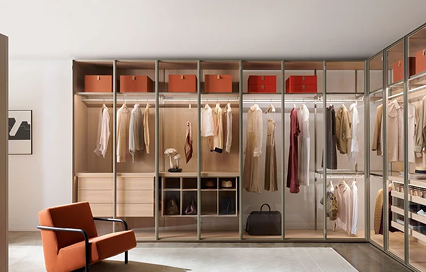
DRESSING ROOM
A modular system that emphasizes continuity and openness. This design creates luxurious spaces that are both functional and visually striking, perfect for showcasing your wardrobe while maximizing accessibility.
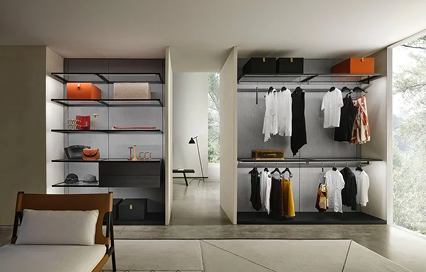
BOISERIE
A wall-mounted panel system blending elegance and minimalism. With no side panels, it offers a clean, uninterrupted surface that integrates seamlessly with other Porro solutions.
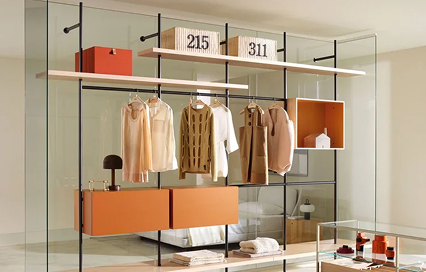
BOUTIQUE MAST
A dynamic, freestanding design that pairs vertical uprights with elegant shelves and accessories. Ideal for displaying clothing and accessories like an upscale boutique.
Storage as Structural Framework Within the Modern Residence
The most refined projects of closet design in Los Angeles begin with geometry. Porro’s systems eliminate visual density through ultra-thin profiles and concealed structural cores, allowing shelving spans to extend horizontally without bulky vertical partitions. The result is continuity rather than fragmentation.
An internal aluminum frame provides structural integrity while remaining invisible, permitting long horizontal runs that emphasize calm and order. Glass, wood, and metal align seamlessly, creating planes that read as walls, not millwork. In such compositions, the wardrobe does not intrude into the room. It defines it.
When storage is treated as architecture, it becomes part of the building’s logic. Door reveals align with ceiling grids. Panel widths correspond to window mullions. The volume feels integrated instead of just installed.
A New Paradigm for Custom Closet Design in Los Angeles
True customized closet design moves beyond built-in cabinetry toward adaptable systems that respond to specific footprints. Porro’s modular logic allows configurations to evolve without compromising coherence.
The Boutique Mast system exemplifies this evolution. Composed of slender iron uprights, it creates a vertical cadence that supports floating shelves and drawer modules. The structure resembles a finely calibrated framework in comparison to a closed wardrobe box. Garments become visible within a disciplined grid, suspended between structure and void.
This approach shifts the philosophy from concealment to curation. Clothing and accessories are not hidden but framed. The openness of the system introduces air and light, particularly effective in gallery-like hallways or open-plan suites. It challenges the notion that luxury requires enclosure. Instead, it privileges clarity.
For those who regard their wardrobe as an extension of personal authorship, such transparency becomes architectural.
The Dressing Suite as Immersive Interior
When the closet expands into a dedicated dressing room, spatial choreography becomes paramount. Circulation must remain fluid. Light must be considered in the elevation as well as the plan.
Porro’s storage system allows continuous cabinetry runs that envelop the room without compressing it. Glass-fronted modules introduce depth. Back panels in tinted mirror or textured finishes amplify light without glare. The selection of materials alters psychological temperature. Eucalyptus introduces shadowed warmth, matte lacquer maintains neutrality, and smoked glass creates atmosphere.
In advanced projects of custom closet design in Los Angeles, zones are arranged rhythmically. Long-hang garments transition into shoe storage. Drawer banks align beneath shelving. Islands may anchor the center, introducing a secondary datum.
The experience becomes immersive rather than functional. The dressing suite operates as a private gallery, where alignment and material coherence elevate the daily act of dressing into a ritual.
Technical Precision and Invisible Innovation
Luxury reveals itself in mechanisms that remain unseen. Porro’s patented integrated lighting system exemplifies this principle. Electrical current is conducted through structural uprights, eliminating visible wiring and allowing shelves to reposition without disruption.
The result is diffused illumination that follows the architecture rather than interrupting it. Garments are rendered accurately under soft, even light. Shadow is minimized without glare.
Hinges are concealed within frame profiles, allowing doors in glass or timber to appear as uninterrupted planes. The absence of exposed hardware reinforces the purity of the surface.
In a refined work of custom closet design in Los Angeles, such details define the difference between cabinetry and architecture. They ensure that attention remains on proportion and material, not mechanics.
Material Calibration for Southern California Light
Los Angeles presents a particular challenge: light that is bright, directional, and persistent. Material selection must respond accordingly.
Non-reflective glass reduces glare. Matte timber absorbs excess brightness. Burnished brass introduces warmth without excessive reflection. Eco-leather drawer liners introduce softness at the micro scale, reinforcing tactile engagement.
Surface calibration is not an aesthetic preference. It is environmental intelligence. When materials respond appropriately to light, the space feels grounded rather than fatigued.
Storage as Curated Living
When executed with discipline, custom closet design in Los Angeles transcends organization. It becomes a curated extension of the interior narrative. The wardrobe reads as an exhibition, yet without spectacle. Every line aligns, and every surface is intentional.
Through collaboration with Porro and under the influence of Piero Lissoni’s architectural restraint, storage becomes spatial composition. The boundary between furniture and structure dissolves. The closet becomes part of the architecture’s bones.
In the end, custom closet design is not about maximizing capacity. It is about clarifying volume, light, and proportion. It is about constructing a framework that supports daily life with quiet authority.
FAQs
1. How do Porro closets integrate lighting without visible wires?
Porro utilizes a patented system that conducts electricity through structural metal uprights, allowing shelves to illuminate without exposed cabling.
2. What distinguishes Boutique Mast from traditional wardrobe systems?
Boutique Mast replaces heavy partitions with slender iron uprights, creating a graphic framework that blends openness with structural precision.
3. Is eucalyptus suitable for wardrobes in bright climates like Los Angeles?
Yes. Its dense grain and deep tone absorb light effectively, reducing glare and adding architectural weight to dressing rooms.
4. Can Porro closet systems be reconfigured after installation?
Yes. Their modular construction allows for disassembly and reconfiguration while maintaining structural integrity.
5. How does glass-fronted storage affect spatial perception?
Glass panels introduce depth and reflectivity, expanding visual volume while maintaining alignment and proportion.
