
The Modern Dining Table: Material, Scale, and Craft in Contemporary Homes
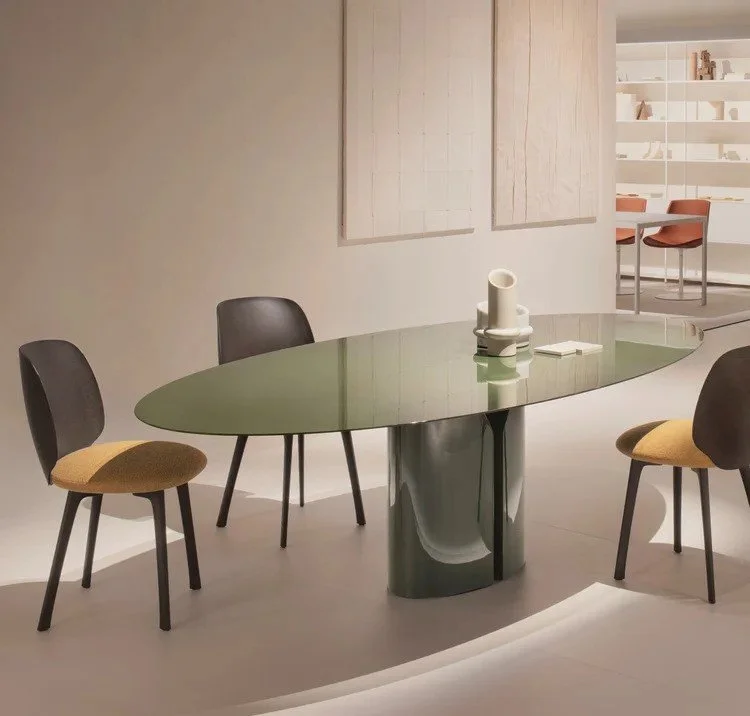
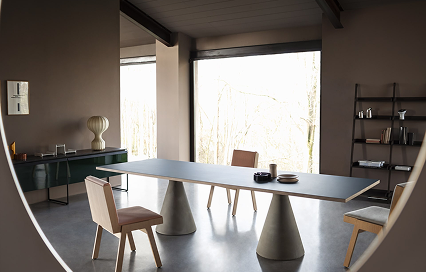
TAVOLO
Features a three-part construction: concrete base, a wooden top and steel connector. Available in various sizes, shapes, and finishes.
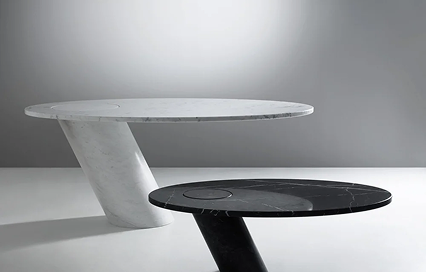
ECCENTRICO
All-marble table with an elliptical top fitted asymmetrically into an inclined cylindrical leg, using weight, friction, and eccentricity to lock the joint without fasteners. Custom sizes and finishes available.
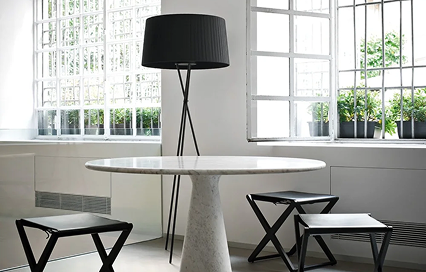
M
All-marble table with a lathe-turned central base in a hyperboloid shape—wider at the bottom, tapering toward the top—to support a circular top that rests embedded in its own thickness. Available in various finishes and sizes.
The dining table occupies a singular position within the domestic landscape. It is not peripheral furniture, but a structural presence that organizes space around it. In today's interiors, where kitchen, dining, and living areas often merge into a continuous volume, the table becomes the gravitational center. Its scale, material, and proportion establish hierarchy within an otherwise fluid plan.
To engage seriously with modern dining table design is to consider the object as architecture. The table must anchor the room without imposing excess. It must hold authority without weightiness. Its surface becomes a horizontal plane that mediates between human interaction and architectural volume.
Luxury in this context is not a decorative flourish. It is calibration.
The Table Within Open-Plan Architecture
Modern residential architecture frequently positions the dining zone between the functional energy of the kitchen and the relaxed openness of the living area. The table must therefore operate as a bridge between these volumes, establishing its own territory while maintaining spatial continuity.
Scale is the first discipline. A table too slight in proportion to ceiling height or floor area forfeits presence. One that overwhelms interrupts circulation and visual flow. Designers such as Piero Lissoni approach this balance through long horizontal planes supported by slender yet precise structures. The effect is visual lightness paired with structural clarity.
The geometry of the base determines how the table inhabits the floor plane. Central pedestal designs allow the top to appear as a floating slab, maximizing legroom and maintaining openness beneath. Perimeter legs anchor the object more firmly, creating a rhythmic dialogue with architectural lines such as window mullions or wall panels.
The interaction between the table and floor should never be incidental. It is here that the object declares its relationship to the room.
The Evolution of Modern Dining Table Design
The trajectory of modern dining table design has been defined by the removal of superfluous ornament and the elevation of material honesty. Brands such as Angelo Mangiarotti have pursued this evolution with precision, reducing form to essential geometry while refining structural performance.
Advanced fabrication techniques now allow for expansive surfaces rendered in remarkably thin profiles. Aluminum, high-pressure laminates, and engineered composites permit spans that would once have required bulk. These ultra-thin tops challenge expectations of weight and solidity, creating a graphic tension between visual delicacy and structural strength.
At the same time, contemporary tables embrace tactile complexity. Carbonized woods, acid-etched metals, and honed stones introduce texture that invites engagement. The dining surface is no longer a neutral backdrop but an active participant in the ritual of gathering. When a ceramic vessel rests upon matte marble or softly finished timber, material conversation replaces ornament.
The table becomes a plane of encounter.
Material Dialogue Between Natural and Industrial
Material choice determines the emotional register of the dining space. Solid timber introduces warmth and continuity with the natural environment. In Lissoni’s work, thick slabs of European cherry or ash reveal grain as structure rather than pattern. The finish remains restrained, allowing the material to mature over time.
Metal surfaces, by contrast, introduce a controlled coolness. Burnished brass or iron finishes offer industrial clarity softened by patina. These metals evolve subtly with use, recording touch and time without deteriorating. Their reflective quality must be managed carefully through lighting and surrounding materials to avoid glare.
Stone represents permanence. A circular marble top supported by a geometric base embodies both monumentality and restraint. Carrara or Marquinia marble introduces depth through veining instead of color. The presence of stone demands confidence. It fixes the dining zone architecturally, transforming it into a point of gravity within the room.
Each material alters how light moves across the surface and how sound behaves in the volume.
Structural Tension and Engineered Precision
The true sophistication of a dining table lies in its structural resolution. Contemporary design reveals tension rather than concealing it. The Notes table by Massimo Mariani exemplifies this clarity. Its base, composed of intersecting steel rods, introduces visual transparency while maintaining stability. Light passes through the structure, reducing visual mass and enhancing spatial continuity.
For larger gatherings, the Brasilia table responds with a more robust architectural base capable of supporting expansive tops without auxiliary bracing. Its silhouette remains clean, uninterrupted by visible reinforcement. The engineering is precise yet discreet.
Such tables are not simply functional platforms. They are structural statements, balancing compression and extension in disciplined proportion.
Enduring Presence
The enduring appeal of modern dining table design lies in its restraint. Ornament has been replaced by material clarity. Excess has yielded to proportion. The table’s authority derives not from embellishment but from the integrity of its construction.
When selected with discipline, the table becomes an enduring anchor within the home. Timber acquires softness, stone reveals subtle wear, and metal deepens in tone. These shifts do not diminish value. They record presence.
In the modern-day interior, the dining table remains the most essential horizontal plane. It gathers architecture, light, and human interaction into a singular composition. Through scale, craft, and material honesty, modern dining table design transforms a functional object into an architectural constant, grounding the room and the rituals it hosts with quiet authority.
FAQs
1. How does the weight of a stone tabletop influence installation?
Stone tables require structurally sound flooring and precise leveling to ensure even load distribution and long-term stability.
2. What is the difference between honed and polished marble in dining applications?
Honed marble displays a matte finish that is more forgiving of scratches and etching, while polished marble provides higher reflectivity and sharper visual contrast.
3. Can metal dining tables feel cold in residential settings?
Metal surfaces naturally conduct temperature, but their tactile quality can be moderated through lighting and the introduction of textiles during use.
4. Is it advisable to place a wooden table near large windows?
Direct sunlight can fade or dry timber over time, so UV-filtering glazing or controlled shading is recommended.
5. What clearance is required around a dining table for comfort?
Maintaining at least thirty-six inches between the table and surrounding walls or furniture ensures comfortable circulation and spatial balance.
