
Luxury Dining Room Lighting: Creating Ambiance with Modern Design
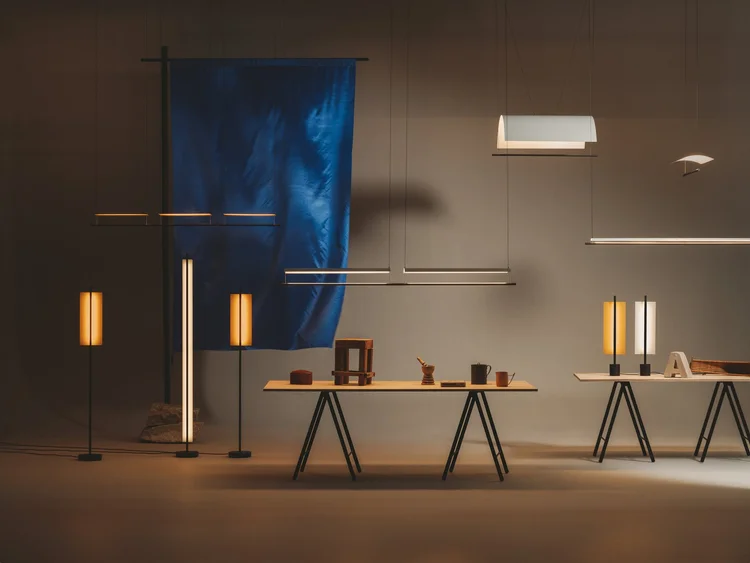
The most enduring dining room lighting ideas begin with an understanding of ceremony. Dining is not just a functional act but a ritual shaped by anticipation, presence, and memory. Light must frame that ritual without overpowering it.
In refined interiors, illumination defines volume, clarifies proportion, and modulates atmosphere as evening deepens. Luxury, in this context, is not spectacle but calibration. It is the measured dialogue between the table surface and ceiling plane, between shadow and glow, between guest and architecture.
To create ambiance with modern design, lighting must be both structural and subtle. It should anchor the table as a civic object within the home while preserving visual restraint. When composed with discipline, light becomes the quiet architecture that holds gathering together.
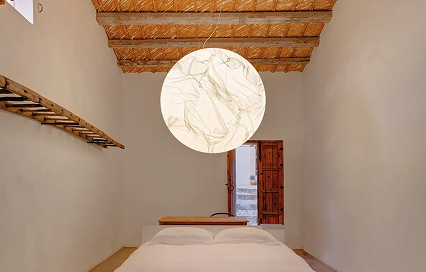
MOON
Softly illuminated, handmade surface of unryu kozo paper.
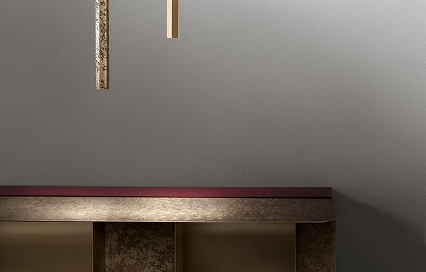
ESA
Hexagon-inspired pendant light with De Castelli finishes, emitting a downward beam and designed for use as a single spotlight or in clustered configurations to create ambient lighting compositions.
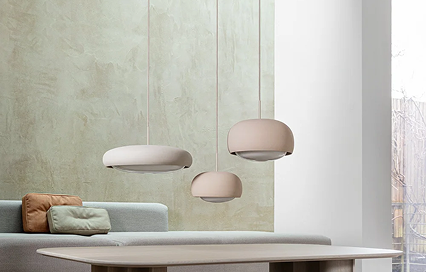
GEMA L
Porcelain shade and mouth-blown white glass diffuser, combining artisanal craftsmanship with soft ambient illumination.
The Central Axis Above the Table
Every exploration of dining room lighting ideas begins with the central axis. The dining table establishes a horizontal datum, and the light above it must respond with equal clarity. A pendant or suspended fixture should align precisely with the table’s center line, reinforcing symmetry and spatial order.
Scale determines authority. A fixture too small feels apologetic and disappears into the ceiling. One too large competes with conversation and overwhelms the table’s proportion. Ideally, the diameter or length of the luminaire should relate directly to the dimensions of the tabletop, neither exceeding its perimeter nor appearing isolated within it.
The vertical distance between fixture and table is equally critical. Hanging approximately thirty to thirty-six inches above the surface allows intimacy without obstructing sightlines. This measured positioning creates a luminous plane that draws attention downward, emphasizing the act of gathering.
Dining Room Lighting Ideas and the Architecture of Ambiance
High-level dining room lighting does not rely on a single source. Instead, they orchestrate layers that respond to architecture. Ambient light may be integrated into ceiling recesses or concealed coves, washing the perimeter walls with subtle illumination. This soft envelope prevents harsh contrast between the table and the surrounding space.
Task lighting can be directed toward sideboards or service areas, supporting functionality without intruding visually. Accent lighting, often discreetly recessed, may highlight artwork or textured surfaces, enriching the room’s depth.
The objective is balance. The central pendant establishes hierarchy, while secondary sources maintain spatial continuity. When layered thoughtfully, the room transitions seamlessly from preparation to dining without abrupt shifts in brightness.
Material Expression and Reflective Surfaces
Light interacts differently with each material in the dining room. Honed marble absorbs glow gently, while polished stone reflects it with sharper clarity. Walnut surfaces warm under amber tones, revealing grain that remains invisible in daylight.
Metal finishes on fixtures should resonate with surrounding hardware. Brushed brass introduces warmth without glare. Blackened steel offers a graphic contrast against lighter ceilings. Glass elements can diffuse light evenly, though their transparency requires disciplined scale.
Reflective surfaces amplify ambiance. A lacquered sideboard or lightly polished plaster wall can extend candlelight across the room. However, reflection must remain controlled. Excess sheen fragments perception and distracts from conversation.
Within curated collections of refined table lights, sculptural forms balance material presence with luminous restraint. The fixture should contribute to the room’s vocabulary rather than impose itself upon it.
Shadows as Spatial Depth
Luxury dining environments embrace shadow, not eliminate it. Soft gradients across walls and ceilings introduce depth without theatricality. Directional light grazing textured plaster reveals subtle irregularities, enhancing architectural richness.
Under-table lighting, when used sparingly, can create a floating effect that lifts the tabletop visually. This technique must remain minimal to avoid distraction. The aim is dimensional nuance, not spectacle.
Darkness also has purpose. Corners left partially unlit contribute to intimacy, allowing the illuminated table to remain focal. Dining room lighting ideas that respect shadow produce an atmosphere rather than glare.
The Dining Room as Transitional Volume
In many contemporary homes, the dining room operates as a threshold between the kitchen and the living zones. Lighting must clarify this territory without imposing physical barriers.
A recessed ceiling plane above the table can define the dining area, with integrated illumination reinforcing its boundaries. Floor continuity between adjacent spaces may remain intact, while light establishes differentiation.
In open-plan environments, pendants can act as vertical anchors, delineating dining from circulation. Their alignment with the table reinforces spatial hierarchy even in expansive volumes.
Thoughtful planning ensures that the dining area feels distinct yet integrated. Light becomes the invisible boundary.
The Relationship Between Fixture and Ceiling Plane
The ceiling must be considered as carefully as the table. In rooms with significant height, elongated pendants or clustered forms can bridge vertical distance. In more modest spaces, flush or semi-flush fixtures preserve headroom while maintaining elegance.
Ceiling finish influences luminosity. Matte surfaces absorb excess reflection, while subtle sheen can amplify glow. The interplay between fixture and plane determines whether the light feels integrated or imposed.
In projects conceived through the curatorial lens of Graye, dining room lighting ideas are treated as an architectural structure more than an accessory. The result is coherence across volume and detail.
FAQs
1. How high should a dining pendant hang above the table?
Typically, thirty to thirty-six inches above the tabletop maintains intimacy while preserving clear sightlines across the table.
2. What color temperature is best for dining rooms?
Warm tones between 2700K and 3000K enhance skin tones and food presentation while creating a welcoming atmosphere.
3. Are multiple pendants suitable for long dining tables?
Yes. A series of aligned fixtures can establish rhythm and proportion across elongated surfaces when scaled correctly.
4. How can lighting define a dining area in an open-plan home?
A central pendant aligned with the table and integrated ceiling illumination can delineate territory without physical partitions.
