
Designer Home Office Furniture for Stylish and Functional Workspaces
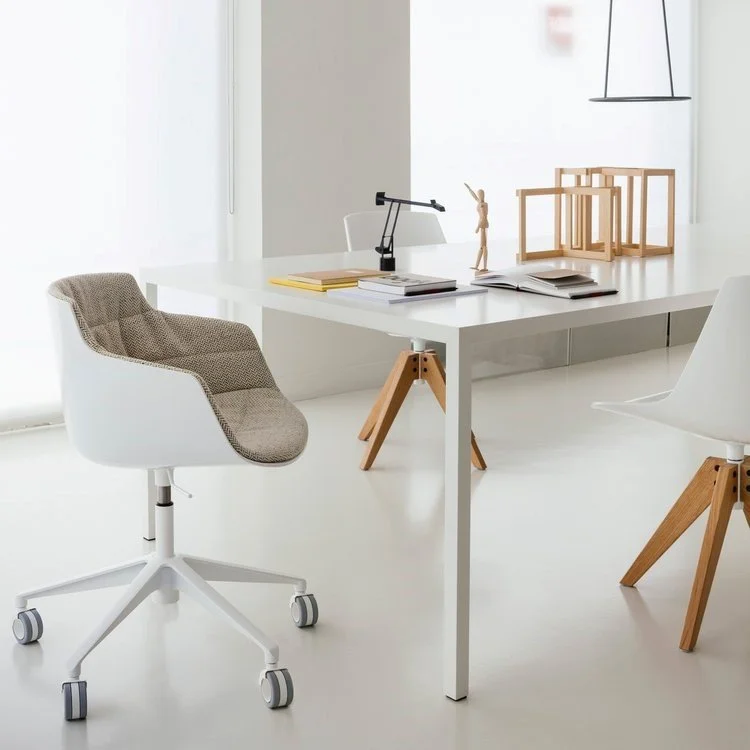
The contemporary home office is defined less by its location and more by the furniture that inhabits it. When work moves into the domestic sphere, the objects that support it must carry both ergonomic intelligence and formal clarity.
Designer home office furniture does not imitate corporate environments. It responds to residential scale, material warmth, and architectural proportion while maintaining the discipline required for sustained work.
Furniture determines posture, storage logic, and visual hierarchy. It establishes the room’s center of gravity. In refined interiors, each piece is selected not only for utility but also for its contribution to a coherent composition.
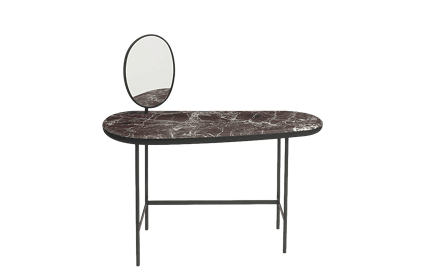
PEBBLE
Inspired by the materiality and the organic form of stones. Available in lacquer, marble, or glass and various finishes.
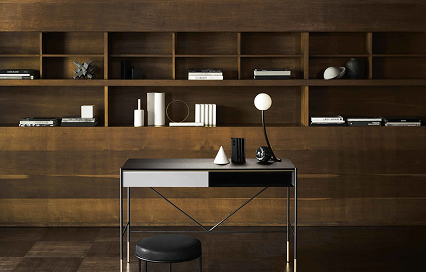
ERA SCRITTOIO
Desk with gunmetal grey legs, matte brass accents, Italian walnut, stone oak, or striped grey top and drawer with coordinating wood or glossy lacquer external parts.
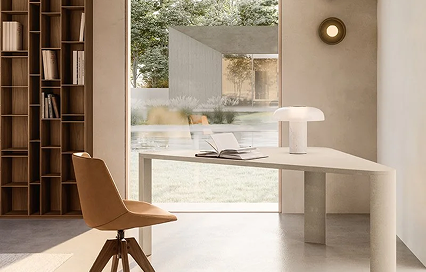
BONNET
Interpret the theme of soft, rational forms with architectural elan, introducing a touch of femininity. With the Coccioperla finish. Available in various colors.
The Desk as Primary Architectural Object
The desk is the fulcrum of the home office. It anchors the room and mediates between body and work. In designer collections, the desk is approached as both surface and structure.
Executive desks carry presence. Often crafted in solid walnut, oak, or lacquered finishes, they feature integrated drawer systems and concealed cable management. Their proportions are deliberate, typically between sixty and seventy-two inches in width, allowing for multiple work zones without excess. The scale must feel grounded but not domineering within a residential context.
Writing desks adopt a lighter posture. Slimmer profiles, exposed legs, and reduced storage create visual permeability. These pieces suit spaces where intellectual work requires fewer physical tools. Their refinement lies in restraint; joinery remains visible, edges are crisp, and the underside is considered the top plane.
Height-adjustable desks, when executed thoughtfully, maintain aesthetic integrity while offering ergonomic flexibility. In well-designed systems, motorized components are concealed within timber or metal frames. The visual language remains architectural, not mechanical.
Graye’s curated selection of designer desks reflects this balance between structure and elegance. Pieces from Italian manufacturers such as David Lopez Quincoces emphasize precision detailing, seamless drawer integration, and material authenticity. The desk becomes a crafted object within the home, not an imported utility.
Task Seating with Structural Clarity
The chair is the most intimate piece of office furniture. It supports the body through hours of concentration. Designer home office furniture addresses this through engineering as much as aesthetics.
Contemporary task chairs integrate adjustable lumbar support, tilt mechanisms, and breathable materials within restrained silhouettes. The goal is comfort without visual bulk. Sculpted shells in molded plywood or upholstered forms in leather and wool maintain tactile warmth.
Bases in polished aluminum, blackened steel, or matte finishes contribute to structural legibility. Casters, when present, are refined and unobtrusive. The chair should move fluidly without disrupting the room’s compositional calm.
Executive chairs in full-grain leather offer a different expression. Their presence is substantial yet tailored. Stitching details, edge piping, and armrest integration reveal craftsmanship. Overly padded forms read as excessive in residential settings. Moreover, proportion and clarity remain paramount.
Storage Systems as Composed Home Office Furniture
Storage in the home office extends beyond filing. It houses archives, reference materials, personal objects, and evolving tools of work. Designer storage systems treat this necessity as an opportunity.
Credenzas provide horizontal mass and concealed capacity. Their doors, whether hinged or sliding, align flush with surrounding planes. Veneer patterns are often book-matched, reinforcing symmetry. Interiors may feature adjustable shelving, integrated file drawers, and hidden compartments.
Tall cabinets introduce verticality. Their proportions should relate to ceiling height, neither truncated nor overly elongated. Handles are minimal. In some systems, push-to-open mechanisms eliminate hardware entirely, preserving uninterrupted surfaces.
Modular cabinetry allows incremental expansion. Units can be stacked, aligned, or extended across walls to form continuous compositions. The rhythm of vertical and horizontal divisions creates architectural cadence.
Materials distinguish designer systems from generic alternatives. Solid wood frames, precision veneer work, lacquer finishes in muted tones, and metal accents in brushed brass or steel introduce material depth. Surfaces age with dignity.
Shelving as Linear Expression
Shelving in the home office carries both practical and aesthetic weight. It organizes books and objects while shaping the wall plane.
Freestanding shelving systems with slender metal uprights and timber shelves create a sense of lightness. The vertical supports establish rhythm, while the horizontal planes align with desk heights or cabinet tops, reinforcing visual continuity.
Wall-mounted systems reduce floor obstruction. Floating shelves appear to emerge from the wall, creating shadow lines beneath. This detail introduces dimensional subtlety.
Closed-back shelving offers solidity. Open-back systems preserve transparency, allowing wall color to read through and reducing visual mass.
The proportion of shelf spacing matters. Oversized gaps dilute cohesion, tight spacing restricts flexibility, and adjustable systems allow calibration to book height and object scale.
Occasional Tables and Auxiliary Surfaces
Beyond the desk, secondary surfaces support workflow. Side tables accommodate documents, laptops, or reference materials. Their scale must complement the primary desk without competing for dominance.
Small pedestal tables in stone or timber introduce sculptural presence. Slim console tables along a wall provide additional display and storage without visual heaviness.
Mobile pedestal units, discreetly scaled, allow flexible storage. They can shift positions as tasks evolve, supporting dynamic work patterns.
Material coherence remains essential. Auxiliary pieces should echo the finishes and proportions of primary home office furniture. Fragmentation occurs when disparate styles accumulate.
Meeting and Collaborative Tables
In larger home offices, particularly those used for client meetings or collaborative sessions, a secondary table may be required.
Round tables facilitate conversation. Their geometry eliminates hierarchy, encouraging equal participation. Rectangular tables align with architectural lines and offer greater surface area.
Scale must be moderated. Residential ceilings and room widths demand proportionate sizing. Overscaled conference tables overwhelm domestic settings.
Chairs surrounding these tables should complement the primary task seating in material or form, creating a unified furniture language.
FAQs
1. What materials are best for high-end home office desks?
Solid hardwoods such as walnut and oak, high-quality veneers, matte lacquers, and powder-coated steel offer durability and visual depth. These materials age gracefully and maintain structural integrity.
2. How do modular office furniture systems improve flexibility?
Modular systems allow desks, storage, and shelving to expand or reconfigure without replacing entire sets. This adaptability supports evolving work requirements.
3. Are executive desks suitable for smaller home offices?
Yes, if proportioned correctly. Compact executive desks with integrated storage can provide presence without overwhelming limited square footage.
4. What distinguishes designer office chairs from standard ergonomic chairs?
Designer chairs integrate advanced ergonomic mechanisms within refined silhouettes and premium materials, balancing performance with architectural clarity.
5. How long should high-quality home office furniture last?
Well-crafted pieces constructed with solid materials and precision joinery can last decades, particularly when properly maintained and periodically refinished if necessary.
