
Living Room Storage Cabinet Ideas for Modern Homes
Find the Right Cabinet for Your Interior
Storage in a living room is often treated as a secondary concern, resolved after the primary furniture has been placed. A living room storage cabinet, when chosen with the same standard applied to a sofa or a coffee table, does something more consequential than holding objects.
It contributes to the room's material register, occupies wall space with intention, and brings a resolved vertical element to a composition that is otherwise primarily horizontal. Pieces that achieve this are designed from the beginning to function and read as furniture of consequence.
What Makes a Storage Cabinet Work in a Living Room
The living room makes different demands on a storage piece than a bedroom or study. The cabinet will be seen from multiple angles, read at a distance as a wall element, and encountered at close range as a surface. Its exterior material, door specification, and proportion all carry visual weight.
A cabinet that reads well at room scale but fails at close range will eventually read as a problem rather than a resolution.
How Material Choice Shapes the Cabinet's Role in the Room
The exterior material of a living room storage cabinet determines how it participates in the room's palette. A timber cabinet in a room with timber flooring creates a continuity that can unify or homogenize. A metal cabinet introduces a distinction that gives the piece its own presence.
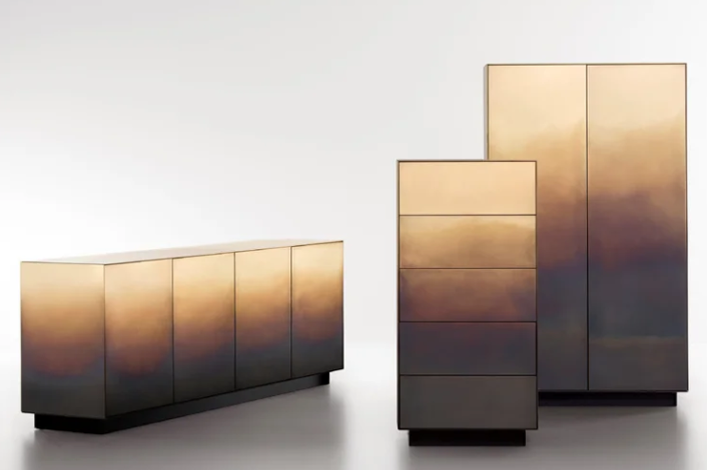
The Marea cabinet, designed by Zanellato/Bortotto, is an oak structure clad in stainless steel, brass, or copper with an interior in natural birch. Copper develops a warm, individual patination over time. Stainless steel reads with architectural neutrality. Brass carries warmth initially and deepens tonally with use, producing a different spatial register within the same room.
Explore Graye's Full Cabinet and Storage Collection
How Door Design Affects the Cabinet's Visual Weight
The decision between a closed, glazed, or open cabinet determines how the piece reads across the room and what it imposes on what it holds.
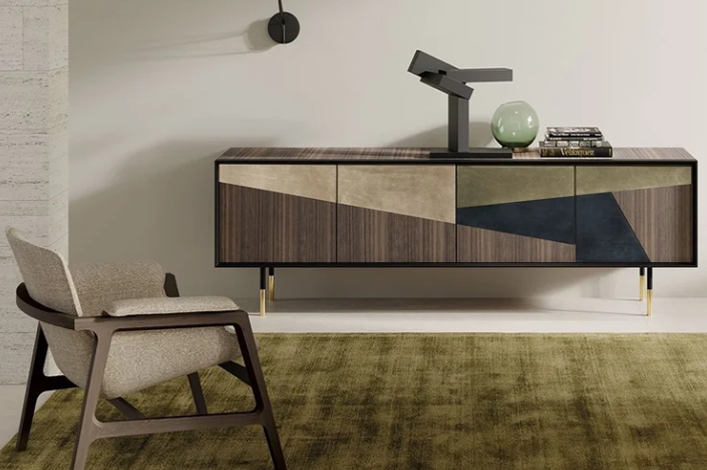
The Norman cabinet, designed by Euro Sironi, is an elegant living room storage cabinet available in heat-treated eucalyptus, nabuk leather, black lacquer, and satin gold with black metal handles and glass shelving. The opaque exterior with internal glass shelving creates a layered quality: closed doors conceal from a distance while the glass gives the piece a lighter interior presence.
As explored in our guide to contemporary interior design trends for modern luxury homes, the decision to conceal or display storage shapes the room's tone. Concealed storage reads with restraint; open shelving reads as more relaxed in its approach to display.
When a Cabinet Becomes the Room's Defining Vertical Element
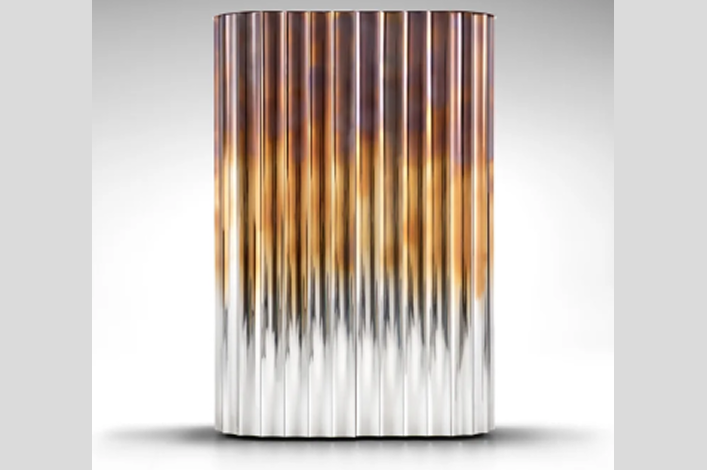
In a living room where seating and tables occupy the lower horizontal band, a tall cabinet anchors a wall in a way that nothing else achieves. The Dorica cabinet, designed by Matteo Nunziati, combines architectural proportions with refined craftsmanship.
Its fluted wood exterior, elegant detailing, and carefully balanced form create a strong vertical presence that defines the room without relying on excessive ornamentation. The cabinet offers generous concealed storage while maintaining a sculptural quality that complements contemporary luxury interiors.
For further reading on how storage contributes to a complete living room composition, our blog on marble coffee table ideas for elegant living rooms addresses how individual pieces relate to the room's material whole.
Discover Designer Living Room Storage Cabinets at Graye
A storage cabinet for the living room must function simultaneously as a wall element read from across the room, a material object encountered at close range, and a container for objects daily life requires.
At Graye, our cabinet collection brings together Italian designers who treat these demands as a single design problem. Reach out to us to explore finishes, configurations, and pieces suited to your living room.
Contact our design specialists today
FAQs
-
A low cabinet at 80 to 90 centimeters reads as a horizontal element below the sightline. A taller piece at 180 centimeters or above introduces vertical presence and anchors a wall lacking architectural punctuation. The right choice depends on the room's proportional needs and the wall it will occupy.
-
Freestanding pieces offer flexibility to reposition independently of the room's architecture. Built-in storage integrates more fully with the wall and addresses specific dimensions precisely, but removes future reconfiguration options. In a permanent residence with a clear design brief, built-in often produces a more architecturally resolved result.
-
Any cabinet intended to hold media equipment should have rear panel apertures confirmed, adequate depth for the equipment, and sufficient interior airflow for heat-generating devices. A cabinet not designed for media use can still accommodate it when these points are addressed at specification.
-
A sideboard is typically a low horizontal piece for storage and surface display. A cabinet encompasses taller configurations oriented toward concealed storage. A sideboard anchors a wall horizontally; a taller cabinet introduces vertical presence. The choice depends on the wall's dimensions and the room's proportional balance.
-
Solid timber, full-grain leather, and patinating metals develop character rather than signal wear. Lacquers and applied finishes can chip or scratch visibly in daily use. For a piece in constant view, specifying a material that improves with time produces a more satisfying long-term result.