
Mid-Century Modern Dining Tables as Timeless Icons
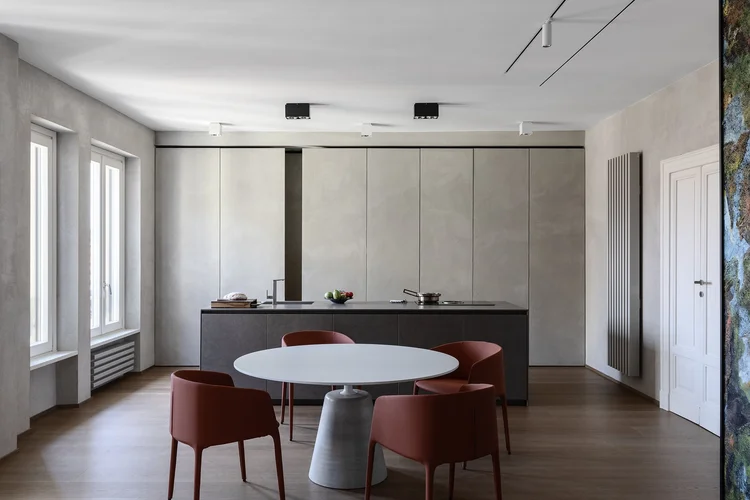
The mid-century period produced a body of dining table designs whose authority has proved remarkably resistant to the passage of time. The reasons are not difficult to identify: the best work from this tradition solved the structural and spatial problem of the dining table with formal intelligence and material honesty, reducing each piece to the logical expression of its own construction.
Mid-century modern dining table design, understood in this light, is not only a stylistic preference. It is a body of spatial thinking whose principles remain as relevant to contemporary interior practice as they were when the pieces were first produced.
Material Honesty as Structural Principle
The mid-century design tradition, shaped by the influence of Bauhaus thinking and the Italian Rationalist movement, held material honesty as a primary principle: the structure of an object should be legible in its form, and the material should be used in a way that acknowledges its specific properties rather than disguising them.
Applied to the dining table, this principle produced a body of work in which the relationship between top, base, and joint is architecturally clear, where you understand, looking at the piece, exactly how it stands.
This structural transparency is among the qualities that give the mid-century modern dining table its enduring presence in contemporary interiors. A table whose structure is legible does not depend on surface decoration or applied ornament for its authority. It holds the room through the quality of its formal logic, which remains consistent regardless of the material context around it.
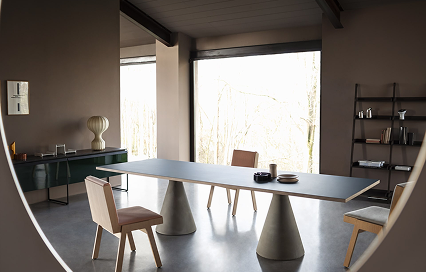
TAVOLO
Features a three-part construction: concrete base, a wooden top and steel connector. Available in various sizes, shapes, and finishes.
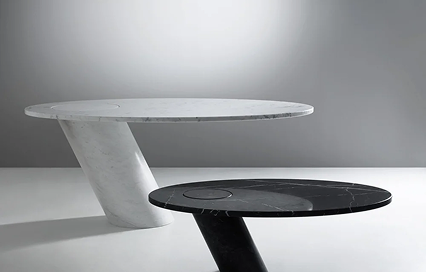
ECCENTRICO
All-marble table with an elliptical top fitted asymmetrically into an inclined cylindrical leg, using weight, friction, and eccentricity to lock the joint without fasteners. Custom sizes and finishes available.
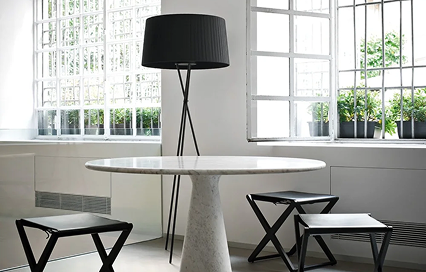
M
All-marble table with a lathe-turned central base in a hyperboloid shape—wider at the bottom, tapering toward the top—to support a circular top that rests embedded in its own thickness. Available in various finishes and sizes.
Stone and the Weight of the Gathering
The dining table's top carries the weight of the social event it hosts. A surface in stone, marble, basalt, or composite introduces a material gravity that timber or lacquer cannot replicate. Stone does not age toward softness; it maintains its precision and density indefinitely, accumulating only a surface polish from the contact of daily use. This permanence is appropriate to the dining table's social function: the table that witnesses decades of meals develops a kind of material biography.
Piero Lissoni's Materic, available in round or oval forms with a marble or wooden top and metal or wooden base, holds the mid-century formal vocabulary with material specificity. The round or oval form acknowledges the table's social function, the gathering without hierarchy, while the marble top carries the material authority appropriate to a piece that will be used, seen, and inhabited for decades. The optional lazy Susan is a detail that belongs specifically to this form: it acknowledges the centrality of the round table and provides a means of sharing that the rectangle cannot offer.
Metal and the Sculptural Base
The base of a mid-century modern dining table is where the design tradition produced some of its most compelling formal propositions. Where the top is a horizontal plane defined by its material and edge detail, the base is a three-dimensional object occupying the room's floor plane, a sculptural element as much as a structural one.
Jean Nouvel Design's NVL is a round or oval metal table with a sculptural base. The base is not just a support structure; it is the table's primary formal statement, establishing the piece's spatial presence in the room independent of the top it carries.
In metal, the base reads with a precision and tonal consistency that timber alternatives cannot replicate. Its sculptural quality, the sense that the base is an object with its own formal logic rather than a structural necessity, gives the NVL a presence in the dining room that extends well beyond its functional role.
The Dining Table in Its Room
A mid-century dining table achieves its fullest authority when it is placed in a room that understands its requirements: sufficient clearance for chairs and circulation, a ceiling height that allows the table to read as a spatial anchor instead of an awkward intrusion, and lighting positioned to illuminate the table surface without creating the overhead flatness of general ambient illumination.
Pendant lighting positioned at 70 to 80 centimeters above the table surface produces the most spatially precise dining light: focused, warm, and directional, it defines the table's territory within the room and creates the quality of gathered attention that the dining ritual requires. The mid-century modern dining table, lit in this way and properly cleared, holds its room with the authority that the best work from this tradition always intended.
Graye's dining table collection holds pieces across the full range of the mid-century tradition's material vocabulary, from stone and metal to solid timber, each resolved as a spatial proposition as much as a functional object.
FAQs About Mid Century Modern Dining Table
-
Structural transparency, material honesty, reduced ornament, and a legible relationship between top, base, and joint. These are the principles that define the tradition, regardless of the specific material or form.
-
Yes, often very effectively. The formal economy of mid-century design creates a productive tension with richer architectural contexts. The key is ensuring that at least one material element speaks to the existing palette.
-
A 200 by 90 centimeter rectangle or a 130 centimeter round table suits most dining rooms of standard proportions, allowing 60 centimeters of clearance on all sides with six to eight seated guests. Verify clearance with tape before ordering.
-
Not necessarily. Pairing a resolved mid-century table with contemporary chairs often produces a more interesting and personally specific result than a period ensemble. Material or tonal consistency between the table and chair base is the primary discipline.
-
Precision joinery, tapered forms, solid wood craftsmanship, and balanced proportions are key characteristics of well-made mid-century furniture.
