
Essential Types of Living Room Furniture for Every Modern Home

The living room is the room that does the most with the least. It must absorb domestic life in its most varied forms: conversation and solitude, gathering and rest, the accumulated objects of a household, and the sightlines that give a room its sense of spatial generosity.
Understanding the essential types of living room furniture and what each one contributes spatially and functionally is the beginning of assembling a room that serves all of these purposes without visual overload.
The Sofa and the Room's Primary Territory
Of all the types of living room furniture, the sofa is the piece whose selection most contributes to what the room becomes. Its length relative to the wall it fronts, its height in relation to the ceiling, and its material in relation to every other surface are all decisions with compounding spatial consequences. Graye's sofa collection treats each as a design variable instead of a default, presenting systems whose formal vocabulary ranges from the low and linear to the modular and spatially complex.
The sofa's relationship with the floor plane is among the least discussed and most significant of these decisions. A piece raised on visible legs, particularly slender or metal legs, allows the floor surface to read beneath it, which gives the room a visual openness that a floor-hugging base cannot provide. A sofa that sits directly on or very close to the floor creates a different spatial register: more casual, more grounded, with the floor plane anchoring the room rather than being implied beneath the piece.
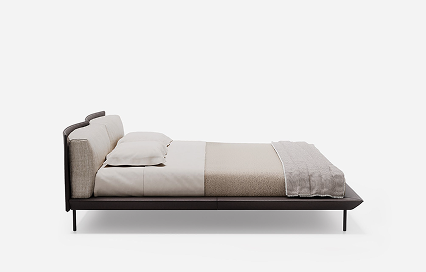
GREENE
Upholstered bed with padded steel-frame headboard, removable goose down cushions, and a two-part bed base with powder-coated steel feet.
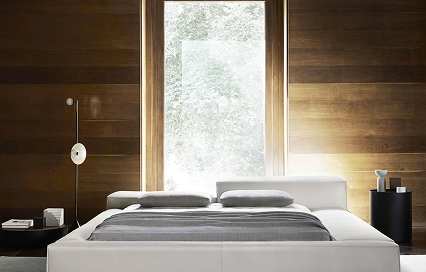
EXTRASOFT
Modular bed comprised of different size elements with fully removable fabric or leather covers and exposed seams.
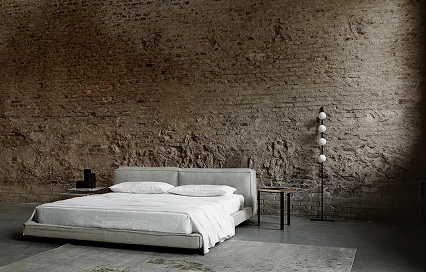
NEOWALL
Bed comprised of soft elements with fully removable fabric or leather covers.
Accent Tables and the Supporting Spatial Layer
Accent and coffee tables compose the living room's secondary surface layer, providing horizontal planes at various heights that serve both functional and compositional roles. The coffee table at the center of the seating area establishes a focal point between the primary seating pieces and contributes material contrast to a room that would otherwise be dominated by upholstery.
Graye's accent table collection includes pieces in stone, patinated metal, stained wood, and composite materials, giving the designer or homeowner access to the full range of material counterpoints that contemporary interior practice can require. The discipline of selection is identical to that governing the larger pieces: material, proportion, and formal character must speak to the room's existing vocabulary while contributing something that vocabulary alone cannot provide.
The Console as Threshold Element
The console table is among the types of living room furniture most frequently overlooked and most spatially potent when deployed well. Positioned behind a floating sofa, it defines the boundary between the seating territory and the circulation space behind it. Positioned against a wall, it introduces a horizontal surface at standing height that can hold objects, lamps, and displays without the visual weight of a sideboard.
The R&D De Castelli Saracena is a wall-mounted floating console with sliding metal fronts featuring reflective, light-reactive textures that reveal burgundy interior shelving within a slender, sculptural frame. The sliding front introduces a kinetic element to the living room, a surface that changes character with use, revealing or concealing its interior in response to the occupant's needs. Its wall-mounted position eliminates the floor footprint entirely, leaving the floor plane fully readable beneath it.
Mirrors, Rugs, and the Room's Dimensional Perception
The remaining varieties of living room furniture include pieces that shape spatial perception without establishing territory or providing surface area. The mirror's capacity to appear to expand a room is well understood; less discussed is its role as a light reflector, which can dramatically alter the quality of natural light in rooms that receive it from a single direction.
Emilio Nanni's Syro is a set of three mirrors with orbital delabré brass structures. The set format allows the mirrors to be positioned in a compositional arrangement rather than as a single isolated element, distributing reflected light and spatial depth across a wall in a way that one mirror alone cannot achieve.
The rug establishes the seating territory with as much spatial authority as the sofa. The Thinstripes Circular by JOV, made of Merino wool and cotton and customizable in color, quality, shape, and size, provides the living room with a circular floor plane that reinforces the seating composition's centrality without competing with the furniture it sits beneath. These types of living room furniture anchor the room's spatial argument from the ground up.
Types of Living Room Furniture FAQs
-
A sofa, a coffee or accent table, and adequate lighting constitute the functional minimum. Most rooms benefit from the addition of one or two lounge chairs, a rug to define the seating territory, and a console or accent surface at the room's perimeter.
-
A floating sofa, positioned away from the primary wall, allows circulation on all sides and creates a room-within-a-room quality in generous open-plan spaces. Wall-anchored arrangements maximize floor area and suit more compact rooms.
-
Material consistency between the table and the sofa base produces a more unified composition, but is not required. A coffee table that introduces a material counterpoint, stone, where the sofa base is metal, for example, can be equally resolved if the contrast is clearly intentional.
-
Define spatial zones first using rugs and light, then furnish each zone as a self-contained composition. The furniture should reinforce the zone boundaries rather than drift ambiguously between them.
-
Furniture that combines storage, flexibility, and comfort supports cleaner spaces and more efficient daily living, especially in contemporary homes.
