
Modern Luxury Living Room Ideas That Feel Effortlessly Curated
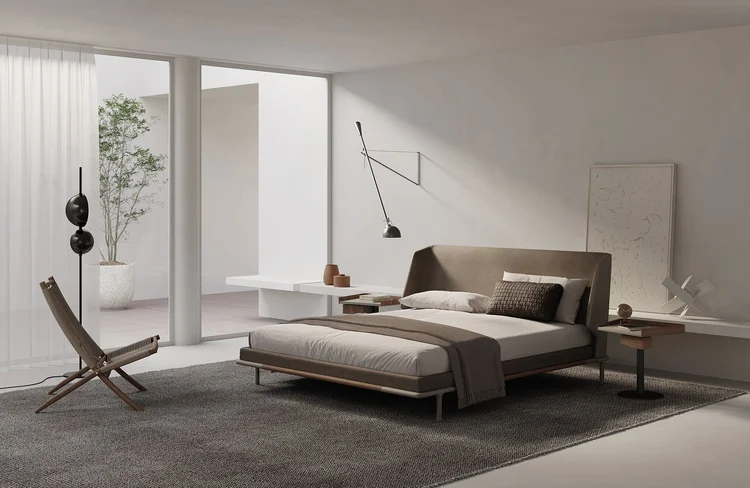
The most persuasive modern living room ideas do not announce their design intent; they reveal it gradually through coherence. In its highest expression, luxury is not defined by abundance but by resolution. A living room that feels effortlessly curated is rarely the result of impulse. It reflects discernment, careful editing, and a cultivated understanding of how objects, materials, and proportion interact over time.
Contemporary luxury has shifted away from acquisition toward authorship. The living room becomes less a container of impressive pieces and more a manifesto of values. Restraint replaces novelty. Material integrity supersedes surface glamour. Permanence takes precedence over trends. What distinguishes the refined interior is not the quantity of elements it contains, but the clarity with which it holds them.
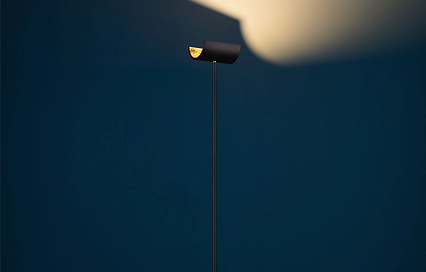
U
Available in two floor versions and comes in black or white finishes, featuring a low voltage COB LED light source.

WAWA
Floor lamp with a nickel structure, glass lens, and blue wire.
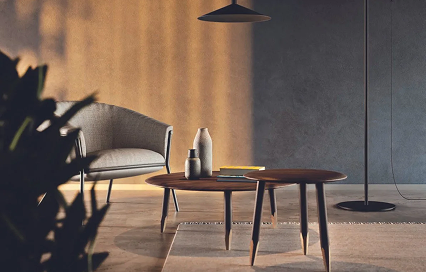
ALTURA
Two thin rods, one vertical and a horizontal one made of steel, are connected by a joint. Lightweight materials and technology contained within the cone-shaped lampshade.
Curation as Intellectual Discipline
True curation begins well before furniture is selected or art is hung. It begins with elimination. Many modern living room ideas falter because they attempt to accommodate multiple stylistic narratives at once, layering references without hierarchy. A curated interior operates within a defined conceptual frame. Whether grounded in Italian rationalism, Californian modernism, or a quiet European minimalism, its references are structural rather than decorative.
Such rooms contain fewer pieces than expected, yet each carries weight. A Piero Lissoni sofa, a sculptural De Castelli table, and a singular work of contemporary art do not function as fillers; they establish a point of view. Their presence is deliberate, and their relationship to one another is considered.
The discipline lies in resisting visual chatter. Decorative accessories are restrained. Surfaces are left largely uninterrupted. The eye moves across the room without obstruction, registering proportion and material continuity rather than distraction.
The Living Room as a Gallery Condition
In elevated modern living room ideas, the space begins to behave like a private gallery. Walls are treated as planes rather than backdrops, and art is granted breathing room. A single commanding work can anchor an entire composition more effectively than a cluster of smaller pieces competing for attention.
Scale becomes psychological. A large canvas asserts confidence and communicates that the room does not rely on embellishment. Furniture placement follows exhibition logic, with negative space surrounding key objects and circulation paths allowing each piece to be experienced fully. Lighting is directional and precise, illuminating form without theatrical exaggeration.
Even absence becomes expressive. The silence within a room, the decision not to fill every wall or surface, communicates authority more effectively than ornament ever could.
The Power of Material Continuity
Where many interiors pursue contrast as a visual strategy, curated modern luxury privileges continuity. A single timber species may extend from flooring into millwork and reappear in furniture detailing, creating a quiet thread that unifies the room. Stone surfaces might echo across a coffee table, a console, and architectural cladding, while metal finishes remain disciplined in tone, such as brushed brass, blackened steel, or patinated bronze.
This continuity produces calm. The room reads as intentional, not assembled. Materials operate as narrative threads that recur subtly, reinforcing unity without obvious repetition. The effect is one of seamless integration, where each element feels inevitable within the larger composition.
Controlled Contrast Instead of Decoration
Effortless curation does not imply monotony. It requires controlled contrast introduced with clarity. Instead of relying on decorative patterns, refined interiors employ textural opposition. A bouclé sofa against honed stone, polished plaster walls beside matte oak cabinetry, and leather juxtaposed with linen. These contrasts create depth without fracturing coherence.
The introduction of an unexpected material, perhaps oxidized metal or cast glass, can provide tension when deployed sparingly. The key lies in hierarchy. One dominant material language governs the room, supported by one or two counterpoints that enrich rather than compete.
Architectural Lighting as Quiet Authority
In refined living rooms, light is approached architecturally rather than ornamentally. Integrated ceiling lighting establishes ambient calm, while sculptural fixtures are selected for proportion and form. Illumination reveals material texture and spatial depth without calling undue attention to itself.
Layered lighting allows the room to shift character throughout the day. Morning light emphasizes clarity and surface articulation, while evening light softens intensity and enhances tactility. Floor and table lamps function as spatial punctuation, defining edges and creating intimate zones within larger volumes.
Consistency in light temperature preserves coherence. Abrupt shifts between cool and warm undermine the subtle continuity that curated interiors depend upon.
Mirrors as Instruments of Spatial Editing
Mirrors, when thoughtfully integrated, function as architectural editing tools. Large-scale installations can extend sightlines and amplify natural light, yet they must remain disciplined in form. Frameless applications or slim metal borders maintain visual clarity.
A mirror positioned opposite a window doubles daylight and reinforces axial alignment, while one installed behind a console introduces depth without adding new objects. Reflection should enhance geometry, not complicate it. Overuse fragments perception and disrupts calm.
Collecting With Intent
Effortless curation implies collecting over time with intention. Rather than sourcing every piece simultaneously, the room evolves gradually. A vintage chair discovered in Milan, a contemporary ceramic from a Los Angeles studio, and a limited-edition piece from a European manufacturer. Each object carries provenance and is added with consideration.
Authentic modern living room ideas reflect biography. They avoid the showroom effect and suggest that the interior has been assembled thoughtfully instead of staged. The result is a space that feels inhabited and enduring.
Emotional Temperature and Psychological Comfort
Luxury is also an emotional calibration. Muted palettes introduce calm, while deeper earth tones provide warmth without excess. Soft neutrals create clarity and allow material texture to emerge as the primary expression.
Acoustic softness, achieved through rugs and upholstered elements, enhances intimacy by absorbing sound and containing conversation. Psychological comfort arises not from overstuffed furniture but from proportion, tactile richness, and spatial breathing room. A curated living room feels settled because it has been measured carefully against the needs of its inhabitants.
FAQs
1. How do modern living room ideas avoid feeling staged?
By limiting decorative excess and allowing negative space. Select fewer, stronger pieces with provenance and material integrity.
2. What distinguishes curated luxury from high-end decoration?
Curation implies authorship and editing. Decoration often emphasizes quantity and visual impact over coherence.
3. Can a neutral palette still feel luxurious?
Yes. Texture, material continuity, and lighting depth create richness without relying on bold color.
4. How should art be scaled in curated modern interiors?
Larger works with breathing room create a stronger impact than multiple smaller pieces competing for attention.
5. Why is restraint essential in modern luxury living rooms?
Restraint preserves clarity. It allows proportion, material, and light to define the space without distraction.
