
Modern Round Dining Table Ideas for Elegant Dining Rooms
Discover Graye's Designer Dining Collection
A modern round dining table does something no other form achieves with the same spatial efficiency. It eliminates the hierarchy of a rectangular table, creates an equal sightline between every seated occupant, and allows circulation without a dominant axis cutting through the space. Understanding how different designs translate these advantages into material and formal terms is the starting point for selecting the right piece.
Why the Round Form Changes How a Dining Room Functions
A rectangular table divides the room into lateral zones: long sides and short ends, each producing a different experience for people seated there. A modern round dining table has no such division.
Every seat is equivalent in its relationship to the center, making the form suited to gatherings where conversation is the primary activity. The circular plan also interacts differently with the room's walls.
A rectangular table reinforces the room's geometry; a round table introduces a counterpoint that makes the dining zone feel more self-contained.
How Base Design Shapes the Visual Character of the Table
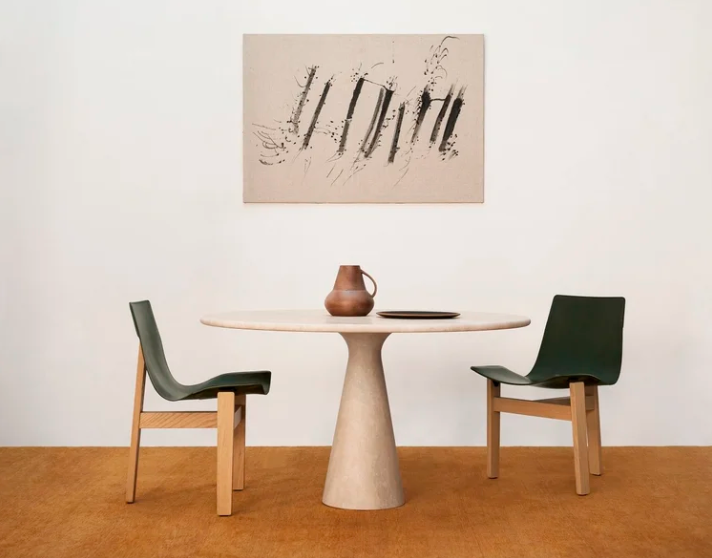
Unlike a rectangular table, where much of the structure disappears beneath the top, a round table reveals its base from every angle. The supporting structure becomes part of the composition, influencing how the piece is experienced throughout the room.
The M table, designed by Angelo Mangiarotti, approaches this relationship with architectural restraint. A generous round top is supported by a sculptural base whose clean geometry gives the table a sense of balance without unnecessary ornamentation. The design allows the proportions to remain the primary focus, making it equally appropriate for minimalist interiors and spaces with richer material palettes.
View Designer Dining Tables Now
Choosing Between Marble, Glass, and Other Materials
Material changes far more than appearance. It determines how a table reflects light, how it relates to surrounding furniture, and how the dining room feels as a whole.
Marble introduces depth that cannot be replicated. Natural veining allows every surface to develop its own identity, while the weight of the material gives the table a sense of permanence that extends beyond function.
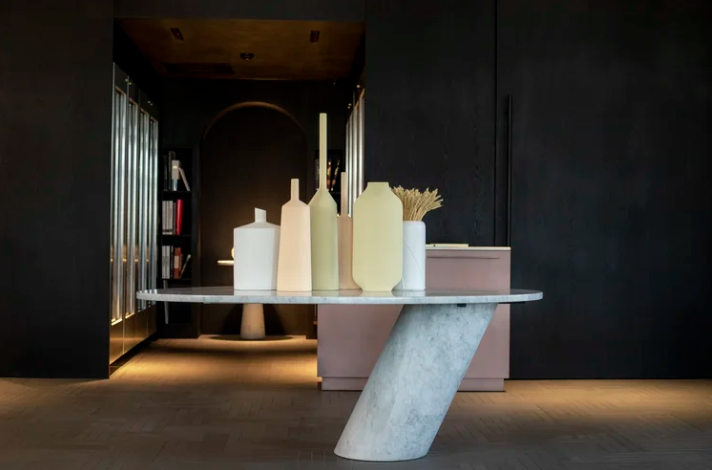
The Eccentrico table, designed by Angelo Mangiarotti, demonstrates how engineering and materials can become inseparable. Formed entirely from marble, its inclined cylindrical base supports the top through carefully resolved geometry rather than visual complexity. The result is a composition where the stone itself becomes the defining expression of the design.
Glass offers a very different experience. Instead of defining the room with a solid plane, it allows light to continue through the tabletop, reducing the table's visual weight while revealing the structure beneath.
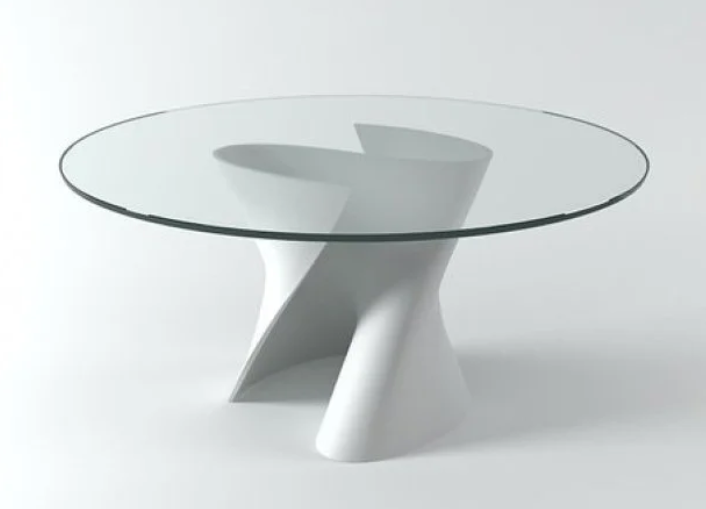
The S table, designed by Xavier Lust, uses a circular glass top to create this sense of openness. The transparency allows the sculptural base to remain fully visible, giving equal importance to both elements of the design. The result is a table that feels present without dominating the room, particularly in interiors where maintaining visual continuity is part of the architectural composition.
As explored in our guide to luxury dining room furniture, the relationship between material and form often determines how a dining room is experienced long before the table is ever used. Choosing between marble and glass is therefore less about preference alone and more about the atmosphere the room is intended to create.
Completing the Composition Around the Table
A round dining table naturally becomes the center of the room, allowing surrounding pieces to play a quieter role. Dining chairs should support the table rather than compete with it, with forms and proportions that feel balanced from every angle.
Lighting follows the same principle. A single pendant centered above the table reinforces its circular geometry and gives the dining area a clear sense of place within the room.
For further inspiration, our guide to pendant lighting ideas to elevate every room in your home explores how lighting can define a dining space while complementing its furniture.
Discover Modern Round Dining Tables at Graye
The modern round dining table is a spatial decision as much as a furniture choice. Its form changes how conversation circulates, how the room reads from every position, and how the dining zone relates to the space around it.
At Graye, our dining collection brings together European designers who treat the round table as a resolved formal object. Contact our design specialists to explore materials, bases, and dimensions suited to your dining room.
Let Us Help You Specify the Right Dining Table
FAQs
-
A table of 120 centimeters in diameter seats four people comfortably. A table of 150 centimeters seats five to six. Beyond 180 centimeters, the distance across the table begins to work against conversation, reducing one of the round form's primary spatial advantages.
-
A pedestal base frees the floor plane and removes the corner-positioning conflict that a four-leg base introduces between the table legs and chair legs during seating. For a round table, it is generally the more resolved structural choice.
-
A round table that extends typically becomes oval when a leaf is added, changing the table's fundamental spatial character. For clients who need occasional additional seating, an oval format specified at the larger size is often a more considered approach than a round table with an extension mechanism.
-
A round table requires a circular floor zone including seating clearance. For equivalent seating capacity, a round table typically requires a slightly larger footprint because the curved perimeter is less spatially efficient per linear meter than a straight edge.
-
Yes, and often better than a rectangular table. The circular form does not establish a strong directional axis competing with the kitchen's linear geometry. It reads as a self-contained object within the floor plan, giving the dining zone a defined spatial identity without architectural separation.