
Small Living Room Layouts Optimized for Style and Sophistication
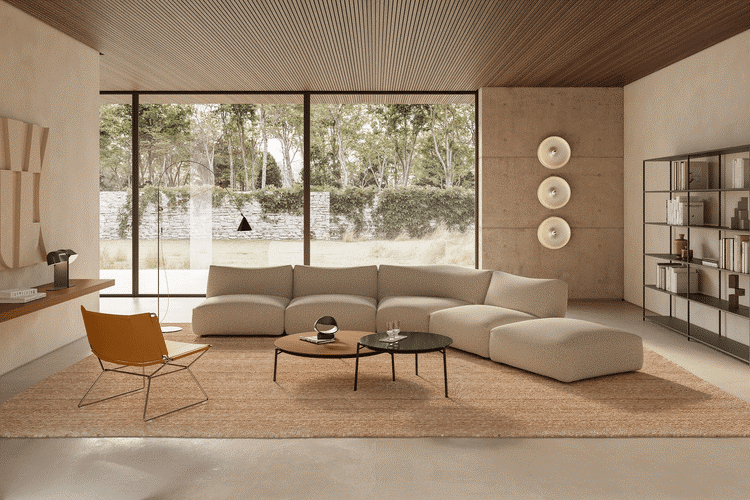
A small living room layout is an exercise in proportion. When square footage contracts, geometry becomes explicit, circulation paths are visible, sightlines are immediate, and volumes are read in full.
In such conditions, spatial decisions cannot rely on excess or ornament. They must rely on calibration. The arrangement of furniture becomes architectural, defining axis lines, framing voids, and establishing visual equilibrium within compressed dimensions.
The small living room rewards discipline. When composed with intention, it achieves a clarity often absent in larger rooms. Its intimacy becomes spatial coherence.
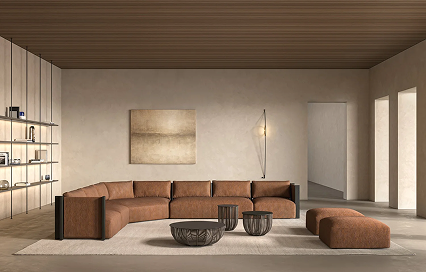
ARKADIUS
Modular seating system with architectural wooden backrests and armrests, pairing structured vertical slats with soft upholstered cushions.
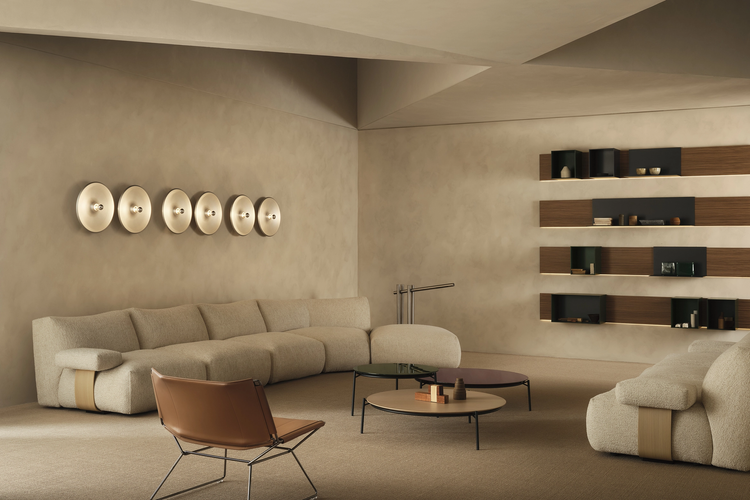
GOOM
A modular system comprising single units, corner units, chaise longue and poufs, with the option of adding one or more armrests.
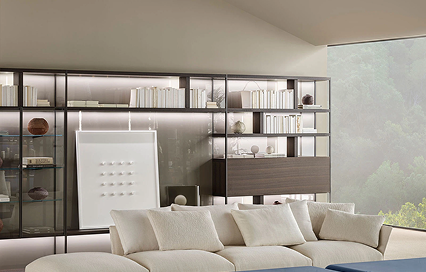
TOBU
Linear three- and four-seater configurations, as well as closed or open corner versions with armless central or end modules. complemented by a square armchair with one or two backrests.
The Architectural Framework of a Small Living Room Layout
Every small living room design begins with an understanding of its primary axis. This is typically established by the longest wall, a fireplace, or a central window. Furniture should align to this datum, reinforcing orientation and stabilizing the room’s geometry.
Circulation defines the secondary structure. Entry points determine how the body moves through the space. A clear path from threshold to seating anchor maintains legibility. When furniture intrudes into this path, the room fragments. When it respects it, the room reads as resolved.
Void is as critical as mass. The negative space between objects allows the eye to register composition. In compact rooms, these intervals become structural. A narrow band of exposed flooring along the perimeter frames the seating area like a mat border, clarifying edges and preventing visual congestion.
Furniture should not drift. It should lock into an implied grid. Aligning the front legs of seating with an area rug’s edge, centering a coffee table on the sofa’s axis, and maintaining consistent clearances establishes rhythm. The room begins to function as a unified field.
Seating as Spatial Anchor and Horizontal Datum
In a small living room layout, the sofa establishes the primary horizontal line. Its length, depth, and elevation influence the room’s balance.
A sofa scaled between seventy-two and eighty-four inches maintains proportional integrity in most compact environments. Depth should support comfort while preserving passage. Profiles around thirty inches allow adequate seating without encroaching excessively into circulation.
Leg exposure contributes to volumetric lightness. Sofas elevated on slim metal or timber legs reveal the floor beneath, maintaining visual continuity across the plane. Solid plinth bases introduce density and visually lower the room’s center of gravity.
Upholstery tone interacts with light. Pale textiles amplify natural illumination and extend perceived volume. Deeper tones compress and anchor. Both can succeed when integrated into a cohesive material strategy.
For adaptable compositions, modular sofas introduce flexibility. Armless sections reduce visual interruption. Movable chaise components allow the seating field to shift as needs evolve, preserving the logic of the small living room layout over time.
Secondary seating should reinforce the composition. Two compact lounge chairs placed symmetrically establish balance. A single sculptural chair positioned along a perpendicular axis can introduce tension without disrupting order.
Tables as Transitional Planes Within the Layout
Coffee tables operate as mediators between seating volumes. Their dimensions must correspond precisely to the surrounding mass.
A table measuring approximately two-thirds of the sofa’s length maintains proportional dialogue. Height aligned with seat cushions ensures ergonomic coherence. Overscaled tables overwhelm, and underscaled tables lose presence.
Material selection alters spatial weight. Glass surfaces dematerialize, preserving axial views and floor continuity. Stone or solid timber introduces grounded mass and textural gravity. In compact rooms, heavier materials benefit from slender profiles or recessed bases that create shadow lines.
Side and accent tables function as transitional elements between seating and perimeter. Cylindrical forms ease movement along circulation paths. Pedestal bases eliminate corner obstruction and maintain fluid passage.
Nesting tables offer a dynamic surface area. Their layered geometry introduces flexibility without adding permanent volume.
The objective is measured placement. Tables should feel inevitable within the grid, not incidental.
Perimeter Storage and the Discipline of Containment
Storage defines the room’s edge condition. In a small living room layout, perimeter elements must reinforce architectural clarity.
Low-profile media consoles establish a horizontal datum along the wall. Their restrained height preserves vertical openness above, allowing artwork or windows to remain dominant.
Built-in cabinetry creates a continuous plane, dissolving storage into architecture. Flush doors, recessed pulls, and integrated shelving maintain compositional unity. When material continuity extends from wall to cabinet face, the boundary between object and envelope softens.
Open shelving requires curatorial discipline. Objects should be spaced with intention. Alternating filled and empty sections introduces rhythm. Dense accumulation collapses depth.
Floating units enhance perceived volume. The shadow beneath a wall-mounted console introduces levity, allowing the floor plane to read uninterrupted.
Containment is critical. Surfaces free of extraneous objects allow the room’s geometry to register clearly.
Light as Volumetric Expansion
Light defines the room’s perceived dimension. In compact environments, layered illumination extends depth and clarifies form.
Natural light should be modulated, not obstructed. Sheer textiles diffuse glare while preserving vertical continuity. Floor-to-ceiling drapery elongates walls, drawing the eye upward and enhancing perceived height.
Ambient light establishes baseline volume. Recessed fixtures aligned to the room’s grid provide even illumination. Cove lighting washes ceilings softly, lifting the visual plane and reducing compression.
Task lighting articulates function. A reading lamp positioned at the edge of a seating zone reinforces its boundary. Accent lighting directed at artwork or textured walls introduces dimensional contrast.
Multiple light sources at varied elevations create a layered sectional experience. The room becomes stratified: floor plane, seating plane, wall plane, and ceiling plane. Each reads distinctly yet cohesively.
Color temperature influences atmosphere. Warm light introduces intimacy, while neutral white supports clarity. Tunable systems allow transitions that correspond to time and use.
Reflective Surfaces and the Extension of Depth
Reflectivity expands spatial perception. A mirror placed opposite a window amplifies daylight and extends the visual field. Positioned along a narrow wall, it elongates the room’s axis.
Frame profiles should align with surrounding materials. Slim metal frames maintain precision. Frameless installations integrate seamlessly.
Selective gloss finishes, lacquered cabinetry, polished plaster, or honed stone with a subtle sheen contribute reflectivity without visual duplication.
Chromatic Restraint and Material Continuity
Color fragmentation diminishes cohesion. A disciplined palette allows the small living room layout to read as a unified composition.
Monochromatic schemes, warm grays, mineral whites, and muted taupes create continuity across planes. Tonal variation introduces depth within a controlled range.
Material contrast supplies richness. Linen upholstery, wool rugs, timber flooring, metal accents, and stone surfaces each contribute texture. Their interplay sustains interest without chromatic excess.
A single accent hue can punctuate the composition. A rust textile, a deep olive cushion, or a terracotta vessel introduces saturation as a focal gesture.
A flooring tone anchors the room; light oak extends brightness, and dark walnut introduces gravitas. Consistency between flooring and furniture materials reinforces spatial unity.
Object Placement and Visual Hierarchy
In compact interiors, hierarchy must be explicit. One dominant artwork establishes focal authority. Its scale should correspond to the wall and adjacent furniture mass.
Smaller objects operate as secondary notes. Sculptural forms on consoles, ceramic vessels on tables, and singular plants articulate edges without overwhelming them.
Surfaces should remain composed. A clear plane allows proportion to register. The eye requires intervals of rest.
Plants introduce verticality and organic contrast. A single tall specimen can balance horizontal seating lines and soften architectural edges.
Hierarchy ensures clarity. Each element knows its role within the composition.
Reconsidering the Small Living Room Layout
A successful small living room design is not defined by illusion or visual trickery. It is defined by order. Axial alignment, proportional furniture, layered lighting, and disciplined containment create spatial coherence.
When geometry is respected and the void is preserved, the room achieves compositional calm. Intimacy becomes an asset. Every element participates in a unified structure.
The refinement of a small living room setup lies in its precision. Nothing is incidental or excessive. The result is a room that feels measured, grounded, and complete within its scale.
FAQs
1. What is the ideal sofa depth for a small living room layout?
Approximately thirty inches maintains comfort while preserving circulation. Deeper profiles consume valuable floor area and compress the passage.
2. How should furniture align in a narrow living room?
Establish a clear longitudinal axis along the longest wall. Align the sofa parallel to this line and maintain consistent clearances along the opposite side for circulation.
3. Can a sectional work in a compact living room?
A carefully scaled modular sectional can succeed if it respects circulation paths and maintains a visible floor perimeter. Oversized corner units typically disrupt spatial flow.
4. What rug size anchors a small seating area effectively?
The rug should extend beneath the front legs of all primary seating. This unifies the composition and clarifies the seating zone within the larger room.
5. How many light sources are appropriate in a small living room?
Three to five layered sources, ambient, task, and accent, provide dimensional balance. Placement should reinforce architectural lines and focal points.
