
Standard Desk Height Guide for Maximum Ergonomic Comfort
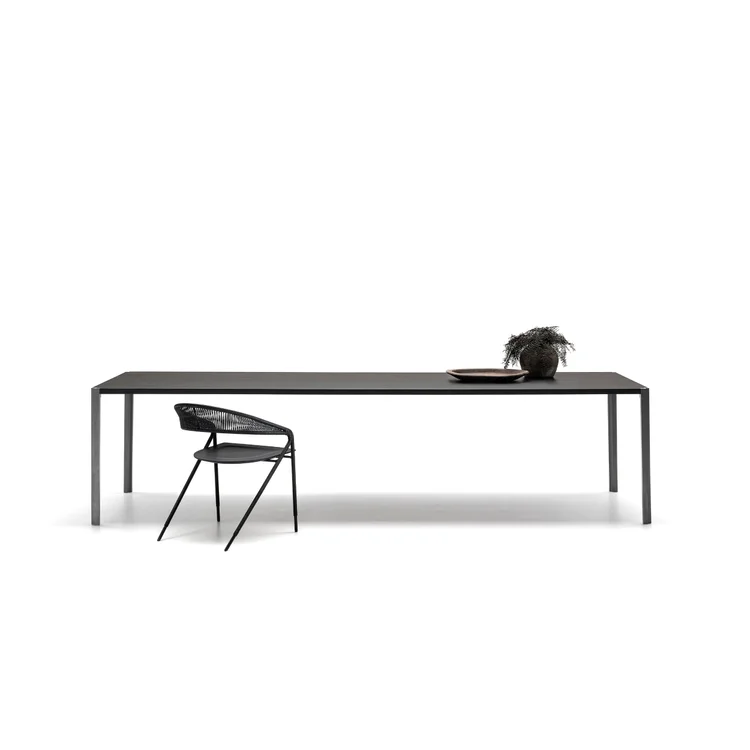
The standard desk height is one of those dimensional decisions that tends to be accepted without examination, treated as a fixed convention rather than a considered specification. Most desks manufactured for the residential market fall in the 72 to 76 centimeter range, a measurement derived from a mid-twentieth-century ergonomic study of average adult male body proportions that has persisted long past its conditions of relevance.
For many people, this height is a reasonable starting point. For many others, it is a source of compounding physical discomfort that no chair adjustment fully resolves.
What Standard Desk Height Means for Your Body
The ergonomic ideal for a sitting desk positions the forearms parallel to the working surface, with the elbow at approximately 90 to 110 degrees of flexion. For a person of average height, this forearm angle occurs when the desk surface sits at approximately elbow height in a relaxed seated position.
The problem with a fixed standard desk height is that elbow height varies considerably across the population: a seated person of 160 centimeters and one of 190 centimeters will have elbow heights that differ by 8 to 12 centimeters, a range that exceeds the entire adjustment range of most fixed-height desks.
The consequence of a desk that is too high is chronically elevated shoulders and a forward-reaching posture that loads the cervical spine unevenly over sustained working periods. A desk that is too low produces a forward trunk flexion that places a sustained compressive load on the lumbar discs. Neither condition produces symptoms immediately, but both compound over the months and years of regular use that a home office demands.
The calculation for your proper working surface height begins at the floor: measure the distance from the floor to the crease at the inside of your elbow while seated in your working chair, with your feet flat on the floor and your back supported in an upright position. This measurement, typically between 65 and 78 centimeters for most adults, is your target desk height. If it differs substantially from the standard desk height of the desk you are considering, the chair's height adjustment, a footrest, or the desk's own adjustability should bridge the gap.
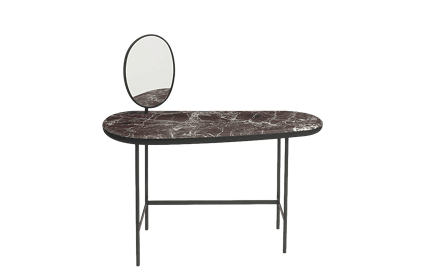
PEBBLE
Inspired by the materiality and the organic form of stones. Available in lacquer, marble, or glass and various finishes.
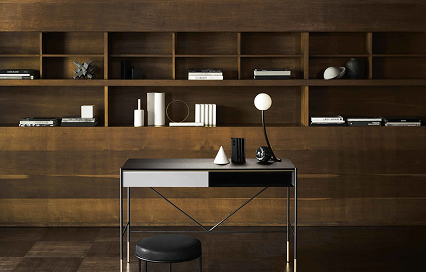
ERA SCRITTOIO
Desk with gunmetal grey legs, matte brass accents, Italian walnut, stone oak, or striped grey top and drawer with coordinating wood or glossy lacquer external parts.
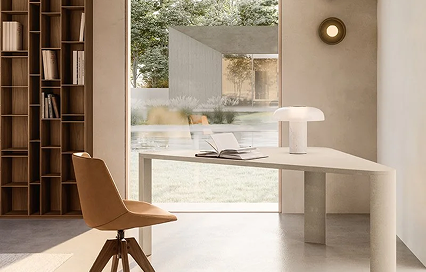
BONNET
Interpret the theme of soft, rational forms with architectural elan, introducing a touch of femininity. With the Coccioperla finish. Available in various colors.
Material and the Working Surface
The ergonomic specification and the material specification of a desk are related. A surface at the correct height but made of a material that reflects overhead light into the eyes undermines the ergonomic correctness of the overall arrangement.
David Lopez Quincoces's Era Scrittoio addresses both dimensions with material specificity: gunmetal grey legs with matte brass accents and a top in Italian walnut, stone oak, or striped grey with a drawer in coordinating wood or glossy lacquer. The walnut and stone oak options produce a warm, matte surface that absorbs rather than reflects the light above it, which is the material condition most supportive of sustained work.
The Desk Surface as the Room's Primary Horizontal Plane
The working surface of a desk is not encountered at the arm's length of a dining table or the elbow's reach of a sofa arm. It is the surface on which the most sustained daily physical contact occurs in the workspace, which makes its material character a daily sensory experience in a way that more distantly used surfaces are not.
Lanzavecchia and Wai's Pebble desk, inspired by the materiality and organic form of stones and available in lacquer, marble, or glass with various finishes, addresses the working surface as a material proposition in its own right.
The reference to stone form produces a desk whose silhouette refuses the orthogonal conventions of the standard office surface, introducing a biomorphic edge profile that reads as resolved instead of as decorative. The marble option produces a surface whose tonal variation is continuous, a quality that changes character at different light conditions and viewing angles throughout the working day.
Form and the Desk's Spatial Presence
Marialaura Irvine's Bonnet interprets soft, rational forms with architectural elan. Its Coccioperla finish, available in various colors, produces a surface that sits between the hard precision of lacquer and the tactile warmth of soft materials. The form's reference to femininity in its design intention is a formal position that produces a desk with a gentler, more organic silhouette than the severe rectangularity that most working surfaces adopt.
The placement of such a desk within a room is as important as the desk itself. A desk positioned at 90 degrees to the primary window controls daylight on the working surface; a desk facing directly toward a window produces glare conditions that are difficult to manage with any chair position. The standard desk height becomes most effective when light, surface, and posture are resolved together.
Graye's desk collection approaches the working surface as a spatial and material argument, presenting pieces whose formal vocabulary is as considered as the ergonomic specification that governs their use.
Standard Desk Height FAQs
-
If the desk is too high, the keyboard sits above the ideal elbow position, which forces the shoulders up. If too low, the trunk flexes forward, which often pulls the screen too close to the face. Correct average desk height allows the screen to sit at or slightly below eye level at arm's length without postural compensation.
-
A fixed-height desk whose height matches the user's ergonomic needs precisely is preferable in terms of quality of material and formal resolution. Adjustable desks are more appropriate in shared workspaces or when the user's posture requirements change over the day.
-
A minimum depth of 70 centimeters allows a monitor to be positioned at arm's length, which is the standard minimum viewing distance for sustained screen use. Deeper surfaces, 80 to 90 centimeters, give more flexibility for document work alongside the screen.
-
Harder surfaces, including glass and stone, transmit wrist pressure without absorption. A wrist rest or desk pad is advisable when working on these surfaces for extended periods. Timber and lacquered surfaces provide slightly more compliance under wrist contact.
-
A dual-monitor setup in a landscape orientation requires a working surface of at least 150 centimeters in width to position both screens within a comfortable horizontal visual arc.
